Meilleur logiciel marketing d'influence pour e-commerce

March 6, 2026
|
Publié

October 19, 2026
|
Mis à jour

14 minutes
|
Lecture

Cours de Marketing de Performance avec Influencers | BON DE RÉDUCTION : IMC100

Lucía Zabala
I Author

Générez du ROI avec les Influencers

Base de données mondiale d'influencers
Plateforme TOUT-EN-UN
CRM, Affiliate, UGC & Plus
Meilleur logiciel de marketing d'influence pour boutiques en ligne
Si vous gérez une boutique en ligne, votre logiciel de marketing d'influence doit se connecter directement à votre façon de vendre. La plupart des marques DTC opèrent au sein d'un écosystème CMS et eCommerce plus large — que ce soit Shopify, WooCommerce, BigCommerce, ou une vitrine personnalisée. Cela signifie que votre plateforme d'influence ne peut pas fonctionner indépendamment de vos données de magasin. Elle doit prendre en charge la découverte d'influencers, l'envoi de produits, le suivi des affiliés, et surtout, l'attribution claire des revenus.
L'objectif n'est pas seulement de gérer les creators, c'est de suivre ce qui génère réellement des ventes. Vous devez générer des codes de réduction, surveiller les liens d'affiliation, synchroniser les commandes et comprendre le ROI sans extraire des rapports de cinq outils différents. Ce guide décrit les meilleurs logiciels de marketing d'influence pour les boutiques en ligne, spécifiquement pour les marques qui vendent via leur propre vitrine et souhaitent un flux de travail plus connecté et mesurable.
- Influencer Hero
- GRIN
- Upfluence
- Modash
- Aspire
- CreatorIQ
- Traackr
- Impact
- Refersion
- Afluencer
Comment nous avons évalué les logiciels de marketing d'influence pour les boutiques en ligne
Pour créer cette liste, nous avons évalué les plateformes de marketing d'influence en fonction de la façon dont elles soutiennent les marques eCommerce utilisant des boutiques en ligne.
Les critères se sont concentrés sur la compatibilité des intégrations et la capacité à gérer des campagnes d'influence axées sur la performance à grande échelle.
Critères d'évaluation
- Intégration et compatibilité avec les boutiques en ligne : La façon dont chaque plateforme fonctionne avec les boutiques construites sur des boutiques en ligne, soit par des intégrations natives, soit par des flux de travail compatibles qui s'intègrent aux opérations eCommerce existantes.
- Capacités de campagne d'influence : L'étendue du soutien de chaque plateforme pour les cas d'usage core du marketing d'influence, y compris la découverte de creators, l'outreach, la gestion des relations, les campagnes de gifting et de seeding, et les collaborations basées sur l'affiliation.
- Suivi des performances et rapports : La capacité à suivre les performances au niveau du creator et de la campagne, y compris les conversions, l'attribution des revenus et le ROI, ce qui est essentiel pour les équipes eCommerce axées sur des résultats mesurables.
- Automatisation et efficacité du flux de travail : L'efficacité avec laquelle la plateforme automatise les tâches chronophages telles que l'outreach, la gestion des campagnes, les relances et les rapports — particulièrement important pour les petites équipes gérant des programmes d'influence à grande échelle.
- Facilité d'utilisation (UX/UI) : L'expérience utilisateur globale, y compris la conception du tableau de bord, la navigation, le processus d'intégration et la courbe d'apprentissage pour les équipes qui opèrent déjà sur des boutiques en ligne.
- Scalabilité pour les marques en croissance : La façon dont la plateforme soutient la croissance, depuis les petites équipes lançant leurs premières campagnes d'influence jusqu'aux marques DTC établies gérant des centaines ou des milliers de creators.
- Tarification et flexibilité des contrats : La transparence des tarifs, la disponibilité de plans flexibles et le fait que la plateforme supporte les programmes en croissance sans forcer des engagements à long terme trop tôt.
- Support client et intégration : La disponibilité et la qualité des ressources d'assistance, y compris l'assistance à l'intégration, la documentation, les délais de réponse et le support continu du succès client.
Meilleur logiciel de marketing d'influence pour les boutiques en ligne
Si vous vendez via Shopify, WooCommerce, BigCommerce, ou une vitrine personnalisée, votre logiciel de marketing d'influence doit se connecter directement à vos données de magasin. Cela signifie synchroniser les commandes, suivre les codes de réduction, gérer l'envoi de produits et lier les revenus à des creators individuels, sans feuilles de calcul manuelles.
Vous trouverez ci-dessous une comparaison rapide des meilleurs logiciels de marketing d'influence pour les boutiques en ligne. Cela vous donne un aperçu de haut niveau avant que nous détaillions chaque plateforme.
Comparaison rapide : meilleur logiciel de marketing d'influence pour boutiques en ligne
1. Influencer Hero
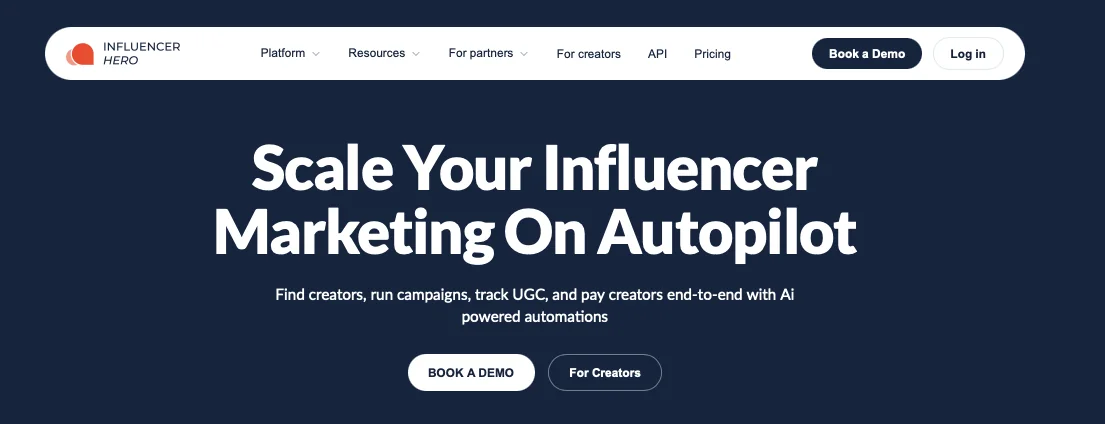
Influencer Hero est une plateforme CRM de marketing d'influence tout-en-un conçue spécifiquement pour les marques eCommerce et D2C. Si vous recherchez le meilleur logiciel de marketing d'influence pour les boutiques en ligne, Influencer Hero est conçu pour se connecter directement à votre plateforme de vente afin que vous puissiez gérer les creators, les envois de produits, le suivi des affiliés et l'attribution des revenus au même endroit.
À Qui S'adresse-t-il
Les marques D2C, les boutiques Shopify et WooCommerce, ainsi que les agences qui souhaitent découvrir des influencers, effectuer des démarches de prospection, envoyer des produits et suivre les ventes, tout en restant étroitement connectés à leur boutique en ligne. Il est particulièrement efficace pour les marques qui se soucient du ROI mesurable, pas seulement de la production de contenu.
Comment Cela Fonctionne avec les Boutiques en Ligne
Influencer Hero se connecte directement à votre boutique en ligne pour que les campagnes d'influence soient liées à de véritables ventes. Vous pouvez générer des codes de réduction, suivre les liens d'affiliation, synchroniser les commandes et surveiller les revenus générés par les creators, le tout dans un seul tableau de bord.
Le flux de travail reste simple : découvrir des creators → envoyer des démarches de prospection → gérer les envois de produits → générer des liens ou codes de suivi → suivre les conversions → calculer le ROI.
Il fonctionne également avec Creator Hero, ce qui permet à votre catalogue de produits de se synchroniser avec les vitrines des creators. Cela signifie que les influencers peuvent promouvoir et vendre vos produits via leurs propres pages de vitrine, tandis que toutes les données de performance reviennent à Influencer Hero pour un suivi précis des revenus.
Tarification et Engagement
Influencer Hero propose des plans flexibles avec un engagement de 3 mois, permettant aux marques de se développer en fonction du volume de campagnes.
- Plan Standard : À partir de $649/mois — Contactez jusqu'à 1 000 creators par mois
- Plan Pro : À partir de $1,049/mois — Contactez jusqu'à 5 000 creators par mois
- Plan Business : À partir de $2,490/mois — Contactez jusqu'à 10 000 creators par mois
- Plan Custom et Agence : Tarification personnalisée selon les besoins de la marque
Facilité d'Utilisation (UX/UI)
Influencer Hero est réputée pour son tableau de bord intuitif et épuré qui simplifie l'exécution des campagnes. Les flux de travail automatisés réduisent les tâches répétitives, et les modèles d'e-mail personnalisables rendent la prospection évolutive sans donner l'impression d'être manuelle. L'interface est conçue pour que les équipes marketing puissent se déplacer rapidement sans avoir besoin de configuration technique.
Support Client
Le support client est l'un des plus grands atouts d'Influencer Hero. Chaque plan inclut un gestionnaire de compte dédié dès le premier jour.
Le support comprend :
- Chat en direct 24/7 avec des vrais humains
- Support par e-mail réactif
- Un centre d'aide complet avec des guides écrits et des tutoriels vidéo
- Consultations en stratégie optionnelles pour guider la croissance
- Les utilisateurs du plan Pro ont accès à un canal Slack privé pour un support plus rapide et continu
Fonctionnalités Clés
- Intégration Native des Boutiques (Shopify + WooCommerce) : Connecte votre plateforme de vente directement aux campagnes d'influence. Les commandes, les codes de réduction et les revenus d'affiliation se synchronisent dans votre tableau de bord, vous donnant une attribution des ventes réelle sans exports manuels.
- CRM Centré sur les Campagnes avec Suivi des Revenus : Gérez les relations avec les influencers au sein de campagnes structurées tout en suivant les performances au niveau de chaque creator. Les revenus, les conversions et le ROI sont directement liés au flux de travail de la campagne.
- Flux de Travail Automatisés de Gifting et d'Envoi de Produits : Envoyez des produits aux creators directement depuis votre boutique connectée. Suivez le statut d'expédition et l'historique des envois aux côtés de la performance des campagnes, en gardant l'exécution de la distribution alignée avec l'exécution marketing.
- Automatisation des Codes de Réduction et des Affiliés : Générez et gérez des codes de réduction uniques et des liens d'affiliation à grande échelle. Les données de performance se connectent automatiquement aux transactions de la boutique, rendant les calculs de paiement simples.
- Prospection en Masse avec Flux de Travail IA : Contactez des milliers de creators en utilisant des séquences d'e-mail automatisées tout en maintenant la personnalisation. Cela permet aux marques de développer l'acquisition sans perdre le contrôle de la messagerie.
Limitations d'Influencer Hero
Pour les marques nouvelles dans le marketing d'influence, la configuration du suivi, des flux de travail et des intégrations peut nécessiter un accompagnement initial. Cependant, l'équipe d'intégration et les gestionnaires de compte dédiés sont fortement impliqués pour aider les marques à structurer correctement leur configuration dès le départ.
2. GRIN
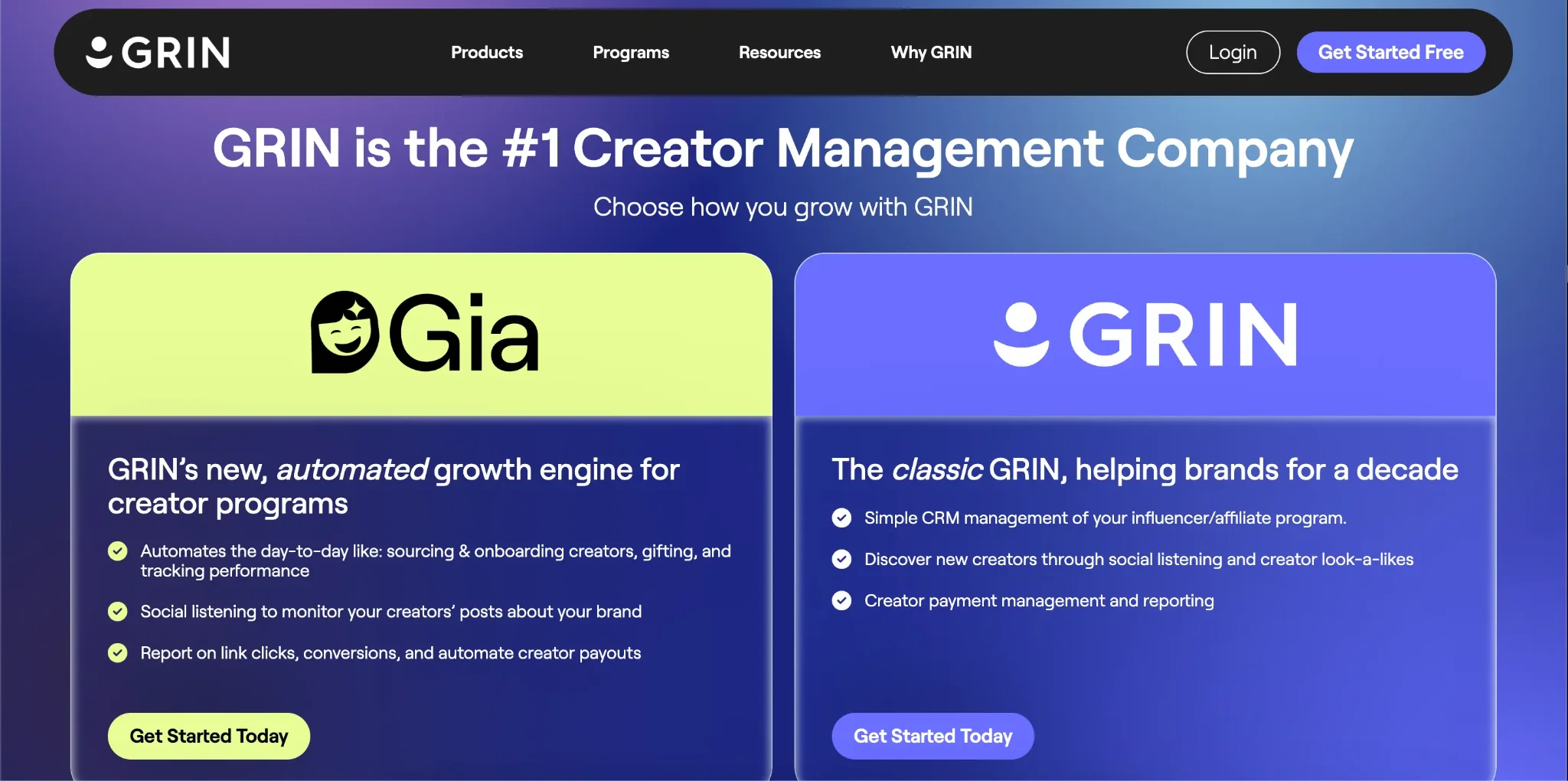
GRIN est une plateforme de marketing d'influence construite principalement pour les marques d'eCommerce, avec un fort accent sur l'envoi de produits en test, les relations avec les creators et les workflows basés sur Shopify. Elle se positionne comme un système de gestion de creators conçu pour aider les marques à gérer les programmes d'influence à grande échelle.
Idéal pour
Les marques d'eCommerce de taille moyenne à grande qui gèrent des programmes continus d'envoi de produits, d'ambassadeurs et de campagnes pilotées par l'UGC — particulièrement celles fortement investies dans Shopify.
Comment cela fonctionne avec les boutiques en ligne
GRIN se connecte directement à votre boutique en ligne, permettant aux produits, codes de réduction et données de commandes de se synchroniser dans les campagnes d'influence. En pratique, les marques l'utilisent pour envoyer des produits aux creators, générer des liens d'affiliation et suivre les ventes liées à chaque influencer.
Le workflow typique ressemble à ceci : importer les produits de votre boutique → envoyer les produits en test → générer des codes uniques ou des liens → suivre les commandes et les revenus dans la plateforme. C'est conçu pour maintenir l'alignement entre la logistique et le suivi des influencers, ce qui est utile pour les marques qui gèrent des programmes d'envoi à grande échelle.
Tarification
- À partir de $2 085 par mois
- Environ $25 000 par an
- Contrat annuel requis
GRIN fonctionne généralement avec des engagements annuels et se positionne dans la tranche tarifaire supérieure des plateformes d'influence.
Facilité d'utilisation (UX/UI)
Les utilisateurs décrivent généralement GRIN comme puissant mais complexe. L'interface offre une fonctionnalité approfondie, ce qui peut être utile pour les équipes avancées, mais certains évaluateurs notent que la courbe d'apprentissage est abrupte — particulièrement pour les petites équipes.
La navigation est structurée autour des campagnes et des workflows, bien que certains utilisateurs mentionnent que la mise en place et la génération de rapports nécessitent une période d'intégration initiale pour être pleinement comprises.
Support client
Les retours sur le support client sont mitigés mais généralement positifs pour les comptes plus importants. De nombreux utilisateurs mentionnent avoir des responsables de compte dédiés et une assistance à l'intégration, ce qui est utile lors de la mise en œuvre.
Cependant, certaines petites marques signalent des temps de réponse plus lents ou un support qui dépend fortement du niveau de contrat.
Fonctionnalités clés
- Intégration d'envoi de produits Shopify : GRIN permet aux marques d'extraire des produits directement de Shopify et de les envoyer aux creators dans des campagnes. Cela maintient l'envoi d'influence directement lié à l'inventaire du magasin et aux workflows de logistique.
- Gestion des liens d'affiliation et des codes de réduction : Les marques peuvent générer des liens d'affiliation uniques et des codes de réduction pour chaque creator. L'attribution des revenus est connectée aux transactions du magasin, permettant aux équipes de suivre les performances par influencer.
- Gestion de creators illimitée : GRIN propose des profils de creators illimités au sein de son système. Cela soutient les grands programmes d'ambassadeurs où les marques maintiennent des relations de creators à long terme.
- Gestion des droits médias et bibliothèque de contenu intégrées : La plateforme inclut la gestion des droits médias et une bibliothèque de contenu pour le stockage d'UGC. Cela aide les marques à réutiliser le contenu des influencers pour les publicités et le marketing par email.
- Infrastructure de paiement PayPal : GRIN offre des outils de paiement intégrés pour compenser directement les creators. Cela simplifie le processus de paiement pour les marques qui gèrent un grand nombre de collaborations.
Limitations de GRIN
GRIN nécessite un engagement annuel et a un prix d'entrée plus élevé, ce qui peut ne pas convenir aux petites marques ou aux marques DTC en phase de démarrage. Certains utilisateurs mentionnent également que bien qu'elle soit forte pour les workflows Shopify, la personnalisation en dehors de cet écosystème peut sembler plus rigide comparée aux plateformes plus axées sur l'automatisation.
3. Upfluence
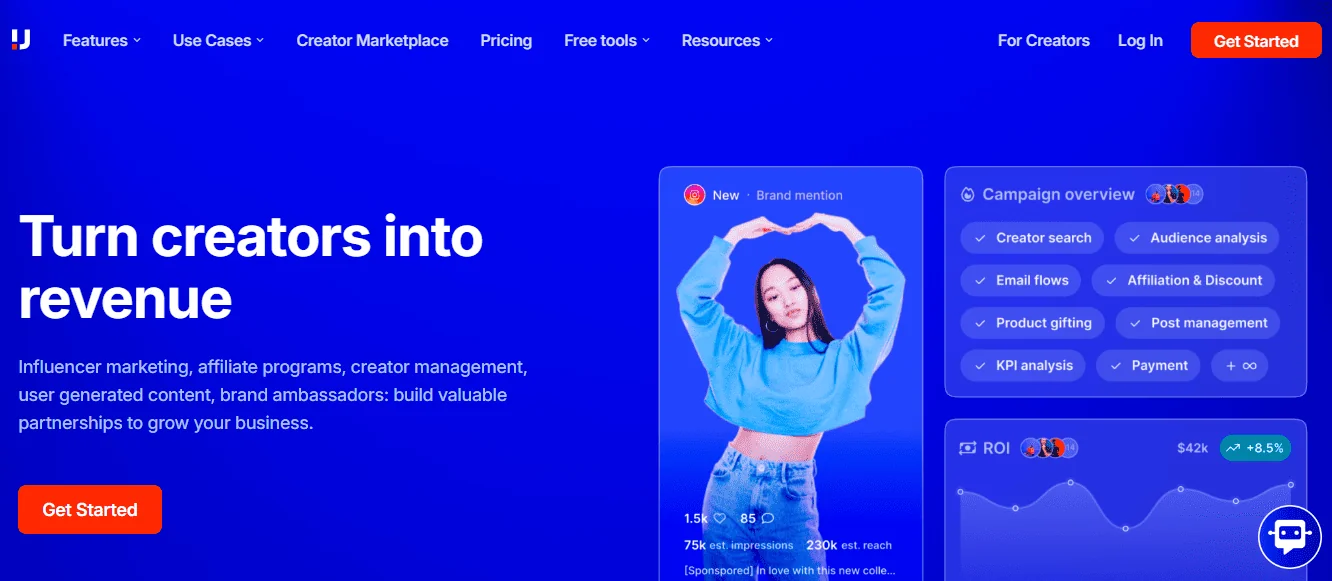
Upfluence est une plateforme de marketing d'influence construite autour de la découverte, de la sensibilisation et de l'intégration de données d'eCommerce. Elle se positionne comme un outil qui relie les campagnes d'influence directement aux données du magasin, y compris les listes de clients et l'historique des commandes, ce qui la rend particulièrement pertinente pour les marques en ligne.
Idéal pour
Les marques DTC et d'eCommerce qui veulent combiner la découverte d'influencers avec les données client — particulièrement les marques vendant sur Shopify ou Amazon qui veulent identifier les influencers au sein de leur base client existante.
Comment cela fonctionne avec les boutiques en ligne
Upfluence se connecte à votre boutique en ligne et extrait les données des clients et des ventes, vous permettant d'identifier les creators qui ont déjà acheté chez vous. À partir de là, les marques peuvent gérer la sensibilisation, envoyer des produits, générer des codes de réduction et suivre les revenus liés aux campagnes d'influence.
Le workflow typique ressemble à ceci : synchroniser les données du magasin → identifier les creators potentiels (y compris les clients) → gérer la sensibilisation → générer des liens d'affiliation ou des codes de réduction → suivre les ventes et le ROI dans la plateforme. C'est conçu pour établir un pont entre le marketing d'influence et les données client plutôt que de les traiter comme des canaux distincts.
Tarification
- Environ $2 000 par mois (estimation initiale)
- La tarification est généralement personnalisée et basée sur la taille du CRM et l'accès aux fonctionnalités
- Généralement structurée comme un contrat annuel
Upfluence ne divulgue pas publiquement les détails de ses tarifs par palier, et les coûts varient généralement en fonction du nombre d'influencers gérés au sein de la plateforme.
Facilité d'utilisation (UX/UI)
Les retours utilisateurs suggèrent que l'interface est robuste mais peut sembler dense au premier abord. Puisque la plateforme combine CRM, découverte d'influencers et données d'eCommerce, les nouveaux utilisateurs peuvent avoir besoin d'une période d'intégration pour bien comprendre les flux de travail.
Une fois configurée, les utilisateurs rapportent que le suivi des campagnes et la recherche d'influencers sont relativement simples, mais la personnalisation et les filtres avancés peuvent nécessiter un peu de pratique.
Support client
De nombreux utilisateurs soulignent un support d'intégration solide et des gestionnaires de compte réactifs, en particulier pour les clients de taille moyenne et entreprises. Les conseils à la mise en œuvre sont souvent cités comme utiles lors de la connexion des données de magasin et de la configuration des campagnes.
Cependant, certains avis notent que les délais de réponse peuvent varier selon le palier de compte et la taille du contrat.
Fonctionnalités clés
- Identification Client-Creator : Upfluence permet aux marques d'identifier les influencers au sein de leur propre base de clients. Cela est particulièrement utile pour les marques DTC cherchant à transformer les acheteurs fidèles en défenseurs de la marque.
- Intégration Shopify et Amazon : La plateforme se connecte directement aux données de magasin et de marché. Cela permet le suivi des revenus, la synchronisation des produits et la mesure des performances des campagnes liées aux transactions réelles.
- CRM intégré pour la gestion des influencers : Les influencers sont gérés dans un environnement CRM structuré. Les marques peuvent suivre les conversations, les campagnes, les contrats et les performances au sein d'un seul système.
- Suivi des liens d'affiliation et codes promotionnels : Des liens d'affiliation uniques et des codes promo peuvent être générés et suivis. Les données de revenu se synchronisent avec la plateforme pour les rapports ROI.
- Assistance de sensibilisation assistée par IA : Upfluence comprend des outils de messagerie assistés par IA pour aider à automatiser la communication avec les influencers. Cela soutient la sensibilisation à grande échelle tout en maintenant la personnalisation.
Limitations d'Upfluence
Les tarifs peuvent augmenter rapidement en fonction du nombre d'influencers stockés dans le CRM, ce qui peut limiter la flexibilité pour les marques expérimentant de grandes listes de creators. Certains utilisateurs mentionnent également que, bien que la plateforme soit forte dans l'intégration des données d'eCommerce, les flux de travail d'automatisation peuvent sembler moins rationalisés par rapport aux outils CRM plus axés sur les campagnes.
4. Modash
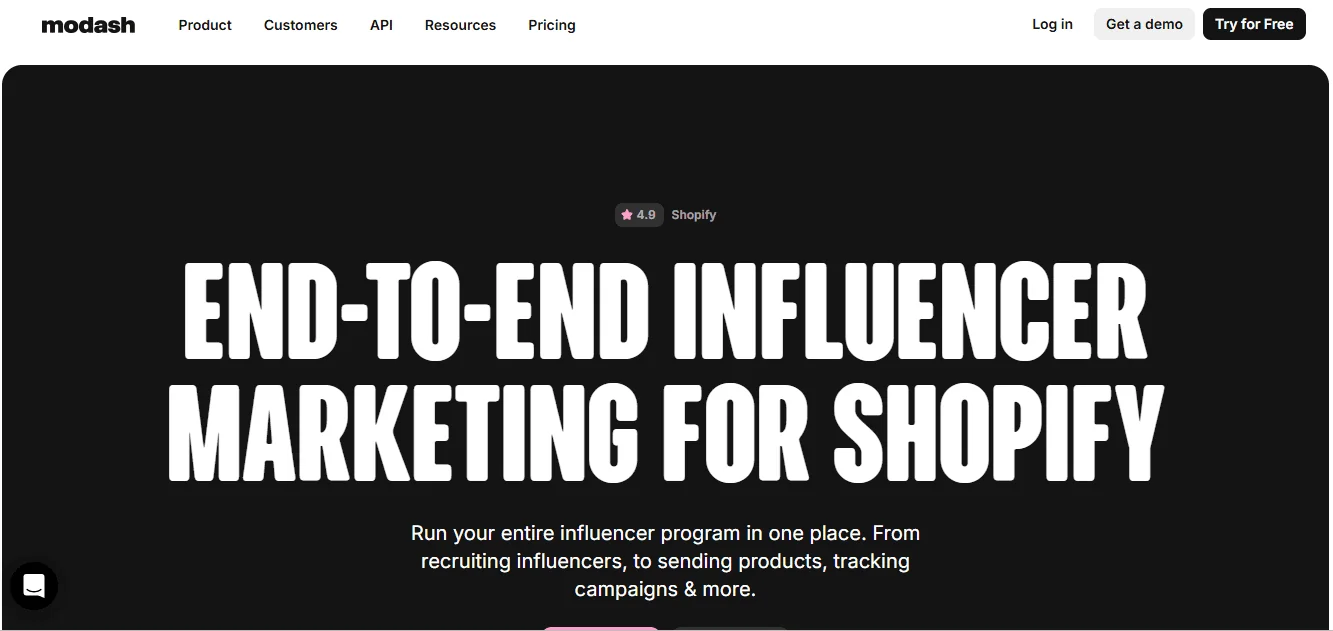
Modash est une plateforme de marketing d'influence fortement axée sur la découverte de creators et l'analyse d'audience. Elle est connue pour sa grande base de données de creators et ses filtres axés sur la performance, ce qui la rend populaire auprès des marques qui privilégient la sélection d'influencers basée sur les données.
Idéal pour
Les marques d'eCommerce et les spécialistes du marketing de performance qui souhaitent des capacités de découverte approfondies et une analyse d'audience solide avant de lancer des campagnes de marketing d'influence — en particulier les équipes réduites axées sur l'acquisition mesurable.
Comment cela fonctionne avec les boutiques en ligne
Modash s'intègre aux boutiques en ligne pour suivre les conversions des campagnes de marketing d'influence. Les marques utilisent généralement Modash pour découvrir des creators, gérer la sensibilisation, générer des liens d'affiliation ou des codes de réduction, puis surveiller les revenus générés par ces liens suivis.
Le flux de travail est généralement : trouver des creators → examiner les données d'audience → lancer la collaboration → attribuer des liens de suivi → surveiller les conversions du magasin. C'est davantage axé sur la découverte, avec le suivi du magasin intégré pour la mesure des performances.
Tarification
Modash propose une tarification par paliers transparente :
- Plan Essential : À partir de $199/mois
- Plan Performance : Paliers supérieurs jusqu'à $499+/mois
- Les plans annuels sont disponibles (environ $14 700/an pour les paliers supérieurs)
La tarification varie en fonction de l'accès aux fonctionnalités, du nombre de sièges utilisateur et des limites de suivi des creators.
Facilité d'utilisation (UX/UI)
Les utilisateurs décrivent souvent Modash comme épurée et facile à naviguer, en particulier par rapport aux plateformes plus lourdes au niveau entreprise. L'interface de découverte est considérée comme intuitive, avec un filtrage puissant et des performances de recherche rapides.
Puisqu'elle se concentre principalement sur la découverte et l'analyse, le tableau de bord tend à être plus léger et moins encombré que les plateformes entièrement basées sur les CRM.
Support client
Les retours des clients sur le support sont généralement positifs, en particulier en termes de réactivité et d'intégration utile. Les utilisateurs mentionnent que l'équipe de support est accessible et rapide pour répondre aux questions.
Cependant, puisque Modash est davantage en libre-service par rapport aux plateformes entreprises, les conseils stratégiques peuvent être moins fournis que sur les plateformes qui assignent des gestionnaires de compte dédiés.
Fonctionnalités clés
- Base de données de 350M+ creators (Pas d'inscription requise) : Modash offre l'une des plus grandes bases de données d'influencers disponibles. Comme les creators n'ont pas besoin de s'inscrire, les marques peuvent découvrir un large éventail de collaborateurs potentiels au-delà des pools traditionnels de marketplace.
- Analyses d'audience avancées : La plateforme fournit des insights détaillés sur les données démographiques de l'audience, l'authenticité de l'engagement et l'affinité à la marque. Cela aide les marques à réduire le risque de faux followers et d'alignement inadéquat de l'audience.
- Recherche visuelle alimentée par l'IA : Les marques peuvent rechercher des creators en fonction de la reconnaissance d'image et des thèmes de contenu. C'est utile pour identifier les creators de niche qui s'alignent visuellement avec les catégories de produits.
- Suivi des influencers et surveillance des performances : Modash prend en charge le suivi des liens d'affiliation et la surveillance des conversions depuis les magasins en ligne. L'attribution des revenus permet aux marques de mesurer la performance des ventes générées par les influencers.
- Capacités de sensibilisation en masse : La plateforme permet de contacter plusieurs creators à grande échelle. Bien qu'il ne s'agisse pas d'un système d'automatisation CRM complet, elle prend en charge la communication basée sur les campagnes.
Limitations de Modash
Modash est axée sur la découverte mais moins complète en matière d'automatisation CRM et de gestion des workflows par rapport aux plateformes orientées campagnes. Les marques exécutant des programmes de cadeaux à grande échelle ou des programmes d'affiliation complexes peuvent avoir besoin de processus internes supplémentaires pour gérer les opérations au-delà de la découverte et du suivi des creators.
5. Aspire
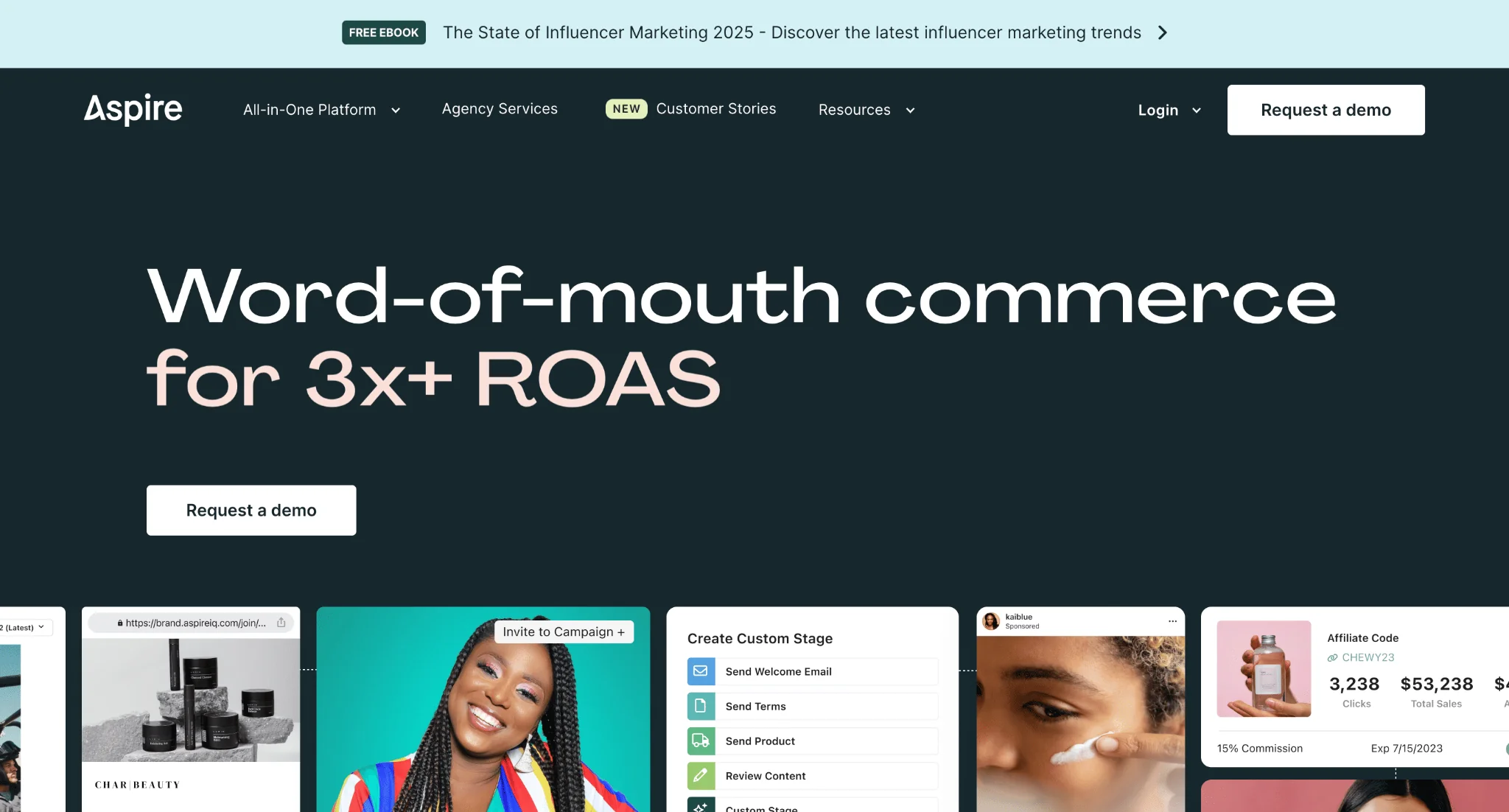
Aspire est une plateforme de marketing d'influence axée sur le sourcing de creators, la gestion des relations et les programmes de type ambassadeur. Elle combine la découverte d'influencers avec un marketplace de creators intégré, ce qui la rend populaire auprès des marques qui souhaitent à la fois des efforts de sensibilisation externes et des candidatures entrantes.
Meilleur pour
Les marques DTC et eCommerce qui construisent des programmes d'ambassadeurs à long terme, des communautés d'affiliés et des pipelines UGC — en particulier celles qui veulent que les creators postulent directement aux campagnes.
Comment cela fonctionne avec les boutiques en ligne
Aspire s'intègre aux boutiques en ligne pour synchroniser les produits, générer des codes promotionnels et suivre les ventes générées par les influencers. Les marques peuvent importer des produits dans des campagnes, envoyer des articles pour le gifting, attribuer des liens d'affiliation et mesurer les conversions liées à des creators spécifiques.
Le workflow est généralement le suivant : lancer une campagne → attirer des candidatures entrantes de creators ou lancer une sensibilisation → envoyer des produits → attribuer des liens de suivi ou des codes → surveiller les revenus du magasin. Aspire est particulièrement efficace pour les marques qui veulent un mélange de candidatures entrantes et d'un suivi d'affiliation structuré.
Tarification
Aspire ne liste pas publiquement les niveaux de tarification complets. Selon les données disponibles :
- Prix de départ estimé : Environ $2,000/mois
- Peut atteindre $5,000/mois ou plus selon le volume de creators et les fonctionnalités
- Généralement structuré sous forme de contrat annuel
La tarification évolue en fonction du nombre de creators gérés et de l'accès aux fonctionnalités.
Facilité d'utilisation (UX/UI)
Les utilisateurs décrivent souvent l'interface d'Aspire comme moderne et visuellement épurée. Les tableaux de bord des campagnes sont structurés de manière à permettre de suivre facilement les étapes des creators, les soumissions de contenu et les approbations.
Cependant, certains critiques mentionnent que la plateforme peut sembler riche en fonctionnalités, et l'onboarding est utile pour bien comprendre comment structurer les campagnes efficacement.
Support client
Les retours des clients sont généralement positifs, de nombreux utilisateurs soulignant l'onboarding utile et les account managers dédiés. Les marques exécutant des programmes plus importants mentionnent souvent un support solide lors de la mise en œuvre.
Certaines petites équipes notent que le conseil stratégique peut dépendre de la taille du contrat et du niveau d'engagement.
Fonctionnalités clés
- Marketplace de creators entrante : Aspire permet aux creators de postuler directement aux campagnes de marques. Cela aide les marques à construire des programmes de type ambassadeur et à augmenter la production de contenu sans dépendre uniquement de la sensibilisation sortante.
- Intégration Shopify pour la synchronisation des produits : Les produits de votre boutique peuvent être importés directement dans les campagnes. Cela simplifie le gifting et maintient l'exécution alignée avec la gestion des influencers.
- Suivi des affiliés et des codes promotionnels : Les marques peuvent attribuer des liens d'affiliation et des codes promotionnels uniques aux creators. Les données de ventes se synchronisent avec les tableaux de bord des campagnes, permettant de mesurer la performance liée aux revenus réels du magasin.
- Accès aux données sociales propriétaires : Aspire s'intègre directement avec certaines plateformes sociales pour accéder aux données de performance vérifiées. Cela aide les marques à prendre des décisions basées sur des métriques d'engagement plus précises.
- Workflows de contenu UGC et d'approbation : La plateforme comprend des étapes structurées d'examen et d'approbation de contenu. C'est utile pour les marques exécutant des annonces payantes ou réutilisant le contenu des influencers sur les canaux.
Limitations d'Aspire
La tarification d'Aspire peut augmenter rapidement à mesure que votre liste de creators s'agrandit, ce qui peut limiter la flexibilité pour les marques testant des programmes d'influencers. Certains utilisateurs notent également que si les candidatures entrantes sont puissantes, l'automatisation de sensibilisation sortante peut ne pas être aussi avancée que les plateformes fortement axées sur les workflows de sensibilisation orientés CRM.
6. CreatorIQ

CreatorIQ est une plateforme de marketing d'influence d'entreprise conçue pour les marques mondiales gérant des programmes creators à grande échelle. Elle met fortement l'accent sur la gouvernance, la conformité, la précision des rapports et la collaboration interfonctionnelle.
Idéal pour
Les marques eCommerce d'entreprise et les sociétés multinationales menant des campagnes de marketing d'influence sur plusieurs marchés, équipes et régions — notamment celles qui exigent des processus de rapport et de conformité strictes.
Fonctionnement avec les boutiques en ligne
CreatorIQ intègre les données de magasin et de ventes dans les tableaux de bord de rapport d'influence, permettant aux marques de connecter la performance du creator aux résultats de revenus. Il est généralement utilisé par les grandes organisations où le marketing d'influence doit s'aligner sur les systèmes plus larges de marketing, de finance et de conformité.
Le flux de travail ressemble souvent à ceci : identifier les creators → gérer les contrats et les approbations → synchroniser les données de campagne avec les métriques de ventes → générer des rapports ROI structurés. Plutôt que de se concentrer sur l'exécution rapide, CreatorIQ met l'accent sur la surveillance centralisée et la visibilité interfonctionnelle dans les revenus générés par l'influence.
Tarification
CreatorIQ ne publie pas de tarification publique. Sur la base des repères industriels :
- À partir d'environ $35,000 par an
- Peut augmenter jusqu'à $200,000+ par an selon l'étendue
- Généralement structuré comme un contrat d'entreprise annuel
Elle est fermement positionnée dans la catégorie des tarifs d'entreprise.
Facilité d'utilisation (UX/UI)
Les utilisateurs décrivent CreatorIQ comme puissante mais complexe. La plateforme offre des outils de personnalisation et de rapport approfondis, mais de nombreux critiques mentionnent une courbe d'apprentissage, notamment pour les nouvelles équipes.
Parce qu'elle est construite pour les cas d'usage d'entreprise, l'interface privilégie la structure et le contrôle plutôt que la simplicité.
Support client
Le support client est généralement bien noté parmi les utilisateurs d'entreprise. De nombreuses marques mentionnent des gestionnaires de compte dédiés et des programmes d'intégration structurés.
Cependant, parce qu'elle fonctionne au niveau de l'entreprise, la qualité du support peut dépendre de la taille du contrat et du niveau de compte.
Fonctionnalités clés
- Rapports et analyses de niveau entreprise : CreatorIQ offre des tableaux de bord personnalisables qui connectent les métriques d'influence aux KPIs métier. Ceci est particulièrement utile pour les marques qui doivent présenter les données de performance aux équipes exécutives.
- Synchronisation de données en temps réel basée sur API : La plateforme se connecte à plusieurs sources de données, y compris les systèmes eCommerce. Cela permet aux données de performance de circuler dans les environnements de rapport centralisés.
- Conformité mondiale et gestion des paiements : CreatorIQ inclut les workflows de contrat, la gestion de la documentation fiscale et les outils de traitement des paiements. Ceci soutient les marques multinationales opérant dans différents environnements juridiques.
- Contrôles avancés de CRM et de flux de travail : Les relations d'influence sont gérées dans un environnement CRM structuré. Les équipes peuvent attribuer des rôles, des approbations et des permissions entre les départements.
- Outils d'approbation de contenu et de gouvernance de marque : Les processus d'approbation structurés aident à maintenir la cohérence et la conformité de la marque. Ceci est particulièrement utile pour les industries réglementées.
Limitations de CreatorIQ
La tarification et la structure de contrat annuel de CreatorIQ peuvent ne pas être pratiques pour les petites et moyennes marques DTC. Certains utilisateurs signalent également que si les capacités de rapport sont solides, l'exécution de campagne au jour le jour peut sembler moins agile par rapport aux plates-formes construites spécifiquement pour les équipes eCommerce en mouvement rapide.
7. Traackr
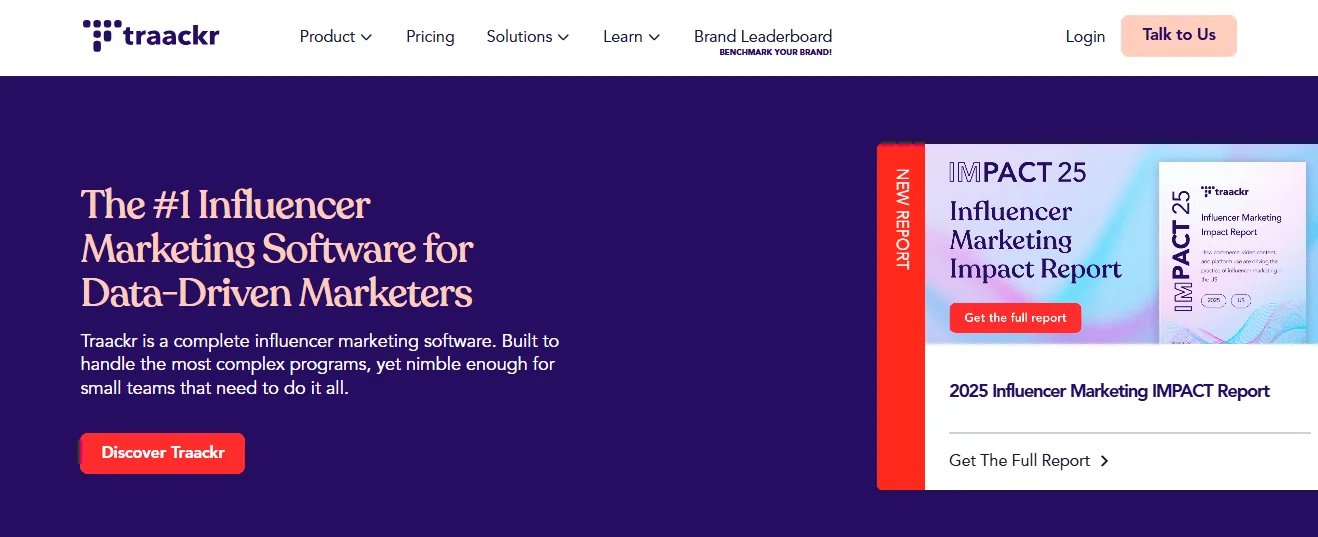
Traackr est une plateforme de marketing d'influence d'entreprise axée sur l'évaluation comparative des performances, le suivi budgétaire et la gestion des relations à long terme. Elle se positionne comme un système de mesure de l'impact d'influence sur les marchés plutôt que de simple gestion des contacts.
Idéal pour
Les marques eCommerce d'entreprise et mondiales qui souhaitent une mesure de performance d'influence structurée, un étalonnage compétitif et une visibilité budgétaire sur plusieurs régions.
Fonctionnement avec les boutiques en ligne
Traackr connecte les données de performance d'influence avec les métriques de revenus pour aider les marques à évaluer le ROI et l'efficacité des coûts. Plutôt que de se concentrer sur l'ensemencement de produits ou la diffusion automatisée, il est généralement utilisé pour suivre la façon dont les investissements d'influence se traduisent par l'impact de la marque et la performance des ventes.
Le flux de travail ressemble généralement à ceci : identifier et intégrer les creators → suivre la performance de la campagne → analyser les résultats → analyser l'allocation du ROI et du budget. Pour les boutiques en ligne, elle agit plutôt comme une couche de mesure et d'analyse qu'un outil d'exécution pratique.
Tarification
Traackr ne publie pas de tarification publique. Sur la base des repères 2025 :
- À partir de $32,500 par an
- Structuré sous forme de contrat annuel d'entreprise
Les tarifs évoluent selon les marchés, le nombre d'utilisateurs et l'étendue des rapports.
Facilité d'utilisation (UX/UI)
Les utilisateurs décrivent souvent Traackr comme riche en données et structuré, mais pas léger. Les tableaux de bord sont conçus pour les rapports et les comparaisons, ce qui peut sembler accablant pour les petites équipes.
Les équipes qui privilégient l'analyse apprécient la profondeur des rapports, mais certains utilisateurs mentionnent que la navigation quotidienne peut sembler moins intuitive comparée aux plateformes axées sur les campagnes.
Service Client
Les utilisateurs d'entreprise signalent généralement des expériences positives avec l'onboarding et la gestion des comptes stratégiques. Un support de compte dédié est généralement inclus à ce niveau.
Cependant, comme pour la plupart des outils d'entreprise, le niveau de support est souvent corrélé à la taille et à l'étendue du contrat.
Fonctionnalités Clés
- Brand Vitality Score (BVS) : Le système de notation propriétaire de Traackr aide les marques à mesurer l'impact des influencers au-delà des métriques de surface. Il évalue la portée, la qualité de l'engagement et l'alignement de marque sur l'ensemble des campagnes.
- Suivi du Budget et des Dépenses : La plateforme permet aux marques de surveiller les dépenses liées aux influencers sur les campagnes et les régions. C'est utile pour les marques de commerce électronique qui répartissent les budgets d'influencers sur plusieurs gammes de produits ou marchés.
- Comparaison Concurrentielle : Traackr permet aux marques de comparer la performance des influencers par rapport à leurs concurrents. Cela aide les équipes à comprendre leur part de voix et leur positionnement relatif sur le marché.
- Suivi de l'Historique des Relations : Les interactions avec les influencers et les collaborations historiques sont stockées dans un système centralisé. Cela soutient la construction de relations à long terme plutôt que des campagnes ponctuelles.
- Rapports de Performance et Mesure du ROI : Traackr connecte l'activité des influencers aux métriques métier, aidant les marques à analyser le retour sur investissement sur l'ensemble des campagnes.
Limites de Traackr
Traackr est fortement axé sur l'analyse et les comparaisons, mais moins sur la prospection automatisée, les cadeaux ou l'exécution rapide de campagnes. Pour les marques DTC qui ont besoin d'intégrations Shopify pratiques et d'automatisation des flux de travail quotidiens, cela peut sembler plus comme une couche de rapports qu'un système opérationnel.
8. Impact

Impact.com est une plateforme de gestion des partenariats qui combine le marketing d'affiliation, les partenariats d'influencers et les programmes de parrainage plus larges dans un seul système. Bien qu'elle ne soit pas construite exclusivement comme un CRM d'influencers, elle est largement utilisée par les marques de commerce électronique qui souhaitent gérer les influencers aux côtés des affiliés et autres partenaires de performance.
Idéale Pour
Les boutiques en ligne de taille moyenne à grande qui gèrent des programmes d'affiliation structurés et souhaitent que les influencers soient gérés dans le cadre d'un écosystème plus large de marketing de performance.
Comment Cela Fonctionne avec les Boutiques en Ligne
Impact.com s'intègre directement aux boutiques en ligne pour suivre les conversions, les revenus et les commissions entre les partenaires. Dans un contexte d'influencers, les marques intègrent généralement les creators en tant qu'affiliés, génèrent des liens de suivi et surveillent les ventes dans la plateforme.
Le flux de travail ressemble généralement à ceci : intégrer l'influencer en tant que partenaire → générer des liens de suivi → connecter les données de ventes de la boutique → automatiser les paiements de commissions → analyser la contribution aux revenus. Cela fonctionne bien pour les boutiques qui traitent déjà le marketing d'influence comme un canal de performance étroitement lié aux revenus d'affiliation.
Tarification
Impact.com ne publie pas publiquement les détails des niveaux tarifaires. En fonction des normes de l'industrie :
- Tarification personnalisée (orientation vers l'entreprise)
- Généralement structuré sous forme de contrat annuel
- La tarification varie en fonction du volume de partenaires, du volume de transactions et des modules de fonctionnalités
Elle est positionnée à un niveau tarifaire plus élevé comparé aux outils d'influencers légers.
Facilité d'utilisation (UX/UI)
Les utilisateurs décrivent souvent Impact.com comme puissant mais complexe. Le tableau de bord offre des rapports détaillés et des outils d'automatisation, bien que certains utilisateurs notent que la configuration nécessite une coordination technique.
Parce qu'elle est conçue pour la gestion plus large des partenariats, les équipes d'influencers peuvent la trouver moins rationalisée pour l'exécution quotidienne des campagnes comparée aux plateformes d'influencers dédiées.
Service Client
Les retours sur le service client sont généralement positifs pour les clients d'entreprise, en particulier autour de l'onboarding et de la mise en œuvre. Les plus grandes marques reçoivent souvent une gestion de compte structurée et une assistance technique.
Certains utilisateurs mentionnent que le temps de réponse et la profondeur du support peuvent dépendre du niveau de contrat et de la taille de l'entreprise.
Fonctionnalités Clés
- Infrastructure de suivi des affiliés et des partenaires : Impact.com est construit autour d'un suivi robuste des revenus générés par les affiliés et les partenaires. Les influencers peuvent être gérés en tant qu'affiliés avec des structures de commission automatisées directement liées aux transactions du magasin.
- Gestion automatisée des commissions et des paiements : La plateforme prend en charge les calculs de commission et les paiements automatisés. Cela réduit la réconciliation manuelle pour les marques eCommerce gérant de grands programmes d'affiliation d'influencers.
- Gestion des partenariats multi-canaux : Au-delà des influencers, les marques peuvent gérer les affiliés, les ambassadeurs et autres partenaires dans un seul système. Cela centralise les rapports de performance sur plusieurs canaux d'acquisition.
- Modélisation d'attribution avancée : Impact.com offre un suivi d'attribution détaillé, aidant les marques à comprendre comment les points de contact des influencers contribuent aux conversions dans les parcours clients plus larges.
- Rapports et analyses évolutifs : Les outils de rapports au niveau entreprise permettent aux marques de suivre les revenus, les performances des partenaires et les coûts de commission dans des tableaux de bord structurés.
Limitations d'Impact.com
Impact.com n'est pas conçu spécifiquement pour la découverte d'influencers ou la gestion des relations, les marques peuvent donc avoir besoin d'outils supplémentaires pour trouver des creators et gérer les relances. Certains utilisateurs signalent également que la mise en œuvre peut être gourmande en ressources, particulièrement pour les petites équipes sans support technique dédié.
9. Refersion
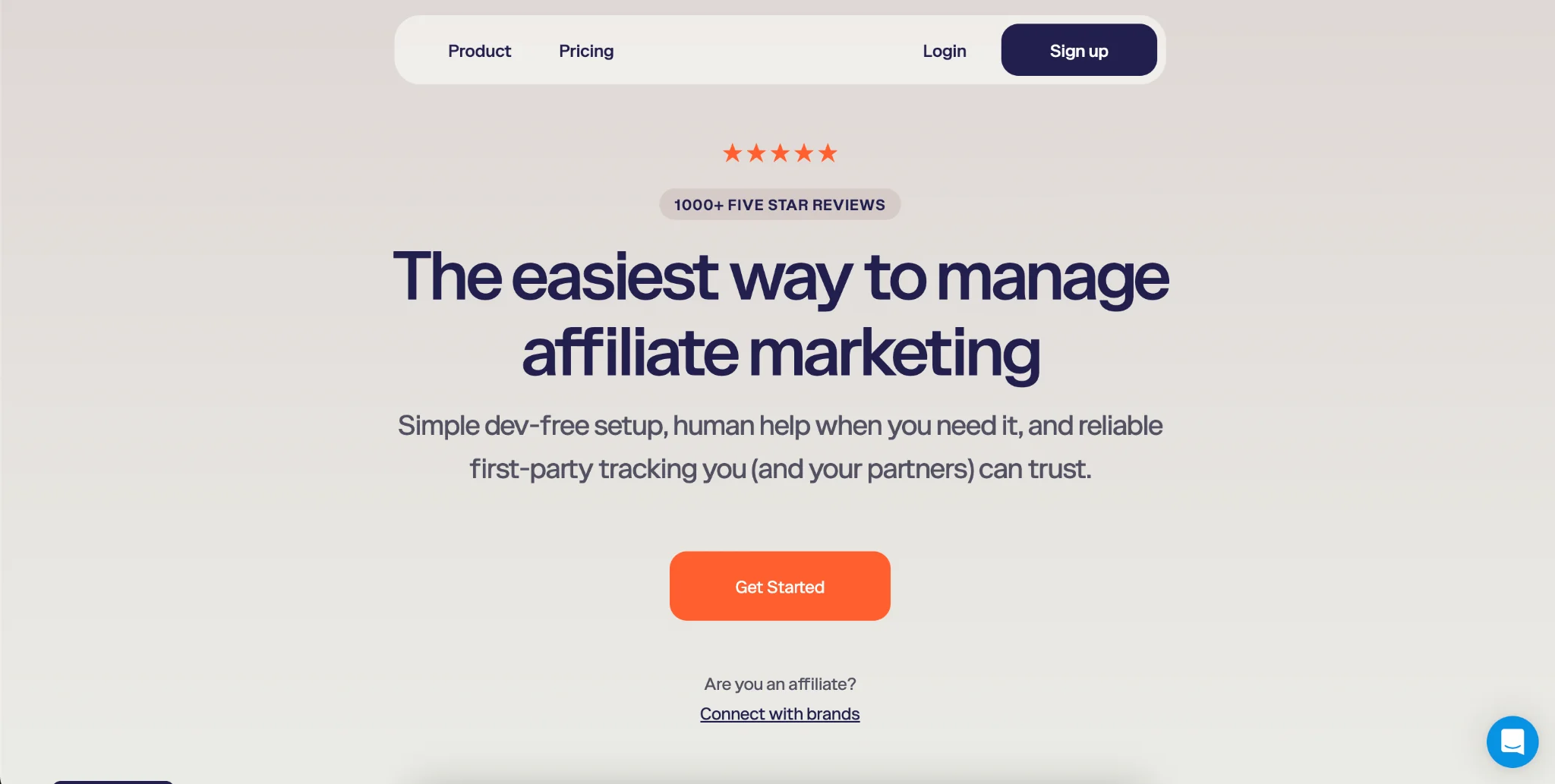
Refersion est une plateforme de marketing d'affiliation conçue spécifiquement pour les marques eCommerce. Bien qu'il ne s'agisse pas d'un CRM complet pour influencers, de nombreuses boutiques en ligne utilisent Refersion pour gérer les programmes d'affiliation d'influencers, suivre les ventes de parrainage et automatiser les commissions directement via leur devanture.
Meilleur convient à
Les marques Shopify, WooCommerce et BigCommerce qui exécutent principalement des campagnes d'influencers via des liens d'affiliation et des codes de réduction plutôt que des flux de relance structurés ou des workflows de gifting.
Comment cela fonctionne avec les boutiques en ligne
Refersion se connecte directement à votre boutique en ligne pour suivre les ventes de parrainage et les paiements de commission. Les influencers sont intégrés en tant qu'affiliés, reçoivent des liens de suivi ou des codes uniques, et leur performance est mesurée en fonction des transactions réelles du magasin.
Le flux de travail ressemble généralement à ceci : inviter l'influencer → attribuer un lien ou un code d'affiliation → suivre les conversions du magasin → automatiser les paiements de commission. Il s'adapte naturellement aux marques qui traitent le marketing d'influence comme un canal d'affiliation basé sur la performance plutôt qu'un flux de travail CRM piloté par des campagnes.
Tarification
Refersion propose une tarification échelonnée (généralement structurée sous forme de plans mensuels) :
- Plan Professionnel : Commence autour de $99/month
- Les niveaux supérieurs varient en fonction du volume de commandes et des fonctionnalités
- Tarification d'entreprise disponible
- Facturation mensuelle, avec réductions annuelles optionnelles
La tarification dépend souvent du volume de commandes et des besoins de suivi des commissions.
Facilité d'utilisation (UX/UI)
Les utilisateurs décrivent généralement Refersion comme simple et facile à configurer, particulièrement pour les boutiques Shopify. Le tableau de bord se concentre sur les performances des affiliés, ce qui rend simple le suivi des commissions pour les équipes.
Cependant, comme il est axé sur les affiliés, les utilisateurs notent qu'il manque la profondeur de gestion des campagnes des plateformes d'influencers dédiées.
Support client
Les avis clients mentionnent souvent un support par e-mail réactif et une documentation d'intégration utile. De nombreux utilisateurs Shopify signalent des expériences d'intégration relativement fluides.
Certains utilisateurs indiquent que le dépannage plus avancé peut nécessiter d'attendre un suivi du support, selon le niveau du plan.
Fonctionnalités clés
- Intégration directe avec le magasin : Refersion se connecte directement aux principales plateformes eCommerce pour suivre automatiquement les ventes de parrainage. Les commandes sont attribuées au bon affilié sans réconciliation manuelle.
- Suivi et paiement automatisés des commissions : Les commissions sont calculées en fonction des transactions du magasin. Les marques peuvent automatiser les processus de paiement, réduisant la charge administrative.
- Portail d'affiliation pour les creators : Les influencers reçoivent un accès à leur propre portail pour suivre les clics, les ventes et les gains. Cela améliore la transparence et réduit les demandes de rapports répétitives.
- Attribution par code de coupon : Des codes promotionnels uniques peuvent être assignés aux affiliés. Les ventes générées via ces codes sont suivies jusqu'à l'influencer correspondant.
- Tableau de bord de rapports de performance : Refersion fournit des rapports axés sur les clics, les conversions, les revenus et les coûts de commission. Ceci soutient le suivi du ROI pour les campagnes d'influencers pilotées par l'affiliation.
Limitations de Refersion
Refersion est conçu pour le suivi des affiliés, pas pour la découverte d'influencers, la relance ou les flux de travail de gifting. Les marques qui souhaitent une fonctionnalité CRM complète pour influencers ont généralement besoin d'outils supplémentaires pour gérer les relations avec les creators et l'exécution des campagnes.
10. Afluencer
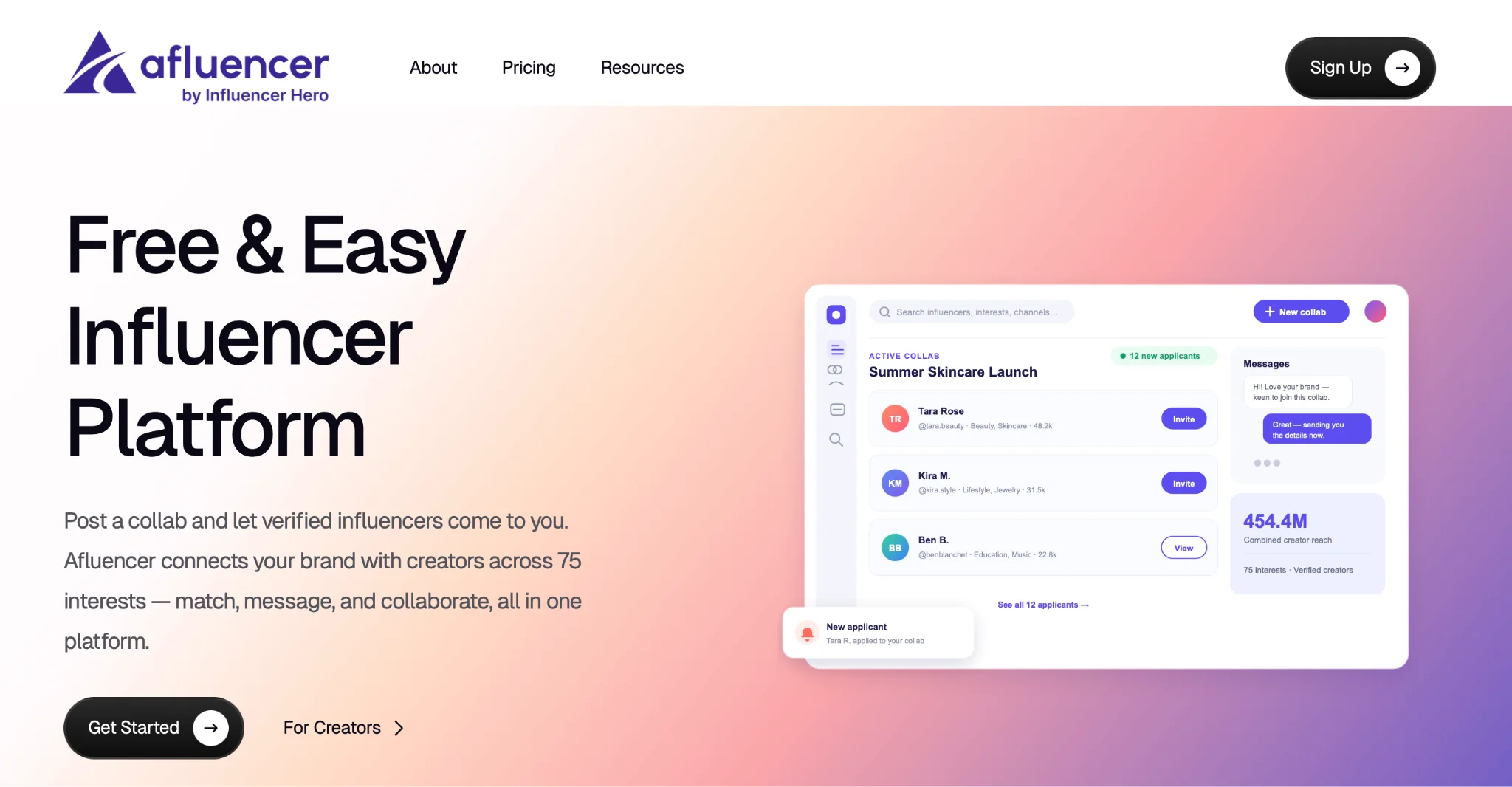
Afluencer est une plateforme de marketing d'influence de type place de marché qui connecte directement les marques et les creators par le biais d'un réseau intégré. Elle est couramment utilisée par les petites marques de commerce électronique cherchant à trouver rapidement des influencers sans gérer un système CRM complexe.
Idéal pour
Les petites et moyennes marques Shopify et BigCommerce qui souhaitent un moyen simple de se connecter avec des influencers et de gérer des collaborations de produits sans automatisation lourde ni infrastructure de niveau entreprise.
Fonctionnement avec les Boutiques en Ligne
Afluencer s'intègre aux boutiques en ligne principalement via son modèle de place de marché et son application. Les marques listent les opportunités de collaboration, les influencers postulent, et les campagnes sont gérées au sein de la plateforme. Les codes de réduction et le suivi des affiliations peuvent être utilisés pour mesurer la performance de la boutique.
Le flux de travail ressemble généralement à ceci : créer une annonce de collaboration → recevoir des candidatures d'influencers → approuver les creators → envoyer des produits ou attribuer des codes de réduction → suivre les ventes via les liens d'affiliation. Cela convient aux marques qui préfèrent les demandes entrantes plutôt que les workflows de prospection sortante.
Tarification
Afluencer propose une tarification échelonnée (généralement des plans mensuels) :
- Plan Basique : À partir d'environ $49/mois
- Plans Pro et Supérieurs : Tarification plus élevée selon les fonctionnalités et la visibilité
- Modèle d'abonnement mensuel
- Aucun contrat annuel à long terme requis pour les plans d'entrée de gamme
La tarification varie en fonction de l'accès aux fonctionnalités de la place de marché et de la visibilité des campagnes.
Facilité d'utilisation (UX/UI)
Les utilisateurs décrivent souvent Afluencer comme simple à naviguer et conviviale pour les débutants. La disposition de la place de marché rend facile pour les marques de parcourir les profils et de publier des opportunités de collaboration.
Parce qu'elle se concentre sur l'appairage plutôt que sur l'automatisation complète des campagnes, l'interface tend à être plus légère comparée aux plateformes d'entreprise.
Support Client
Les retours des clients sont généralement positifs, notamment parmi les petites marques. Les utilisateurs mentionnent un onboarding utile et une communication par email réactive.
Puisqu'elle fonctionne davantage comme une plateforme de place de marché, le support est généralement centré sur l'utilisation de la plateforme plutôt que sur un conseil stratégique approfondi.
Fonctionnalités Clés
- Modèle de Place de Marché d'Influencers : Les marques peuvent lister les campagnes et recevoir des candidatures directement des influencers. Cela réduit le besoin de prospection sortante.
- Intégration d'Application Shopify : Afluencer offre des options d'intégration pour les marques basées sur Shopify. Cela supporte le suivi des affiliations et la gestion des collaborations au sein d'un écosystème de boutique familier.
- Appairage Basé sur le Profil : Les influencers créent des profils détaillés, permettant aux marques d'évaluer la taille du public, la niche et l'engagement avant d'approuver les collaborations.
- Suivi des Codes d'Affiliation et de Réduction : Les marques peuvent attribuer des codes de réduction ou des liens d'affiliation aux influencers. Les conversions de la boutique sont ensuite suivies en fonction de ces liens.
- Tableau de Bord de Gestion des Collaborations : La plateforme comprend des outils pour gérer les collaborations actives, la communication et le suivi du statut au sein des campagnes.
Limitations d'Afluencer
Afluencer se concentre sur l'appairage de la place de marché plutôt que sur l'automatisation avancée des CRM ou la prospection à grande échelle. Les marques exécutant des programmes d'influencers à haut volume ou des structures d'affiliation complexes peuvent trouver son flux de travail trop léger pour évoluer au-delà des collaborations initiales.
Comment Choisir le Bon Logiciel de Marketing d'Influence pour les Boutiques en Ligne
La bonne plateforme dépend de la façon dont le marketing d'influence soutient les objectifs de revenus de votre boutique en ligne.
- Pour le suivi complète de l'entonnoir et la mesure du ROI : Choisissez une plateforme qui connecte les campagnes d'influencers directement aux ventes de la boutique, aux codes de réduction et aux revenus d'affiliation. Si le marketing d'influence est un canal de croissance pour votre boutique en ligne, vous aurez besoin d'une attribution de revenus claire, pas seulement des données d'engagement.
- Pour la découverte et la prospection d'influencers : Si votre objectif principal est de trouver et de contacter des creators, les plateformes riches en découverte avec de grandes bases de données et des filtres puissants peuvent suffire. Notez simplement que vous pourriez avoir besoin d'outils supplémentaires pour un suivi des ventes plus approfondi.
- Pour les programmes de cadeau ou d'affiliation à grande échelle : Les marques envoyant de grands volumes de produits ou gérant de nombreux codes d'affiliation doivent prioriser les plateformes qui se synchronisent avec les commandes de la boutique et automatisent le suivi des commissions.
- Pour un flux de travail de commerce électronique tout-en-un : Si vous souhaitez la découverte, la prospection, le cadeau et le suivi des revenus alignés dans un seul système, recherchez une plateforme construite spécifiquement autour des workflows de la boutique en ligne pour garder tout connecté et mesurable.
Réflexions Finales
Choisir le meilleur logiciel de marketing d'influence pour les boutiques en ligne revient à la proximité de la connexion de la plateforme avec votre moteur de revenus. Pour les marques DTC vendant via Shopify, WooCommerce ou des storefronts similaires, la vraie valeur vient de maintenir la découverte d'influencers, la prospection, le cadeau, le suivi des affiliations et l'attribution des revenus connectés dans un seul flux de travail.
Si votre objectif est de traiter le marketing d'influence comme un canal de croissance mesurable, Influencer Hero se distingue comme le meilleur logiciel pour l'intégration de boutiques en ligne. Il est conçu spécifiquement autour des workflows eCommerce, aidant les marques à suivre les ventes réelles, à gérer efficacement les creators et à développer les performances sans ajouter de complexité opérationnelle.
Si vous souhaitez voir comment il s'intègre à votre pile actuelle, vous pouvez réserver une démo.
Résumé
Ceci est un texte à l'intérieur d'un bloc div.
Ceci est un texte à l'intérieur d'un bloc div.
Tarification/Mois
Avis Shopify
Ceci est du texte à l'intérieur d'un bloc div.
Ceci est un texte à l'intérieur d'un bloc div.
Ceci est un texte à l'intérieur d'un bloc div.
Ceci est du texte à l'intérieur d'un bloc div.
Ceci est un texte à l'intérieur d'un bloc div.
Ceci est un texte à l'intérieur d'un bloc div.
Ceci est du texte à l'intérieur d'un bloc div.
Ceci est un texte à l'intérieur d'un bloc div.
Ceci est un texte à l'intérieur d'un bloc div.
Ceci est du texte à l'intérieur d'un bloc div.
Ceci est un texte à l'intérieur d'un bloc div.
Ceci est un texte à l'intérieur d'un bloc div.
Ceci est du texte à l'intérieur d'un bloc div.
Ceci est un texte à l'intérieur d'un bloc div.
Ceci est un texte à l'intérieur d'un bloc div.
Ceci est du texte à l'intérieur d'un bloc div.
Ceci est un texte à l'intérieur d'un bloc div.
Ceci est un texte à l'intérieur d'un bloc div.
Ceci est du texte à l'intérieur d'un bloc div.
Ceci est un texte à l'intérieur d'un bloc div.
Ceci est un texte à l'intérieur d'un bloc div.
Lire la suite

Questions fréquemment posées





Les Articles les Plus Populaires


Boostez votre ROI grâce au marketing d'influence
Rejoignez plus de 1 200 marques et 150+ agences qui font croître leurs programmes creators avec Influencer Hero.