Best Influencer Marketing Software in 2026 (Comparisons, Features & Pricing)
With so many solutions on the market, choosing the best influencer marketing software for your goals has never been more important. Influencer marketing continues to grow as one of the most reliable ways for brands to reach new audiences through authentic storytelling, trusted creators and high performing content. However, as the space evolves, so does the technology behind it.
Teams face the need of something more than just basic creator search tools, they need platforms that combine discovery, automated outreach, campaign management, analytics and eCommerce integrations into one streamlined workflow.
That’s why we created this guide to break down the Top Influencer Marketing platforms to consider in 2026.
From enterprise-level systems built for global teams to modern, flexible tools like Influencer Hero designed to unify discovery, CRM, gifting, UGC, affiliate tracking, and real sales attribution, you’ll find a clear overview of how each solution performs!
What Is Influencer Marketing Software
Influencer marketing software is a platform that helps brands manage every stage of their creator partnerships — from finding influencers to tracking ROI. As influencer marketing becomes more data-driven and complex, businesses rely on these tools to automate manual tasks, centralize communication, and measure real performance across social platforms.
Modern influencer marketing software typically includes features for creator discovery, outreach automation, campaign tracking, contract and payment management, content approval workflows, and eCommerce attribution. The goal is to help teams run creator programs more efficiently and at scale, without relying on spreadsheets or multiple disconnected tools.
Why Brands Use It In 2026
Influencer marketing has matured into a performance-driven channel, and brands in 2026 rely heavily on software to scale programs, cut operational costs, and optimize ROI.
Here’s why adoption keeps rising:
Creator Spending Is Increasing
Influencer marketing spending is projected to surpass $24 billion in 2024 and continue rising into 2026. As budgets grow, brands need platforms that ensure efficiency, transparency, and measurable performance.
Manual Workflows Are No Longer Sustainable
Brands spend up to 70% of their time on manual tasks such as searching for creators, sending emails, collecting content, and tracking results. Software centralizes all of this, allowing teams to run more campaigns with fewer resources.
ROI and Attribution Matter More Than Ever
With rising customer acquisition costs (CAC), brands are shifting budgets toward creators—but only when they can clearly track revenue. Brands using influencer + affiliate attribution see up to 3x higher repeat campaign performance.
Creators Influence Purchase Decisions More Than Traditional Ads
Consumers trust creator recommendations over brand advertisements. Brands rely on influencer marketing software to identify the right creators and run scalable partnerships across platforms.
Criteria to Choose the Best Influencer Marketing Software for Your Brand in 2026
Our comparison focuses on several key aspects:
Social Media Platform Coverage: The extent to which each platform supports major social networks such as Instagram, YouTube, TikTok, Facebook, and Pinterest.
Reviews: G2/Capterra/Shopify
Pricing and Commitments: Understanding the cost and commitment levels can help brands choose based on budget and flexibility needs.
Ease of Use (UX/UI): The overall user experience, including dashboard design, navigation, and onboarding, especially important for teams with limited time or tech support.
Customer Support: Availability and responsiveness of support channels, including live chat, email, onboarding assistance, and resolution speed for technical or billing issues.
Key Features: Including influencer discovery, outreach, CRM, reporting, gifting, UGC / content collection, affiliate & payments, storefronts, application page, and AI capabilities.
Standout Features: Those unique or innovative features that differentiate each platform (e.g. live tracking dashboards, creator benchmarking, TikTok email finders, etc.).
Best Influencer Marketing Software in 2026
Tool
Best For
Price Starts At
Key Differentiator
Influencer Hero
Shopify & WooCommerce brands needing an all-in-one suite
$649/month
Full funnel automation: discovery, outreach, CRM, gifting & ROI tracking
Modash
Teams focused on fast influencer discovery & audience insights
$199/month
Strongest creator search engine with deep audience data
CreatorIQ
Large enterprises running global, multi-market campaigns
$3,000/month (Custom)
Enterprise-grade compliance, data integrations & advanced analytics
Strong influencer search paired with built-in influencer eCommerce tools
1. Influencer Hero
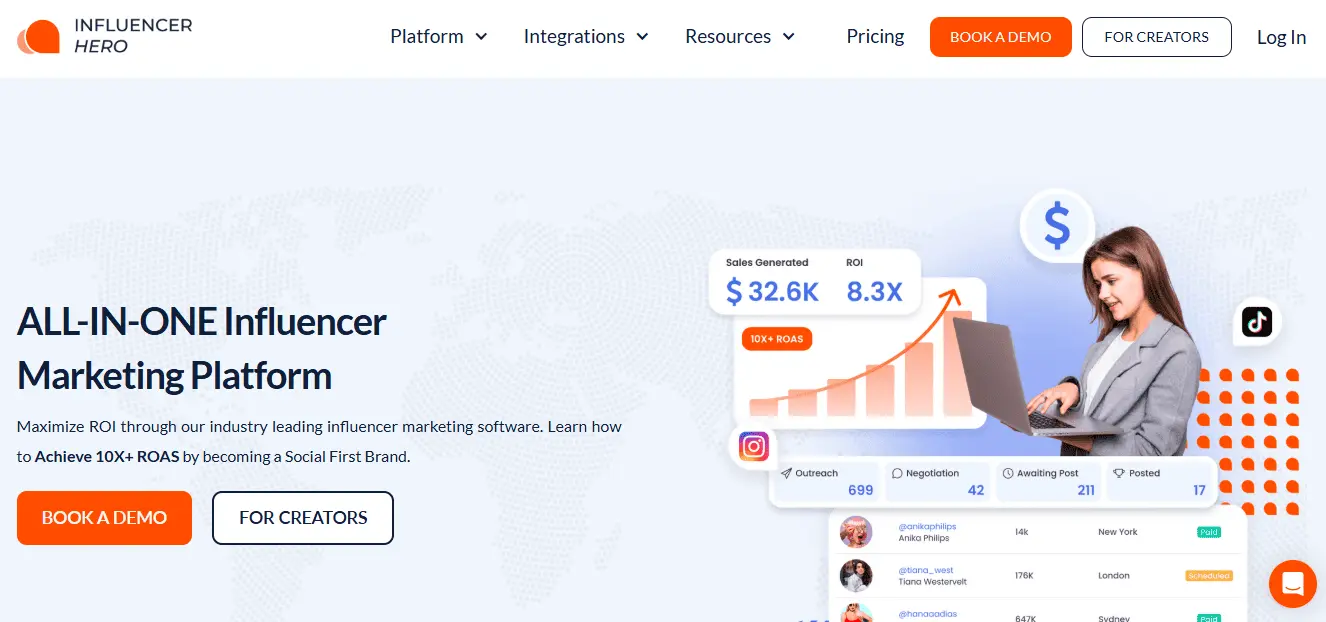
Influencer Hero is an all-in-one influencer marketing software built for brands that want to scale their creator programs with confidence.
As one of the best influencer marketing software solutions available today, it brings together everything teams need, offering automated workflows, data-driven insights, and advanced tracking tools that help you scale campaigns efficiently.
Whether you’re managing 10 creators or 10,00+ Influencer Hero gives you the full infrastructure to run high-performing influencer, UGC, and affiliate programs at scale.
Best for: Growing D2C brands, eCommerce teams, and agencies looking for an all-in-one influencer marketing platform with strong CRM automation, multi-platform support, and AI-powered campaign optimization.
Platform coverage: Instagram, TikTok, YouTube, Facebook, Pinterest, Snapchat, X (formerly Twitter) and Twitch.
Pricing & Commitment: There are different plans depending on your brand’s needs.
Standard Plan: Starts at $649/month. Allows you to contact up to 1,000 creators a month.
Pro Plan: Starts at $1,049/month. Allows you to contact up to 5,000 creators a month.
Business Plan: Starts at $2,490/month. Allows you to contact up to 10,000 creators a month.
Custom & Agency: Custom pricing based on your brand needs.
Reviews: 5.0 / 5.0 (Capterra)
Ease of Use (UX/UI): Known for its intuitive interface, Influencer Hero offers a clean, streamlined dashboard that simplifies campaign management. Automated workflows, customizable email templates, and a Chrome extension make it easy for teams to save hours each week. Users praise how quickly new members can onboard without training.
Customer Support: Customer support is one of Influencer Hero’s strongest assets, offering 24/7 real-human live chat, responsive email support, and a comprehensive Help Center with both written and video tutorials. Every plan includes a dedicated account manager from day one, with Pro users also getting access to a private Slack channel for ongoing, faster support. Optional strategy consultations further guide brands toward growth.
Influencer Hero Standout Features
Advanced AI-Powered Influencer Discovery: Identify high-performing creators across 8 major platforms with precision filters, lookalike modeling, fake-follower analysis, and AI recommendations—designed to surface the right creators faster than traditional databases.
End-to-End Influencer CRM Built for Scale: A visual, pipeline-based CRM that manages 10 to 10,000 creators with ease. Smart tagging, automated tasks, content approvals, shipping statuses, and deal stages keep every collaboration organized in one place.
Automated, Personalized Influencer Outreach: AI-driven email and DM sequences scale warm, personalized communication—boosting reply rates and creator conversions while eliminating manual back-and-forth.
UGC & Campaign Workflow Automation: Streamlined campaign boards track deliverables, approvals, rights, and UGC downloads. Teams can manage affiliate programs, gifting logistics, and performance updates all in one hub.
Storefronts & Influencer Application Pages: Creators can apply directly to campaigns or build personalized storefronts featuring your products—driving more UGC, higher affiliate engagement, and stronger conversion funnels.
Real-Time Reporting, Analytics & Attribution: Dashboards surface true ROI with conversion tracking, revenue attribution, link clicks, affiliate performance, and UGC output—giving brands a clear view of what’s working and why.
Influencer Hero Pros & Cons
Pros
Cons
Full Lifecycle Platform: Covers every step—from discovery to outreach to CRM, gifting, UGC, analytics, and payments—reducing the need for multiple tools.
Premium Pricing: Starting at $649/month, it may be a stretch for early-stage brands with small creator budgets.
Extensive Creator Database: Access 450M+ influencer profiles across Instagram, TikTok, YouTube, Pinterest, Facebook, X, Twitch, and LinkedIn.
No Native Paid Ad Whitelisting: Boosting influencer posts requires an external setup.
AI-Driven Efficiency: Automates outreach, workflows, segmentation, and recommendations, accelerating campaign execution for both small teams and enterprise users.
Manual UGC Licensing: Brands must negotiate reuse rights—no automatic content licensing baked in (yet).
Robust Learning Resources: Offers templates, best-practice guides, campaign playbooks, and onboarding support to help teams scale faster.
-
Flexible Product & eCommerce Integrations: Supports Shopify, WooCommerce, and custom stores, enabling frictionless gifting, affiliate tracking, and conversion attribution.
-
2. Modash
Modash offers end-to-end influencer marketing for Shopify, allowing brands to run their entire creator program in one platform. You can source influencers, ship products, manage campaigns, and monitor performance without relying on multiple tools.
Best for: Brands looking for large scale influencer discovery tools and Shopify based campaigns.
Platform Coverage: Instagram, TikTok, YouTube. Limited support for X, Snapchat and others.
Pricing & Commitment: There are different plans and options.
Essential Plan: Starts at $199/month (is paid annually). Allows you to contact up to 100 creators a month.
Performance Plan: Starts at $499/month (is paid annually). Allows you to contact up to 250 creators a month and gives you access to the Shopify integration.
Enterprise Plan: Custom pricing based on your brand needs.
Reviews: 4.9 / 5.0 (Capterra)
Ease of Use (UX/UI): Modash provides a clean, intuitive interface that makes influencer discovery straightforward, thanks to its easy-to-navigate search filters and clear layout. New users can get up and running quickly, although some of the more advanced analytics and workflow features may take a bit of time to fully master.
Customer Support: Modash offers fast, responsive customer support with in-platform messaging, a helpful knowledge base, and guided onboarding to ensure teams understand how to get the most value from the tool. Their support team is known for being hands-on and proactive, especially during the initial setup phase.
Modash Standout Features
Massive Creator Database: Access 350M+ creator profiles without requiring opt-ins, giving you one of the largest searchable databases available.
Find Your Fans: Automatically identifies creators who already follow your brand, making them more likely to collaborate and convert.
AI Driven Creator Discovery: You can use different text prompts such as "aesthetic fashion influencers in the US”, or upload a reference image to get highly relevant influencer suggestions.
Real-Time Campaign Content Tracking: Collects and analyzes campaign-related creator content instantly so you can monitor performance as it happens.
Shopify-Centric Affiliate Automation: For Shopify brands, Modash centralizes everything—gifting workflows, discount code creation, affiliate links, and payouts—all in one place.
Modash Pros & Cons
Pros
Cons
Advanced Discovery: Powerful filters, lookalikes, plus AI visual search by photo or vibe description.
Shopify-Only Gifting & Tracking: No integration with WooCommerce or other eCommerce platforms.
Efficient Outreach: Bulk email with templates, Gmail & Outlook integration for follow-ups.
No Content Licensing Tools: You must negotiate reuse rights manually with creators.
Performance Tracking: Real-time dashboards for engagement, affiliate sales, and content metrics.
Basic CRM: Simple tagging for pipeline stages like "contacted" or "negotiating."
CreatorIQ is a leading enterprise platform built for companies managing complex, large-scale influencer programs. It excels in areas like compliance, data integrations, and expansive creator coverage, making it a strong fit for global brands that require advanced governance and scalable workflows.
Best For: Enterprise-level brands managing intricate influencer campaigns with heavy data requirements.
Platform Coverage: Instagram, TikTok, YouTube, Facebook, Pinterest, Twitch, and X.
Pricing: There are different plans:
Basic Plan: Starts at $35,000/year. Includes 1,000 contact creators per month
Standard Plan: Starts at $50,000/year. Includes 2,500 contact creators per month
Professional Plan: Starts at $90,000/year. Includes 5,000 contact creators per month
Enterprise Plan: Starts at $200,000/year. Includes 7,500 contact creators per month
Ease of Use (UX/UI): CreatorIQ is widely praised for its clean, modern interface and visually appealing dashboard. The layout is intuitive for enterprise teams, making it easy to navigate large amounts of creator, campaign, and reporting data without feeling cluttered.
Customer Support: Clients receive strong support through a dedicated account manager and a hands-on customer success team. This includes onboarding assistance, ongoing campaign help, and quarterly strategy sessions designed to optimize long-term influencer program performance.
CreatorIQ Standout Features
Robust Data Integrations: Real-time, API-based connections ensure CreatorIQ delivers accurate, compliant analytics across major platforms.
Mass Outreach + CRM Integration: Enables teams to send personalized bulk messages, attach campaign briefs automatically, and manage creator relationships with tagging, notes, and historical timelines.
Trusted by Major Global Brands: Used by companies like Disney, Unilever, Lululemon, and H&M—demonstrating its scalability and enterprise credibility.
Advanced Search Capabilities: Allows highly granular creator discovery using keyword and audience filters, enabling searches as specific as “tennis dads” or “Vietnamese foodies.”
Branded One-Sheets & Collaborative Approvals: Stakeholders can preview creator content and leave feedback directly through shared links—no login required.
CreatorIQ Pros & Cons
Pros
Cons
API Connections: Direct integration with platforms like Meta, TikTok, and YouTube provides trustworthy performance data and early access to new features.
Manual Affiliate Tracking: Does not automate affiliate conversion data; tracking must be done manually.
Tailored Reporting: Offers customizable dashboards and shareable links that don’t require login access.
Lacks a Free Trial: Access is limited to paid annual contracts, with no trial period.
Reliable Support: Clients receive consistent support from an implementation lead and a success team.
Rigid Pricing Structure: Requires a yearly commitment with no flexibility for monthly billing.
Streamlined Approvals: One-sheets and real-time feedback options make collaboration seamless.
Storefront Limitations: “Creator Storefronts” are not designed as complete eCommerce stores, functionality is focused on affiliate visibility rather than full shopping experiences.
4. Captiv8
Captiv8 provides enterprise-grade software to run creator campaigns with confidence.
Best for: Brands looking to partner up with Gen Z audiences.
Platform coverage: Instagram, TikTok, Facebook, YouTube, X (Twitter) and Twitch.
Pricing & Commitment: All plans are custom made, so you pay only for what you need and nothing else. Plans usually start at $25,000/year, there´s an annual commitment needed. There’s also a $3,000 onboarding fee.
Reviews: 4.7/5.0 (G2)
Ease of Use (UX/UI): Captiv8 offers an intuitive dashboard with robust reporting and collaboration tools,though it can be a bit overwhelming for beginners or smaller teams.
Customer Support: Support is primarily handled via email, but many users report issues with responsiveness, making it one of Captiv8’s main drawbacks.
Captiv8 Standout Features
Email & DM Briefing: Easily send content briefs, guidelines, and templates to creators directly through email or Instagram DMs, allowing for smoother communication and faster campaign alignment.
Saved Filters: Save your preferred search filters—such as niche, follower range, audience demographics, or location—and reuse them whenever needed. This helps teams avoid rebuilding searches from scratch and speeds up creator sourcing.
Custom Reports: Captiv8 lets you build fully customizable performance reports using the metrics that matter most to your campaign. All dashboards update in real time, giving teams immediate insights into reach, engagement, and ROI.
Public Report Links: Share campaign results with teammates or external stakeholders through public links that require no login, making collaboration and reporting quicker and more accessible.
Captiv8 Pros & Cons
Pros
Cons
Competitive & Campaign Analytics: Tracks ROAS, EMV, brand mentions, word clouds, and competitor overlap.
High Cost & Annual Only: Starts around $25K+ per year with no monthly plans.
Large Influencer Database: 15M+ creators with advanced filters by niche, location, audience, and more.
Customer Support Issues: Reports of slow or unhelpful responses.
CRM & Collaboration: Integrated IRM and CRM for smooth communication, outreach, approvals, and UGC contracts.
Payment Complaints: Delayed payments and payout issues reported by brands and creators.
Limited eCommerce Integration: Only supports Shopify and Refersion for affiliate and sales tracking.
5. Later
Later is a platform that helps brands discover creators, manage campaigns, and measure performance.
Best for: Influencer discovery and social media management platforms.
Platform coverage: Instagram, TikTok, YouTube, Facebook, Pinterest, X (twitter), Snapchat and LinkedIn.
Pricing & Commitment: All plans come with an additional one-time onboarding fee of $5,000 for all new customers.
Essentials Plan: Starts at $28,500/year. Best for brands starting in influencer marketing.
Pro Plan: Starts at $42,000/year. Best for data and automation to make your campaigns run faster and achieve better ROI.
Premier Plan: Starts at $60,000/year. Everything you need for a scaled influencer program.
Reviews: 4.4 / 5.0 (Capterra)
Ease of Use (UX/UI): Later offers a clean, user-friendly interface that makes navigating everything from influencer discovery to reporting straightforward. Most teams find the platform easy to learn, though the full onboarding process typically takes 4–6 weeks to ensure users understand all advanced features and workflows.
Customer Support: Later provides strong customer support, including three structured onboarding sessions and dedicated account managers for every brand. Their team is known for being responsive and proactive, helping users maximize both the platform and their creator strategy.
Later Standout Features
AI-Assisted Discovery: Later uses AI to surface relevant creators based on keywords, audience demographics, content themes, and brand affinity—while also suggesting related niches you might not have considered.
Advanced Sourcing: In addition to self-service tools, Later’s internal team can source creators on your behalf using your campaign brief. This is ideal for brands that want to streamline or fully outsource discovery.
Hybrid Flexibility: Whether you want full control or guided support, Later allows you to run DIY campaigns or tap into its team for hybrid or fully managed services, offering scalability for teams of all sizes.
Brand Safety & Content Quality: Each creator profile includes detailed checks for fake followers, flagged content, and engagement authenticity, along with examples of past posts so you can confidently evaluate potential partners.
Custom Creator Application Pages: Later makes it easy to build branded landing pages where creators can apply directly to your campaigns—perfect for capturing inbound interest from your website, social media, newsletters, or DMs.
Later Pros & Cons
Pros
Cons
AI Discovery + Large Creator Base: Access 15M+ influencers with advanced filters and AI keyword search.
Basic Compared to Peers: Many features feel standard, without major differentiation.
Centralized Communication: Integrated outreach and CRM keep all emails, conversations, and campaign stages organized.
Paywall for Key Features: Most advanced tools require upgrading to the Pro tier.
Branded Application Pages: Build custom pages for influencers to apply, even those outside the platform.
Slow Onboarding: Typically takes 4–6 weeks to launch live campaigns.
Affiliate Tracking & Gifting: Shopify integration for single-use codes and affiliate links to track ROI.
No Paid Ads/Whitelisting: Doesn’t offer tools to boost posts as ads.
6. HypeAuditor
HypeAuditor is an influencer marketing platform designed to find, vet, and activate creators.
Best for: Brands looking for audience quality and fraud detection.
Platform coverage: Instagram, TikTok, YouTube, X (Twitter), Twitch and Snapchat.
Pricing & Commitment: All plans are custom made, so you pay only for what you need and nothing else. Plans usually start at $10,000/year, there’s an annual commitment needed.
HypeAuditor offers a free trial: Modular plans with a 24–48h free trial let you explore features before committing.
Reviews: 4.8/5.0 (Capterra)
Ease of Use (UX/UI): HypeAuditor has a clean, easy-to-navigate interface, though some of its advanced filters may feel overwhelming for beginners.
Customer Support: HypeAuditor offers responsive support through live chat, email, and dedicated onboarding sessions. Users also have access to a comprehensive Help Center filled with guides, tutorials, and best-practice resources to help them get the most out of the platform.
HypeAuditor Standout Features
Flexible Campaign Management: Manage every step of your influencer campaigns in one place—including outreach, payments, reporting, and eCommerce integrations for tracking promo codes, conversions, and sales.
AI-Powered Discovery: HypeAuditor uses advanced AI to analyze creator bios, captions, visuals, and audience data to accurately categorize influencers and surface the best matches for your niche.
Social Listening & Competitor Tracking: Identify influencers already mentioning your brand or talking about competitors, making it easier to build authentic partnerships and capture strategic opportunities.
Shareable Reporting: Export any report as a PDF for internal reviews, or share direct report links with teammates and stakeholders so they can access real-time metrics such as revenue, conversions, and individual creator performance.
HypeAuditor Pros & Cons
Pros
Cons
Advanced Discovery & AI Search: Filter through 200M profiles for niche targeting, lookalikes, and upcoming prompt-based tools to find new creators.
High Starting Cost: Business plans start around $10K/year, which can be steep for smaller teams.
Omnichannel Outreach: Connect via email, DM, or the integrated CRM to send briefs, contracts, and approve drafts all in one place.
Small Opt-In Pool: Of the 200M profiles, only about 200K influencers are registered and able to apply directly.
ROI & Affiliate Tracking: Measures clicks, orders, revenue, and promo code impact for clear eCommerce performance.
Learning Curve: Rich feature set may require training or onboarding to use effectively.
Branded Application Pages: Build custom landing pages for influencers to apply directly to your campaigns.
-
7. Traackr
Traackr is a leading influencer marketing platform designed to help large-scale brands and enterprises manage, measure, and optimize their influencer marketing programs. The platform offers advanced tools for influencer discovery, campaign performance tracking, and ROI optimization.
Best for: Brands looking to track ROIand measure performance.
Platform coverage: Instagram, TikTok, YouTube, Facebook, Pinterest, X (Twitter), Snapchat, Twitch and LinkedIn.
Pricing & Commitment: All plans are custom made, so you pay only for what you need and nothing else. Plans usually start at $32,500/year.
Reviews: 4.3 / 5.0 (G2)
Ease of Use (UX/UI): Traackr offers an intuitive, easy-to-navigate interface with clean workflows that simplify influencer discovery, campaign tracking, and reporting. Its structured layout makes it easier for teams to manage large datasets without feeling overwhelmed.
Customer Support: Traackr is well-regarded for its strong customer support, providing responsive onboarding guidance and technical assistance to ensure campaigns run smoothly from start to finish.
Traackr Standout Features
Brand Vitality Score (BVS): A proprietary metric that combines brand visibility, audience trust, and overall influence into a single score—making it easy to benchmark your brand’s performance against competitors over time.
Budget Optimization Calculator: Uses historical campaign performance and industry benchmarks to recommend ideal spend levels for each creator, helping brands plan budgets with data-backed ROI expectations.
Cost-Per Metrics Analysis: Tracks detailed cost-efficiency metrics such as CPC, CPE, CPV, and cost-per-story-view, enabling teams to evaluate spend effectiveness across influencers and campaigns.
Live Campaign Benchmarking: Allows you to compare campaign performance to regional and industry benchmarks in real-time, helping you identify what’s working and where to optimize.
Global Discovery & Localization: Access a global database of 6M+ influencers with layered insights around audience location, language, engagement quality, and demographics—ideal for finding high-performing creators in targeted markets worldwide.
Traackr Pros & Cons
Pros
Cons
Global Reach & Enterprise-Ready: Database of 6M+ influencers with tools to run multi-market, multi-language campaigns.
High Pricing & Annual Only: Starts around $32K/year, billed annually, out of reach for many small teams or short-term needs.
Full Lifecycle Management: Handles everything from discovery and CRM to gifting, affiliate management, and reporting.
Questionable Demographic Data: Audience estimates like age, gender, or location sometimes flagged as inaccurate.
Steep Learning Curve: Robust features require more time and training to use effectively.
Recruitment Pages: Lets brands create branded pages for influencers to apply directly.
Limited Niche Coverage: May lack newer or highly niche micro-influencers in certain verticals.
8. GRIN
GRIN is a leading influencer marketing platform built specifically for eCommerce and D2C brands. It combines influencer CRM, affiliate management, content collection, and analytics into one integrated system.
Best for: eCommerce product seeding and payouts.
Platform coverage: Instagram, TikTok, YouTube, Twitch, X (Twitter) and Snapchat.
Pricing & Commitment: All plans are custom made, so you pay only for what you need and nothing else. There’s a minimum full year of service you have to commit to with monthly payments. On average plans start around $2,500/month up to $10,000/month.
Reviews: 4.5/5.0 (G2)
Ease of Use (UX/UI): GRIN features an intuitive, CRM-style interface that makes it simple for teams to manage influencer discovery, content approvals, and campaign tracking all in one place. Its organized workflows help streamline day-to-day operations, allowing users to navigate tasks quickly without a steep learning curve.
Customer Support: GRIN provides responsive and knowledgeable customer support, backed by a structured onboarding program to help teams get up to speed. Users also benefit from a robust library of help articles, tutorials, and troubleshooting guides that cover a wide range of use cases and questions.
GRIN Standout Features
ECommerce-Native Integrations: GRIN connects directly with Shopify, WooCommerce, Magento, and PayPal, allowing D2C brands to manage gifting, track affiliate sales, and send payments without third-party tools. This makes it ideal for Shopify brands focused on direct sales attribution.
GRIN Intelligent Assistant (GIA): GIA is an AI-powered assistant that helps marketers find and manage creators faster, suggesting ideal matches, summarizing communications, and automating manual CRM tasks. Great for lean marketing teams managing large influencer rosters.
Unlimited Creator Partnerships: Unlike most platforms, GRIN doesn’t cap the number of influencers you can work with. This benefits enterprise D2C brands scaling large ambassador or seeding programs.
UGC Library & Media Rights Management: GRIN automatically saves all influencer content (including Stories) with reuse rights built in. Perfect for brands running paid ad campaigns or email retargeting with influencer content.
Affiliate & Payment Automation: Send influencer payments directly through PayPal, assign affiliate links and discount codes, and track commissions automatically. This makes GRIN especially strong for affiliate-driven D2C campaigns.
GRIN Pros & Cons
Pros
Cons
Strong eCommerce Integrations & ROI Tracking: Direct links to Shopify, WooCommerce, and Magento for automatic sales, gifting, and affiliate tracking—many brands report clear ROI gains.
High Cost & Rigid Contracts: Starts around $2–2.5K/month with annual commitments, limiting flexibility for smaller teams.
Complete Campaign Workflow: Manages everything from discovery and outreach to gifting, contracts (via DocuSign), content approval, payments, and affiliate tracking.
Inconsistent Discovery: Users mention low-quality curated lists, duplicate profiles, and weaker search functions over time.
Robust Creator Communication: Integrated email tool connects with Gmail, Outlook, and Klaviyo for sequences, proposals, and brief templates.
Performance Issues: Reports of slow loading, site crashes, glitches with uploads, and duplicate records.
Branded Application Pages: Allows influencers to apply directly, boosting campaign reach and opt-ins.
Support Challenges: Helpful but often slow—some users faced long ticket waits, billing issues, or difficulties canceling.
9. Sprout Social
Sprout Social (formerly Tagger) is ideal for brands embedded in the Sprout ecosystem that want influencer marketing seamlessly integrated with their social analytics. It offers a reliable mid-market toolkit for campaign management, creator workflows, and detailed reporting.
Best for: Brands looking to manage social media, content control and brand safety.
Platform Coverage: Instagram, TikTok, YouTube.
Pricing & Commitment: Pricing varies depending on every brand's needs.
Base Plan: Starts around $1,600/month per user plus $600 per extra user. You can pay monthly or annually, but a full-year commitment is mandatory. This translates into an annual investment of over $19,200 for one person or $25,200 for a team of two.
Reviews: 4.5 / 5.0 (Capterra)
Ease of Use (UX/UI): Sprout Social offers an intuitive interface with clear dashboards and campaign flows that are easy to follow.
Customer Support: SproutSocial support is fast and responsive. They offer live chat, phone, and a list of help articles for brands and creators. They also offer a "system status” page where users can check for any platform issues.
SproutSocial Standout Features
Brand Fit & Safety AI: SproutSocial uses affinity scoring to evaluate how well a creator aligns with your brand’s values, tone, and audience, helping teams make safer, more strategic partnership decisions.
Advanced Discovery Filters: Search creators by age, region, and engagement to find precise matches.
Content Approval Workflow: Creators can upload draft content directly into the platform for review, allowing brands to manage approvals, request edits, and maintain full creative oversight before anything goes live.
Competitive Benchmarking & EMV Reporting: Custom analytics dashboards provide real-time Earned Media Value (EMV), audience insights, and competitive benchmarks so teams can measure performance against industry peers with precision.
SproutSocial Pros & Cons
Pros
Cons
Advanced Discovery Filters: Search creators by age, region, and engagement to find precise matches.
High Cost & Contract: Starts at $1,599/user/month with a 12-month minimum, no monthly plan option.
AI Brand Fit & Safety: Smart brand fit scoring plus content safety filters help pick the right creators.
No Visual AI Search: Lacks “describe a vibe” style image-based discovery tools.
Integrated Outreach & CRM: Use Gmail/Outlook email templates or fallback to DMs, all tracked in a campaign flowboard.
Limited UGC Licensing: No automated content rights management—handled manually.
Shopify Dependency: Gifting & affiliate tracking tied to Shopify; limited outside it.
Payments & Gifting: Smooth product seeding and creator payments via Shopify + PayPal.
Extra Analytics Rely on Ads Manager: Deeper ad performance still needs Meta or TikTok ad dashboards.
10. Upfluence
Upfluence helps you turn creators into revenue by building valuable partnerships to grow your business.
Best For: eCommerce-focused brands, especially on Shopify or Amazon, that want an all-in-one influencer management platform with integrated affiliate management and robust ROI tracking. Ideal for teams looking to directly link influencer campaigns to sales performance.
Pricing: Custom plans starting around $2,000/month with a full-year commitment (approx. $24,000/year). Optional $399/month payment tool can be disabled if not needed. Discounts may be offered for upfront yearly payments.
Reviews: 4.3 / 5.0 (Capterra)
Ease of Use (UX/UI): Upfluence features an intuitive, data-rich dashboard that experienced users find powerful for managing large-scale influencer programs. However, because the platform offers so many advanced features and analytics options, beginners may find the interface a bit overwhelming until they become familiar with the layout and tools.
Customer Support: Upfluence provides strong customer support, starting with a highly rated onboarding program designed to help teams ramp up quickly. Users also benefit from weekly Q&A sessions and ongoing guidance to ensure they’re fully equipped to get value from the platform.
Upfluence Standout Features
AI-Powered Discovery & Outreach: Database of 12M+ influencers with Jace AI assisting in automated outreach, drip flows, and personalized campaigns.
Shopify & Customer Matching: Identifies customers who are influencers and manages gifting, affiliate links, and commissions directly in-platform.
Amazon Integration: Tracks affiliate sales, conversions, and revenue attribution for brands selling on Amazon.
Social Listening Tools: Helps brands research trending content and monitor what posts drive the highest engagement.
CRM & Campaign Management: Centralized relationship management with affiliate code tracking, communication logs, and performance tracking.
Bulk Creator Payouts: Secure in-platform system for handling multi-creator payments at scale.
No Commission Fees: Brands pay a flat subscription cost without additional fees tied to outreach volume or influencer sales.
Upfluence Pros and Cons
Pros
Cons
eCommerce Integrations: Seamlessly integrates with Shopify and Amazon to track ROI
High Cost & Annual Contracts: Starting at $1,276/month with yearly commitments.
All-in-One Solution: Covers discovery, outreach, campaign tracking, affiliate, and payouts
Complex Setup: Beginners may find the platform overwhelming due to robust features
No Commission Fees: Flat subscription model with no extra charges for outreach scale or sales
No Free Trial: Brands must commit without testing the platform first
Customer-Influencer Matching: Identifies loyal customers who can be leveraged as cost-effective creators
Limited Flexibility to Cancel: Full-year payment required, no cancel-anytime options
Final Thoughts
Most marketing teams now rely on AI influencer marketing software to run efficient, performance driven creative campaigns. Whether you are evaluating top influencer marketing platforms like Influencer Hero, CreatorIQ, Traackr or just exploring flexible creator discovery tools such as Modash or HypeAuditor, each solution brings its own strengths to the table.
Influencer Hero stands out because it delivers both—the enterprise-grade functions of the first group and the flexible, creator-focused features of the second—all within one unified platform. If you’re ready to upgrade to an all-in-one influencer platform with conversion tracking, book a demo with Influencer Hero and experience the next generation of influencer marketing tools!
FAQs
When should I start planning my Black Friday 2025 marketing strategy?
It's advisable to begin planning your Black Friday 2025 marketing strategy at least 2–3 months in advance. Early preparation allows you to analyze previous campaign data, set clear sales targets, and ensure your inventory and website are ready for increased traffic. Starting early also provides ample time to build anticipation among your audience through teasers and early-bird promotions.
What are effective strategies for Black Friday marketing in 2025?
Effective strategies for Black Friday 2025 include:
Early Access for VIPs: Offering exclusive deals to loyal customers before the general public.
Collaborations: Partnering with other brands for joint promotions.
Wishlist Incentives: Encouraging customers to create wishlists with the promise of special offers.
Personalized Messaging: Using customer data to tailor marketing messages.
Gamified Campaigns: Implementing interactive elements like quizzes or contests to engage customers.
How can influencer marketing boost BFCM sales?
Influencer marketing can significantly enhance BFCM sales by leveraging influencers' established trust and reach.Collaborating with influencers allows brands to tap into new audiences, create authentic content, and drive traffic and conversions. It's essential to identify influencers whose audience aligns with your target market and to start these partnerships well before BFCM to build genuine relationships.
What role does email marketing play in BFCM success?
Email marketing is a crucial component of BFCM success. Building and segmenting your email list allows for targeted messaging, ensuring customers receive relevant offers. Personalized emails with compelling subject lines can increase open rates and drive sales. Additionally, automated email sequences can nurture leads and re-engage past customers leading up to and during BFCM.
Why is it important to optimize my website for BFCM?
Optimizing your website for BFCM is vital to handle increased traffic and provide a seamless shopping experience. A fast-loading, mobile-responsive site with clear navigation reduces bounce rates and cart abandonment. Ensuring your checkout process is straightforward and secure can significantly impact conversion rates during the high-traffic BFCM period
What are the best influencer marketing platforms for small businesses?
The best influencer marketing platforms for small businesses typically offer cost-effective solutions, user-friendly interfaces, and adequate support for less experienced marketers. Platforms like Influencer Hero and Tribe provide accessible entry points with features tailored for smaller scale operations, allowing businesses to manage campaigns, discover influencers, and measure ROI effectively without a hefty investment.
How do I choose the right influencer marketing platform?
Choosing the right influencer marketing platform involves evaluating several key factors:
Feature Set: Ensure the platform has the tools you need, such as influencer discovery, campaign management, and analytics.
Platform Coverage: Look for platforms that support the social media channels where your audience is most active.
Budget: Consider the pricing structure and whether it fits within your financial constraints.
Ease of Use: The platform should be intuitive and support your team's workflow.
Support and Resources: Adequate support and learning resources can be crucial, especially if you are new to influencer marketing.
Can influencer marketing platforms help with ROI measurement?
Yes, many influencer marketing platforms include analytics and reporting tools that help measure ROI. These tools track campaign performance, influencer engagement, and audience behavior to provide insights into the effectiveness of your influencer marketing campaigns. Platforms like Influencer Hero and Upfluence offer advanced analytics capabilities, allowing brands to track detailed metrics such as engagement rates, conversion rates, and earned media value.
What features do the best influencer marketing platforms offer?
The best influencer marketing platforms offer a comprehensive suite of features that include:
Influencer Discovery and Vetting: Tools to find and vet influencers based on niche, reach, engagement, and more.
Campaign Management: Capabilities to create, manage, and track influencer campaigns.
Analytics and Reporting: Detailed insights into campaign performance and influencer effectiveness.
Compliance and Payment Processing: Features to handle contracts, compliance issues, and payments efficiently.
Content Management: Tools to collect, review, and approve influencer content before it goes live.
Are there any influencer marketing platforms that integrate with e-commerce tools?
Yes, several influencer marketing platforms integrate with e-commerce tools to streamline the collaboration process and track sales directly attributed to influencer campaigns. Platforms like Influencer Hero and Grin integrate with e-commerce systems like Shopify and WooCommerce, enabling brands to connect influencer campaigns with sales data, manage influencer product gifting, and automate affiliate marketing processes.


.png)
.webp)