
How to Budget, Forecast, and Finance a Performance-Driven Influencer Marketing Program

December 10, 2025
|
Published

June 17, 2026
|
Updated

|
Reading

Influencer Performance Marketing Course | VOUCHER: IMC100

Peter Nettesheim
| Author

Drive ROI With Influencers

Global Influencer Database
ALL-IN-ONE platform
CRM, Affiliate, UGC & More
How to Budget, Forecast, and Finance a Performance-Driven Influencer Marketing Program
Running a scalable influencer program isn’t just about creators, content, or campaigns — it’s also about operations, forecasting, and financial discipline. Behind every high-performing influencer engine is a strong operational foundation: inventory planning, cash flow management, revenue forecasting, and smart budgeting.
In this article, we’ll break down the financial and operational levers that keep an influencer program running smoothly, even as revenue spikes unpredictably during seasonality campaigns.
You’ll learn how to forecast revenue across phases, build a working P&L, plan inventory, understand how influencer activity impacts cash flow, and explore financing options to avoid growth bottlenecks.
TLDR - Watch the Video
Take the full Influencer Performance Marketing Course and get certified!
How to Forecast Revenue for a Performance-Driven Influencer Program
Revenue forecasting is the foundation of operational planning in influencer marketing. It determines how much inventory you'll need, how to allocate budget, and how aggressively you can scale. The accuracy of this forecast depends largely on one KPI:
The most important metric: Average sales per post
Whether you're forecasting Phase 1 testing or Phase 2 seasonality campaigns, average sales/post is the number that anchors every calculation.
To build your forecast, you'll need a simple financial model that projects expected monthly revenue. This allows you to plan ahead, anticipate product demand, and make informed decisions about inventory, cash flow, and team bandwidth.
Forecasting Revenue for Phase 1 (Testing Creators)
Phase 1 is where you work with new creators to identify High Performers. The revenue in this phase is usually modest, but it reveals which creators will drive the majority of revenue later (Phase 2).
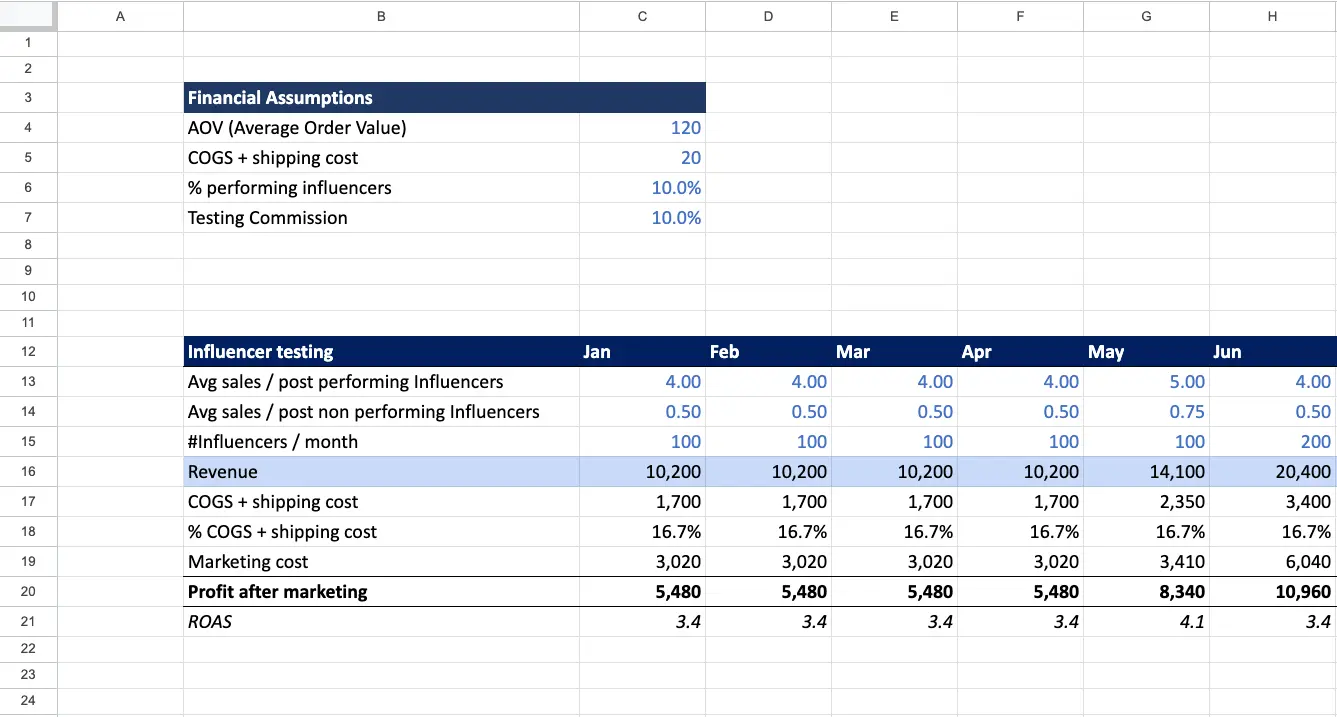
To better understand the steps explained below access our basic financial model template here and navigate to the worksheet: Campaign Input.
Here’s how to build your Phase 1 forecast:
1. Split creators into performance tiers
Use either:
- Three-tier model: High Performers (HP), Medium Performers (MP), Low Performers (LP)
- Simplified model: Performing vs. Non-Performing creators
Example assumption:
- 10% Performing
- 90% Non-Performing
This goes into your model as an input (e.g., cell C6).
2. Determine average sales/post for each tier
For each group, calculate:
- Average tracked revenue per post
- Adjusted revenue per post (to account for the 70% attribution rule)
This gives you your “expected revenue/post” benchmark for each tier.
3. Decide how many creators you’ll test each month
Example:
- Testing 100 creators/month
- With 10% performers → ~10 performing creators/month
This number directly impacts how many HPs you’ll accumulate for Phase 2.
4. Forecast Phase 1 Revenue
Use the formula:
Revenue per tier = Sales per post X Creators tested X AOV
Then sum performing + non-performing revenue to get total Phase 1 monthly revenue.
This number is usually steady but relatively small — which is normal. Phase 1 is about data collection, not maximizing revenue.
Forecasting Revenue for Phase 2 (Seasonality Campaigns)
Phase 2 is where the real revenue happens. Once you’ve identified your High Performers, seasonality campaigns allow you to activate them during high-intent buying windows (e.g., Valentine’s Day, Mother’s Day, Summer, BFCM).
Here’s how to forecast Phase 2:
1. Identify months with seasonality campaigns
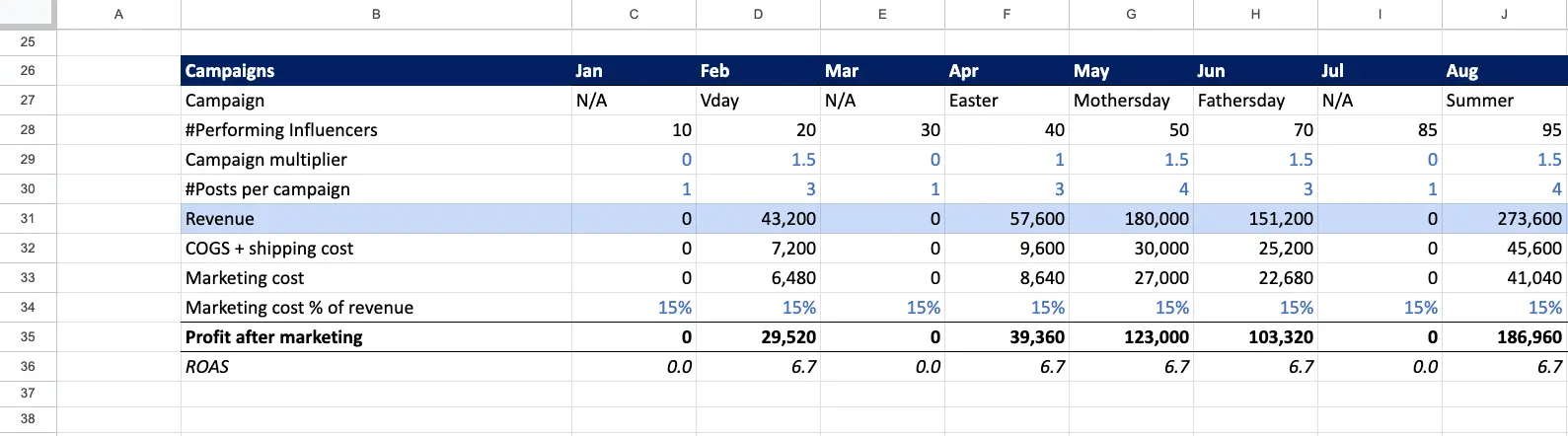
These go into your model (row 27), e.g.:
- February – Valentine’s Day
- May – Mother’s Day
- November – Black Friday
2. Forecast how many performing creators you’ll invite
This number grows every month because:
- The more creators you test in Phase 1 →
- The more HPs you identify →
- The larger your Phase 2 revenue engine becomes
This is why Phase 1 scale is everything.
3. Apply a campaign multiplier
Different months convert differently.
Examples:
- Sunglasses → higher multiplier in summer
- Flowers → higher multiplier for Valentine's Day
- Apparel → higher multiplier during BFCM
This multiplier adjusts your forecast for seasonal demand.
4. Estimate number of posts per creator
Seasonality packages usually bundle multiple posts (e.g., 3–5).
More posts = higher revenue.
5. Calculate Phase 2 Revenue
We will then enter the number of posts we expect per creator (row 30). To forecast revenue we use the formula below:
Revenue (row 31) = #influencers (row 28) X Campaign multiplier (Row 29) X #posts per campaign (row 30) X AOV (C4).
This is the revenue that typically drives 70–90% of total influencer revenue for the year.
Influencer Revenue vs. Other Marketing Channels
One of the biggest operational challenges brands face when scaling influencer marketing is understanding how differently this channel behaves compared to paid ads, Amazon, or retail. Influencer revenue is inherently inconsistent, and that variability affects everything from inventory planning to cash flow.
Here’s why influencer revenue behaves differently - and why understanding this pattern is essential for accurate forecasting.
Why Influencer Revenue Is Less Predictable
Unlike Meta or TikTok ads - where spend and revenue scale in a relatively linear way - influencer performance spikes sharply during activation windows, especially during Phase 2 seasonality campaigns.
There are two main reasons:
1. Batch Posting Drives Sudden Revenue Peaks
During seasonality campaigns, dozens (or hundreds) of creators may post on the same day or within a tight window.
This creates:
- Massive short-term traffic surges
- High conversion moments
- Short bursts of revenue that outperform your “normal” days
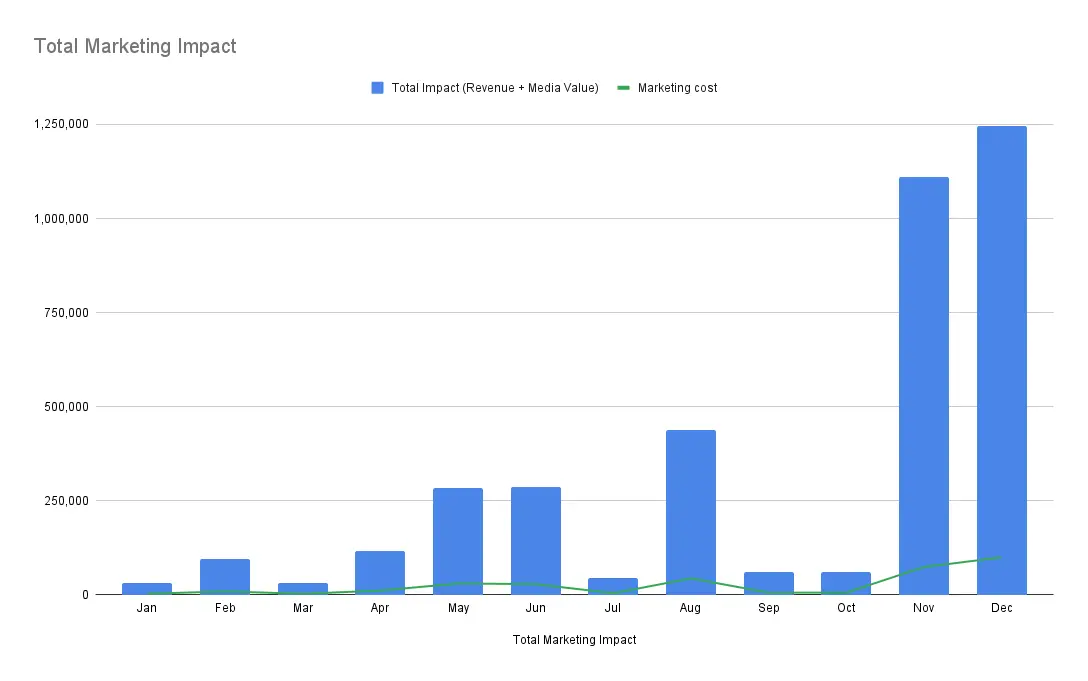
These spikes can represent 30–60% of a brand’s monthly influencer revenue within just a few days.
2. Phase 1 and Phase 2 Create Two Very Different Revenue Profiles
Phase 1
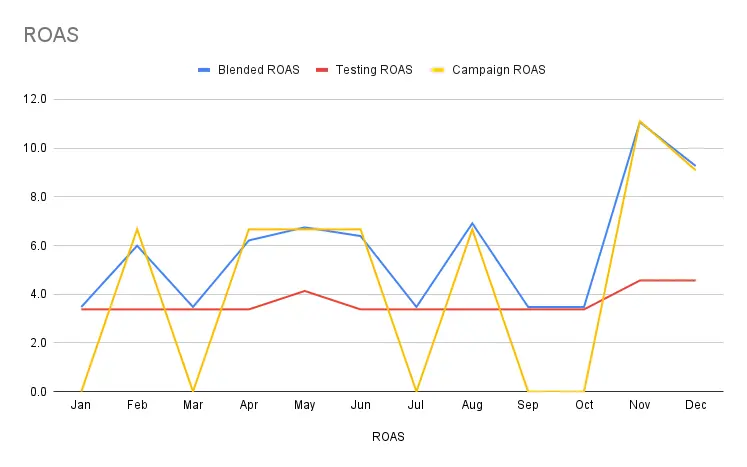
- Consistent but modest revenue
- Driven by testing new creators
- Focused on data, not ROI
- Produces the High Performers that matter later
Phase 2
- High-intent, high-ROI campaigns
- Revenue concentrated around big commercial events
- Dependent on how many performing creators you’ve accumulated
This creates a revenue pattern that looks more like waves than a straight line.
Why This Matters for Brands and Operators
This irregular revenue pattern requires strong operational discipline, because it affects:
- Your inventory forecasting
- Your shipping team’s load
- Your cash flow cycles
- Your budget allocation across marketing channels
- Your ability to stay in stock during peak demand
A brand that doesn’t prepare for these spikes can easily:
- Stock out
- Over-order and tie up cash
- Miss key selling moments
- Delay creator shipments (→ lower posting rates → lower ROI)
All of these issues directly reduce the effectiveness of your influencer engine.
Pro Tip: Concentrate Posts on High-Buying Days
To maximize ROI, brands running Phase 2 campaigns should intentionally cluster creator posts around peak demand moments.
Examples:
- Black Friday
- Cyber Monday
- Valentine’s Day
- Mother’s Day
- Major restock announcements
- Product launches
Because sales/post are significantly higher these days, concentrating activity multiplies your ROI.
What This Means for Your Forecasting
Influencer marketing should never be modeled as evenly distributed revenue.
Instead:
- Phase 1 = steady baseline
- Phase 2 = revenue spikes
- Total forecast = Phase 1 + Phase 2 distribution curve
Brands that model influencer revenue like paid ads almost always:
- Under-forecast seasonality demand
- Misjudge cash flow needs
- Fail to scale efficiently
Planning for these predictable spikes is key to unlocking dependable, compounding revenue year after year.
-
Inventory Forecasting: How to Plan Stock for an Always-On Influencer Program
Inventory planning is one of the most overlooked components of a performance-driven influencer program - yet it’s also one of the biggest sources of operational risk. Because influencer revenue is irregular and highly event-driven, brands must forecast inventory differently than they would for paid ads or retail sales.
Below is a clear, actionable framework to help D2C brands forecast inventory needs for both customer demand and creator shipments, so you never stall your influencer engine.
Step 1: Forecast Customer Demand Based on Influencer Revenue
Once you’ve modeled expected revenue for Phase 1 and Phase 2, you can translate that revenue forecast into inventory needs.
To do this:
- Export your sales by SKU from Shopify, Magento, WooCommerce, etc.
- Analyze SKU contribution (what percentage of overall revenue each SKU represents).
- Adjust these percentages for upcoming changes:
- Discontinued SKUs
- New product launches
- Anticipated hero products
- Seasonal shifts (e.g., sunscreen in summer, florals for Valentine’s Day)
This gives you a SKU-level revenue projection. Now convert revenue → units needed by dividing projected revenue by your AOV per SKU or expected price per SKU.
Step 2: Add Inventory Needed for Influencer Shipments
Many brands forget this part - and it’s where inventory shortages happen. To maintain a healthy performance-driven influencer program, you must also forecast the inventory you’ll send to creators, especially during high-volume seeding and seasonality campaigns.
This comes from:
- Phase 1 creator volume
(row 15 in your financial model: number of creators tested per month) - Average # of gifted products per creator
- Phase 2 seasonality campaigns
(e.g., Mother’s Day, Valentine’s Day, BFCM)
Step 3: Build a 12-Month Inventory Forecast
Once you have both:
- Customer demand units
- Influencer shipment units
You create a consolidated inventory forecast.
This forecast should identify:
- Monthly product demand
- Peak months (usually tied to seasonality campaigns)
- Minimum stock thresholds
- Safety stock buffers
- Lead time constraints
- Reorder triggers
By planning early, you avoid:
- Delays in creator shipments
- Missed posting dates
- Lower posting rates
- Stockouts during your biggest revenue moments
All of which erode ROI.
Step 4: Account for Lead Times & Supplier Constraints
Influencer-driven demand spikes can create operational pressure.
To stay ahead:
- Map lead times for each supplier
- Build longer buffers for overseas production
- Plan seasonality campaign inventory months in advance
- Align your influencer calendar with your supply chain calendar
Brands with long lead times (e.g., 60–120 days) must begin planning BFCM influencer inventory as early as August or September.
How Your Influencer Program Impacts Cash Flow
Influencer marketing generates high-margin sales, but it also introduces a timing gap that affects cash flow. Unlike paid ads, where spend occurs after results, influencer programs require upfront investment - mainly in inventory and shipping. Products need to be manufactured, stocked, and shipped to creators well before campaign revenue comes in, making advance forecasting crucial.
The challenge grows with longer production timelines. Brands with 30–120-day lead times must purchase inventory months before seasonal campaigns, locking up cash long before the first post goes live. Revenue also arrives in spikes rather than steady cycles, especially during phase-2 seasonality campaigns. This volatility can strain liquidity if you’re not planning ahead.
Shipping costs, packaging, and operational overhead scale with your creator volume, while fixed payments to high-performers can create additional short-term pressure. To stay cash-flow healthy, brands should forecast inventory 3–6 months in advance, reserve campaign budgets early, track creator performance to predict demand, and align marketing calendars with operations.
Final Thoughts
A high-performing influencer program isn’t just about great creators, high-converting content, or strong seasonality campaigns - it’s about the operational backbone that keeps all of it running. Forecasting revenue, planning inventory, and managing cash flow are the levers that separate brands who “dabble” in influencer marketing from those who scale it into a predictable, profitable engine.
When you understand how many creators to test, how many will perform, how much inventory you need, and when cash will flow in or out, you remove guesswork from your growth plan. You can prepare stock ahead of demand spikes, allocate budgets with confidence, and avoid the operational friction that slows teams down.
With the right forecasting model, you transform influencer marketing from something reactive into a repeatable system - one that compounds returns month after month.
If you're ready to streamline planning, automate workflows, and manage your entire influencer operation from one platform, book a demo with Influencer Hero. We’ll walk you through how top D2C brands use IH to unify creator discovery, outreach, reporting, budgeting, and seasonality forecasting into a single performance engine.
Key Takeaways
- Forecasting is essential — use sales-per-post and creator tiers to predict revenue across testing and seasonality campaigns.
- Seasonality drives most results — schedule posts around high-intent retail moments for maximum ROI.
- Plan for revenue spikes — influencer sales are uneven, so align posts and inventory ahead of key dates.
- Inventory must cover both customers and creators — failing to plan seeding inventory is a common ROI killer.
- Influencer programs affect cash flow early — production, stock, and shipping costs occur before revenue lands.
- Working-capital financing can help, but use selectively due to high repayment costs during revenue spikes.
Continue learning: BFCM Influencer Strategy: How to Maximize ROI With Seasonality Campaigns
Summary
This is some text inside of a div block.
This is some text inside of a div block.
Pricing/Month
Shopify Reviews
This is some text inside of a div block.
This is some text inside of a div block.
This is some text inside of a div block.
This is some text inside of a div block.
This is some text inside of a div block.
This is some text inside of a div block.
This is some text inside of a div block.
This is some text inside of a div block.
This is some text inside of a div block.
This is some text inside of a div block.
This is some text inside of a div block.
This is some text inside of a div block.
This is some text inside of a div block.
This is some text inside of a div block.
This is some text inside of a div block.
This is some text inside of a div block.
This is some text inside of a div block.
This is some text inside of a div block.
This is some text inside of a div block.
This is some text inside of a div block.
This is some text inside of a div block.
Read More

FAQs
How do I forecast revenue from influencer marketing?

Start with your sales-per-post benchmark, split creators into performance tiers, and estimate how many creators you’ll test each month. Then apply seasonality multipliers for big retail moments (e.g., Valentine’s Day, BFCM) to project total revenue from both Phase 1 testing and Phase 2 seasonality campaigns.
Why is influencer-driven revenue inconsistent?
Unlike paid ads, influencer sales happen in spikes, especially during seasonality campaigns when many creators post at once. This creates uneven monthly revenue, making forecasting and cash-flow planning essential.
How should I plan inventory for influencer marketing?
Plan for two inventory streams: customer demand and creator shipments. Export last year’s sales per SKU, adjust for this year’s product mix, then add all expected influencer seeding units so you don’t run out of stock mid-campaign.
How does influencer marketing impact cash flow?
You must pre-purchase inventory and cover shipping costs weeks or months before revenue comes in. Longer supplier lead times make this even more challenging, so forecasting and early planning are key to avoiding liquidity gaps.
When should a brand use working-capital financing?
Consider financing if you have strong demand forecasts but lack the upfront cash for inventory. Options like Shopify Capital or Wayflyer can help, but they’re expensive - best used selectively for high-confidence campaigns or during periods of rapid growth.



Most Popular Blogs


Drive ROI With Influencer Marketing
Join 1,200+ brands and 150+ agencies scaling creator programs with Influencer Hero.