BFCM Influencer Strategy: How to Maximize ROI With Seasonality Campaigns

December 10, 2025
|
Published

June 17, 2026
|
Updated

|
Reading

Influencer Performance Marketing Course | VOUCHER: IMC100

Peter Nettesheim
| Author

Drive ROI With Influencers

Global Influencer Database
ALL-IN-ONE platform
CRM, Affiliate, UGC & More
BFCM Influencer Strategy: How to Maximize ROI With Seasonality Campaigns
Black Friday and Cyber Monday (BFCM) are the biggest revenue opportunities of the year - and for performance-driven influencer marketing programs, they are the ultimate moment to scale. Conversion intent skyrockets, creators’ audiences are primed to buy, and sales per post jump significantly compared to any other month.
While paid ads become more expensive due to rising CPMs, influencer rates typically remain stable, giving brands a rare opportunity to drive outsized ROI. In other words: if you run influencer marketing, BFCM is where your program can outperform every other acquisition channel.
In this article, you’ll learn how to plan, structure and execute a Black Friday & Cyber Monday influencer campaign using the two-phase performance framework. You’ll learn how to prepare months in advance, how to forecast results, how to build irresistible creator invitations, and how to manage posts so they land when it matters most.
TLDR - Watch the Video
$700K+ (8.4X ROAS) Influencer BFCM Case Study | Session 9.1
$100K+ (5.7X ROAS) Youtube Influencer Campaign Case Study | Session 9.2
Take the full Influencer Performance Marketing Course and get certified!
Why is BFCM So Important for Brands
Black Friday & Cyber Monday aren’t just another sales moment - they are the highest-intent shopping window of the entire year. For influencer marketing, this creates a rare performance advantage: sales per post spike, while creator rates typically stay the same as any other month.
While CPMs for Meta and TikTok ads soar due to competition, influencer content becomes dramatically more cost-efficient. Creators’ audiences convert faster, shop more, and respond more strongly to seasonal offers, meaning brands can unlock their highest ROAS of the year simply by coordinating posts during this period.
At the core of your BFCM revenue potential is a simple formula:
Revenue = #Creators × (Sales per Post) × #Posts × AOV
During BFCM, one variable does the heavy lifting:
Sales per post increase significantly, with conversion rates often rising 300–400% compared to normal weeks.
That means:
- Every creator becomes more valuable
- Every post converts more shoppers
- Every dollar invested goes further
If you've built your Phase 1 testing pipeline correctly, BFCM is when all your work compounds. This is the moment to activate your top-performing creators, bundle multiple posts, and channel as much influencer activity as possible into the Black Friday and Cyber Monday window.
The Two-Tier Influencer Performance Framework (Quick Recap)
Before diving into the Black Friday & Cyber Monday strategy, here’s a fast refresher on the performance framework that makes BFCM campaigns predictable, scalable, and profitable.
To check it more in detail, explore our article: What Performance to Expect from Influencer Marketing
Phase 1: Test Creators to Identify Top Performers
This phase is all about discovery and data. You partner with a large pool of new creators to measure true performance using:
- Conversions per post
- AOV
- Reliability
- Content quality
Roughly 5–10% of creators become “High Performers” (HPs). These are the ones who consistently drive sales — your revenue drivers during BFCM.
Phase 2 - Activate Your Performing Creators in Key Seasonal Moments
Once you know who your HPs and MPs are, this is where the ROI happens. In Phase 2, you:
- Invite top creators into structured seasonality campaigns
- Bundle multiple posts for stronger frequency
- Allocate budgets based on their proven conversions
- Use urgency and time-bound offers to maximize ROAS
BFCM sits at the very center of Phase 2 - it’s the most profitable moment to activate your proven creators, increase posting frequency, and scale revenue.
Why This Matters for BFCM
The brands that win BFCM aren’t the ones who scramble in November — they’re the ones who spend months testing creators, learning who performs, and building relationships ahead of time.
This ensures you enter Q4 with:
- A reliable pool of performing creators
- Accurate forecasting data
- Strong relationships that increase opt-in rates
- A structure to scale quickly
This framework is what enables 5X–10X ROAS (or higher) during BFCM.
How to Prepare for BFCM (Start Months in Advance)
The brands that dominate Black Friday & Cyber Monday don’t start planning in November - they start in August or September. BFCM success is 80% preparation and 20% execution. The earlier you begin testing creators, forecasting sales, and strengthening relationships, the larger your revenue potential becomes once the sale window opens.
Below are the most important pillars of BFCM prep.
1. Inventory & Cash Flow: Avoid Stockouts at All Costs
Running out of stock during BFCM is one of the most expensive mistakes a brand can make - traffic is expensive, creator posts are time-bound, and you may not be able to restock fast enough.
Before entering Q4:
- Review last year’s SKU performance to understand which products spike during sales.
- Map out production lead times (30, 60, 90+ days) and order inventory early.
- Budget for influencer seeding inventory (phase 1) and customer demand (phase 2).
- Stress-test your cash flow, since influencer campaigns require inventory upfront.
A well-stocked BFCM is the foundation of a high-ROI seasonality campaign.
2. Relationship-Building Initiatives (4–6 Weeks Before Inviting Creators)
By Q4, you’ll likely have a list of high-performing creators identified through Phase 1. The goal now is to maximize the number of these creators who agree to join your BFCM campaign.
To increase opt-in rates, strengthen relationships ahead of time:
- Send thoughtful appreciation gifts (flowers, a book, a holiday card, etc.).
- Ensure these gifts feel like gratitude — not a transaction.
- Time it strategically: 4–6 weeks before your BFCM invitation email.
- Add a handwritten note for a more personal touch.
- Keep the gesture unrelated to the campaign — creators can tell when a gift is transactional.
This step alone can dramatically increase participation from your best creators.
3. Budget Allocation (Based on Revenue Forecasting)
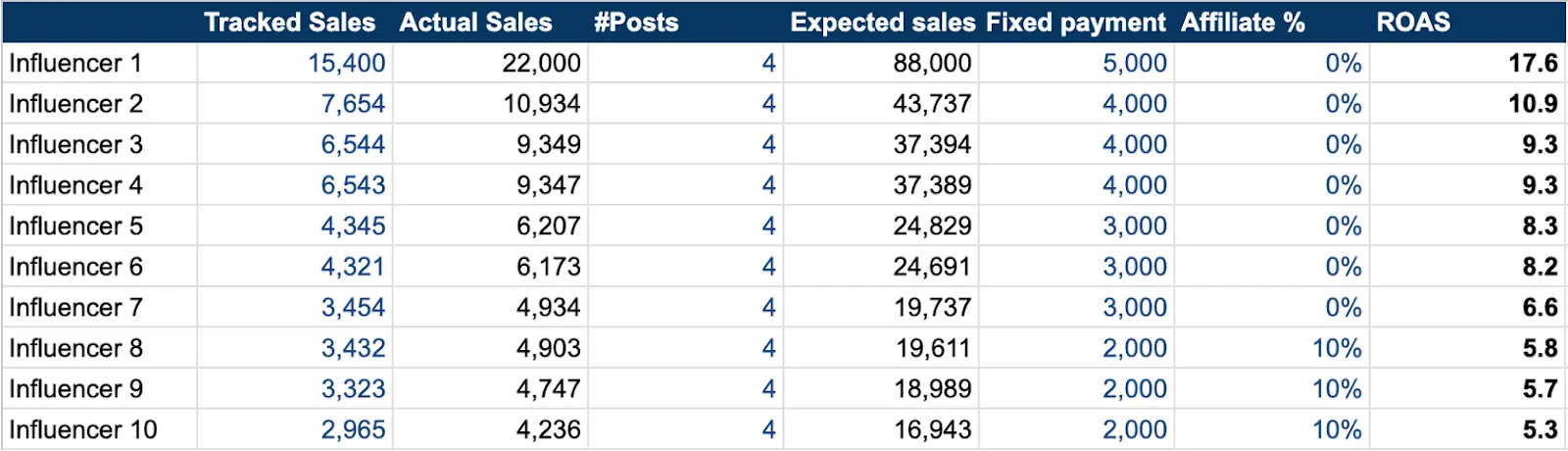
Before you invite creators to participate in BFCM, you must know:
- How much revenue each creator typically drives
- How many posts you want per creator
- What your ROI target is
- How to split fixed vs. affiliate compensation
Use the same forecasting method outlined in this article
- Normalize tracked sales to account for unattributed conversions.
- Calculate average sales per post.
- Forecast expected revenue for a multi-post package.
- Allocate budget tier-by-tier (HP, MP, LP).
For BFCM specifically:
- HPs → fixed fee only
- MPs → fixed + affiliate mix
- LPs → affiliate-only (or skip if time is limited)
A scientific budget allocation ensures your offer is competitive, fair, and ROI-aligned.
BFCM Invitation Email: How to Get Creators Excited to Join Your Campaign
Once your forecasting, inventory planning, and budgets are locked in, it’s time to invite creators to participate in your BFCM campaign. The quality of your invitation email directly impacts your opt-in rate - especially with your High Performers (HPs), who drive the majority of your revenue.
Your BFCM invitation should feel exclusive, valuable, and time-sensitive. Below is the structure that consistently increases creator participation. Access all BFCM campaign templates here.
INVITATION EMAIL: FIXED FEE + COMMISSION
SUBJECT: {{ firstname|default(influencer_handle) }} – ENTER YOUR BRAND NAME BFCM Campaign Invitation!
Hi {{ firstname|default(influencer_handle) }},
{{personalized_sentence}}
We are thrilled to start preparing for this year’s Black Friday and Cyber Monday campaigns, and we would love for you to join us once again!
We’ll be running our biggest sale of the year, which we’re only sharing with a few selected creators, and we’re excited to offer you the following:
* $X Fixed payment
* XY% Affiliate commission on all referrals (tracked through your dashboard)
* XZ% exclusive discount code (not publicly available)
* GIFTED PRODUCT NAME (+ HYPERLINK AND RETAIL VALUE)
As our name of products are the perfect gifts, we typically see a significant increase in demand during this period, which will be beneficial for the affiliate commission you earn!
In exchange, we would like to request for AMOUNT AND TYPE OF DELIVERABLES between November and December.
We’re super excited to work with you again! Can I count you in? :)
Best,
ENTER YOUR NAME
What Makes a High-Converting BFCM Invitation?
1. Lead with Exclusivity
Position the campaign as selective: “We’re inviting a small group of creators who performed exceptionally well this year…”
Exclusivity increases perceived value and reply rates.
2. Highlight What’s In It for Them
Your offer should be clear and creator-centric:
- Fixed payment
- Affiliate bonus
- A strong audience discount
- Early access to products
- A chance to work on your biggest campaign of the year
Creators join when the benefits are obvious.
3. Use FOMO & Urgency (Lightly)
BFCM is naturally time-bound. Leverage that: “Spots are limited - posting window opens November 22.”
Even soft urgency can lift opt-ins by 20–30%.
4. Personalize the Message
Reference their past performance: “Your summer post drove incredible results - we’d love to have you back for BFCM.”
Recognition builds loyalty and increases conversions.
5. Give Their Audience a Strong Offer
Creators convert better when their followers win. Include a standout discount (e.g., 30–40% off) and unique code.
6. End with a Single Clear CTA
Your invitation should end with a simple question: “Can we reserve your spot?”
Avoid multiple links or asks - one CTA = more replies.
7. Always Follow Up
Your job isn’t done after one email.
A gentle reminder 2–3 days later can easily double your acceptance rate.
Campaign Management: What to Do Once Invitations Are Sent
Sending your BFCM invitations is only the beginning. The real impact comes from how well you manage the process between the invitation and the moment creators post. This phase mirrors the negotiation and follow-up steps from Phase 1 - but with a major advantage: you’re now working with creators who already know your product and have performed for you before.
This familiarity makes communication smoother, posting rates higher, and negotiations more predictable. Your job is to maintain momentum, remove friction, and keep creators excited to participate.
1. Expect the Same Three Outcomes - and Manage Each One Strategically
Just like in Phase 1, once your invitations go out, creators will fall into three groups:
A. “Yes, I’m In!” (Best Case Scenario)
These creators are easy wins - but don’t take them for granted.
- Confirm their participation quickly
- Send product if needed (ideally timed to arrive close to the posting window)
- Re-confirm their discount code + link
- Add them to your BFCM campaign tracker or CRM immediately
Early organization prevents bottlenecks later.
B. “What’s the Budget?”
Even creators who performed well may ask for a fee. Before adjusting your offer:
- Reference their historical results
- Offer a mix of fixed payment + affiliate bonus
- Increase the offer in small steps, not all at once
- Reinforce that this is your biggest campaign of the year
Many creators simply want to know they’re not leaving money on the table - a clear structure and warm tone often gets them on board.
C. No Reply
Silence is not rejection - especially during Q4, when inboxes explode.
Use a structured follow-up sequence:
- Follow-up #1: 2–3 days after the original invite
- Follow-up #2: “We’d still love to reserve your spot”
- Follow-up #3: A soft nudge with urgency: “Posting window opens soon”
With BFCM, the majority of your opt-ins will come from these automated reminders.
Follow-ups can 2–3× your participation rate.
2. Use Automation to Keep Everything Moving
When managing dozens - or hundreds - of creators, the biggest risk is operational leakage:
missed follow-ups, late shipments, forgotten reminders, misplaced links.
Tools like Influencer Hero streamline:
- Bulk sending of invitations and follow-ups
- CRM tracking for every creator
- Assigning tags (HP/MP/LP), status updates, and deadlines
- Exporting lists for logistics and product fulfillment
- Automated reminders and email flows
Your BFCM results depend heavily on how well you manage these micro-touchpoints.
3. Prepare Your Email Flows in Advance
Your BFCM campaign should run like a pre-programmed machine. Prepare these sequences ahead of time:
- Invitation sequence
- Negotiation sequence
- Logistics / product shipped email
- Launch reminder (day before)
- Mid-campaign nudges
- Final-day urgency reminder
When these messages are automated, your posting rate and revenue both increase.
4. Keep Creators Warm and Informed
Creators should feel like they’re part of your biggest campaign of the year - because they are.
Send:
- Behind-the-scenes updates
- Aesthetic campaign assets
- Photos or videos they can repost
- Clear talking points about the promotion
- Any important deadlines
Warm communication increases commitment and post quality.
The Result: What to Expect from a Well-Executed BFCM Campaign
When your BFCM influencer campaign is structured correctly, your sales pattern becomes highly predictable:
Early Spike
You’ll see an immediate surge in revenue on launch day as multiple creators post at once and audiences react quickly to limited-time discounts.
Mid-Campaign Dip
After Story posts expire, sales naturally slow. This phase is normal — and where mid-campaign reminders help keep traffic from dropping too far.
Final Push (Highest Conversions)
The last 24-48 hours typically deliver the biggest revenue spike as creators post “last chance” reminders and urgency drives conversions.
This three-phase curve is consistent across top-performing brands and is the closest thing to a guaranteed pattern in influencer marketing - especially during BFCM.
See the full $700K+ (8.4× ROAS) BFCM Influencer Campaign Case Study.
Final Thoughts: Why BFCM Is the Ultimate Influencer ROI Moment
Black Friday & Cyber Monday are where your influencer program delivers its highest return - not because of luck, but because intent, urgency, and proven creators all converge at once. When you prepare early, leverage your top performers, structure your communication, and manage every touchpoint with precision, BFCM becomes a predictable revenue engine rather than a risky experiment.
This is the moment when the entire performance system pays off.
If you’ve tested creators, built relationships, planned inventory, and prepared your flows, your campaign will scale naturally - often outperforming paid social by a wide margin.
If you want to run BFCM with more structure, automation, and predictable ROI, book a demo with Influencer Hero to see how top D2C brands run their seasonal campaigns at scale.
Key Takeaways
- Start preparing 6–8 weeks in advance to maximize performance and avoid operational bottlenecks.
- The more creators you test before Q4, the more High Performers you can activate for BFCM.
- Use exclusivity, urgency, and personalization to boost creator opt-in rates.
- Follow-ups, reminders, and closing-day nudges significantly increase conversions.
- Expect a three-phase curve: launch spike → mid-campaign dip → final-day surge.
- Track everything through a CRM so you can re-activate performing creators year after year.
Continue learning: The Future of Influencer Marketing
Summary
This is some text inside of a div block.
This is some text inside of a div block.
Pricing/Month
Shopify Reviews
This is some text inside of a div block.
This is some text inside of a div block.
This is some text inside of a div block.
This is some text inside of a div block.
This is some text inside of a div block.
This is some text inside of a div block.
This is some text inside of a div block.
This is some text inside of a div block.
This is some text inside of a div block.
This is some text inside of a div block.
This is some text inside of a div block.
This is some text inside of a div block.
This is some text inside of a div block.
This is some text inside of a div block.
This is some text inside of a div block.
This is some text inside of a div block.
This is some text inside of a div block.
This is some text inside of a div block.
This is some text inside of a div block.
This is some text inside of a div block.
This is some text inside of a div block.
Read More

FAQs
1. When should brands start preparing for a BFCM influencer campaign?

Ideally 6–8 weeks in advance. This gives you enough time to test creators, plan inventory, allocate budgets, build relationships, and prepare all email flows before Q4 traffic spikes.
Why are influencer campaigns so effective during Black Friday & Cyber Monday?
Conversion intent is at its highest, meaning sales per post increase dramatically—often 300–400%. Creator rates typically stay the same, making influencers significantly more cost-efficient than paid ads during BFCM.
How many influencers should I activate for BFCM?
As many performing creators as possible. The more you test in Phase 1 throughout the year, the larger your pool of High Performers (HPs) you’ll have ready to activate for BFCM. Expect 5–10% of tested creators to fall into this category.
Should I pay creators more during BFCM?
Not necessarily. In many cases, you pay the same rate you do year-round—yet performance is substantially higher. Offer fixed payments for HPs, mixed compensation for MPs, and affiliate-only for LPs.
What does a typical BFCM sales curve look like?
Most campaigns follow a predictable pattern:
- Day 1 spike when creators first post
- Mid-campaign dip as Stories expire
- Final surge during the last 24–48 hours due to urgency and “offer ends today” content
This final push often contributes 20–40% of total revenue.

Most Popular Blogs


Drive ROI With Influencer Marketing
Join 1,200+ brands and 150+ agencies scaling creator programs with Influencer Hero.