How to Implement BOF High ROI Influencer Seasonality Campaigns

December 10, 2025
|
Published

July 30, 2026
|
Updated

|
Reading

Influencer Performance Marketing Course | VOUCHER: IMC100

Peter Nettesheim
| Author

Drive ROI With Influencers

Global Influencer Database
ALL-IN-ONE platform
CRM, Affiliate, UGC & More
How to Implement BOF High ROI Influencer Seasonality Campaigns
Seasonality campaigns are time-bound influencer activations tied to high-intent retail events such as Black Friday / Cyber Monday, Valentine’s Day, or Mother’s Day. These moments concentrate buyer intent, and when paired with your top-performing creators from Phase 1, they deliver the highest ROI of any influencer initiative.
The logic is simple: awareness peaks, discounts convert, and consumers act quickly. When your high performers post during these windows, your influencer channel shifts from steady growth to hyper-performance.
So, how can you make the most of these seasons? In this article we’ll explain how to make effective seasonality campaigns.
TLDR - Watch the Video
Take the full Influencer Performance Marketing Course and get certified!
Budget Allocation and ROAS Forecasting
Before launching a campaign, you need to forecast sales and assign budgets scientifically rather than by gut feel. Here’s a quick example of a campaign in action before we explain step-by-step how to implement this for your brand.
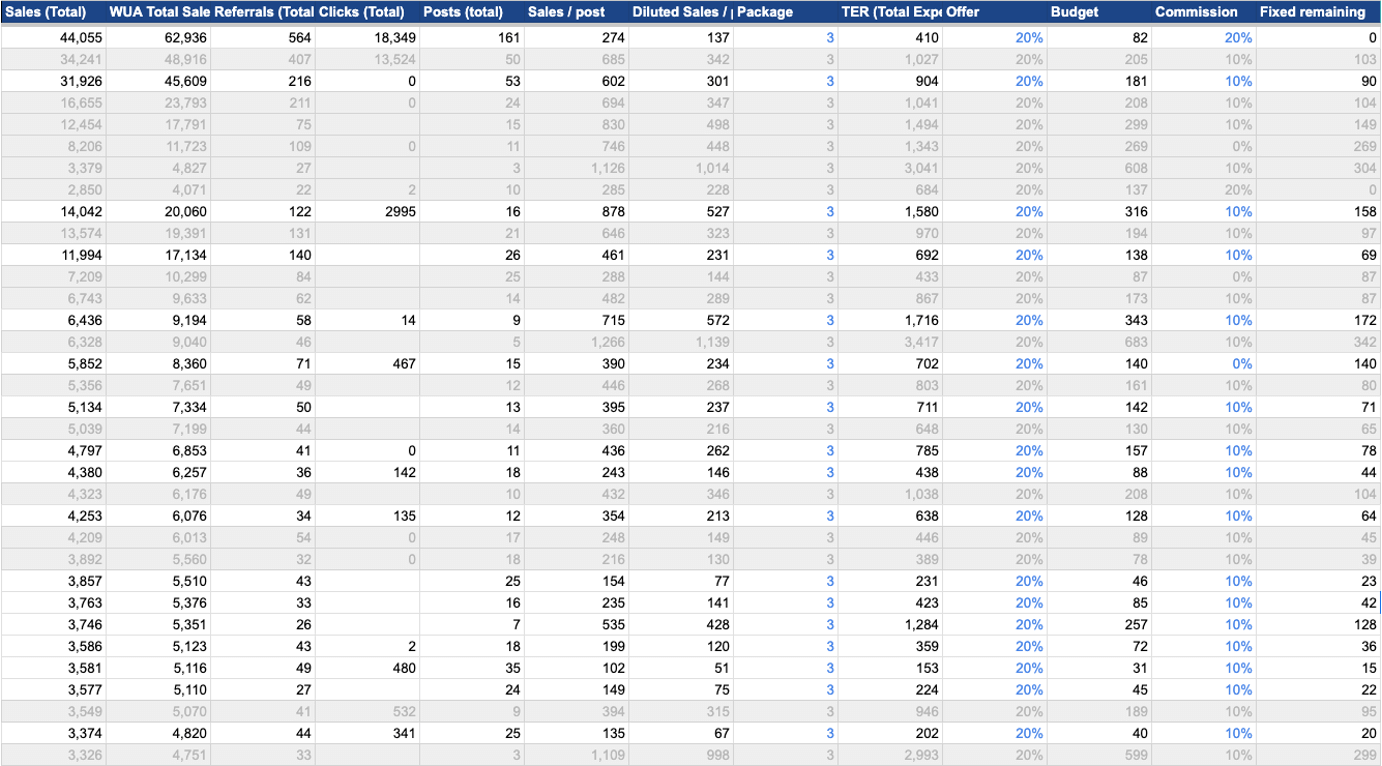
Let’s look at a simple example to understand how to allocate your budget effectively. Since our goal is to maximize ROI, we first need to forecast expected sales and then allocate the budget accordingly to reach the desired outcome.
You can access the example below in this Google Sheet to explore and track the formulas in action.
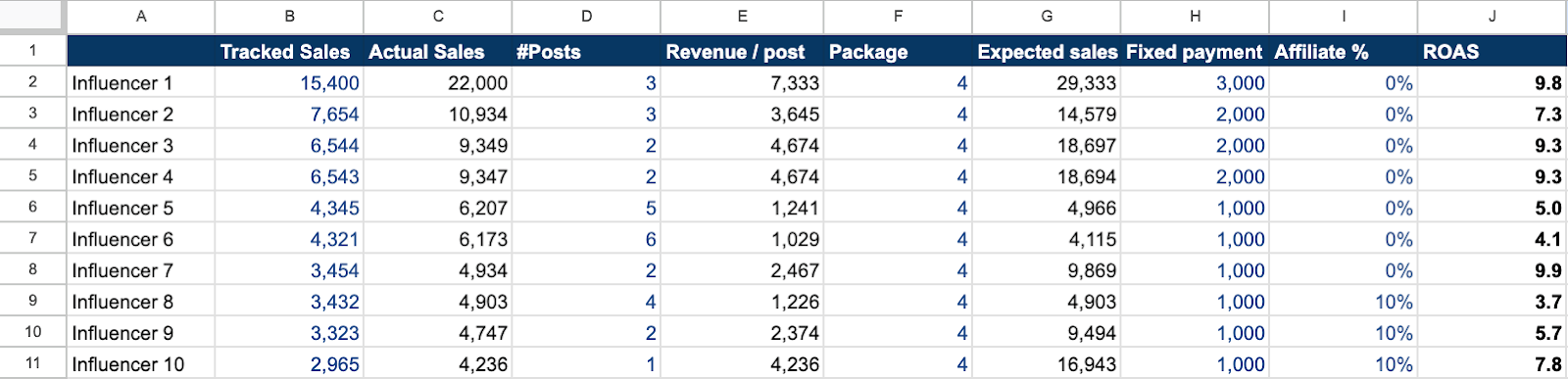
To forecast expected sales (column G), start by normalizing your tracked sales (column B) for unattributed conversions and the number of posts (column D) each creator made. This allows you to calculate the sales per post, a key metric for predicting campaign performance.
Column B (Tracked Sales) represents the sales of an influencer generated during phase 1, tracked using affiliate links and custom discount codes.
Step 1. Normalize Sales for Unattributed Conversions
The first step is to adjust your tracked sales for unattributed conversions.
Since affiliate links and discount codes typically capture around 70% of actual sales, divide your tracked sales by 0.7 to estimate total revenue generated. This gives you column C (Actual Sales) - your normalized sales figure.
If an influencer generated $7,000 in tracked sales, dividing by 0.7 gives you an actual revenue of $10,000.
Step 2. Calculate Sales per Post
Next, divide the normalized sales (column C) by the number of posts (column D). This gives you the sales per post (column E) — also referred to as revenue per post. This metric is one of the most important KPIs for forecasting future sales performance.
Step 3. Forecast Expected Sales
During seasonal campaigns, it’s often more effective to bundle multiple posts into one package. This approach offers two main advantages:
- You can negotiate a better rate per post.
- It creates stronger commitment, often leading to higher performance.
In the previous example, we assume a package of 4 posts. Multiply your sales per post (column E) by the number of posts (column F) to calculate expected sales (column G) for the campaign.
Step 4. Allocate Budget Strategically
Now that you know your expected sales, you can allocate your budget to achieve your desired ROI outcome.
Here’s a simple framework:
- High-Performing Creators (HPs): Offer a fixed payment only. These creators are low-risk, and fixed payments often improve commitment and satisfaction.
- Medium-Performing Creators (MPs): Combine fixed + affiliate payments. This balances risk and rewards, ensuring creators are motivated while protecting your ROI.
- Low-Performing Creators (LPs): Stick to affiliate-only deals, or skip them altogether if time is limited. These creators often represent 80% of your workload but less than 20% of your revenue — the flipped Pareto principle in action.
Automate outreach and communication using tools like Influencer Hero’s bulk actions, automated email flows, and newsletter-style updates to manage this group efficiently.
For your HPs, the small group driving most of your revenue, invest the extra time to personalize communication and build long-term relationships. This is where your biggest ROI gains will come from.
Campaign Invitation: How to Get Creators Excited to Join Your Seasonal Campaign
Once your seasonal campaign packages are ready, the next step is inviting your creators to participate. This stage is all about communication: how you position your offer determines your opt-in rate, creator enthusiasm, and ultimately, campaign ROI.
Here’s an example of a Mother’s day seasonal campaign initiation email:
Hi {{ firstname|default(influencer_handle) }},
I hope you are doing great!
Mother’s Day is just around the corner and we would love to celebrate this with you!
Mother’s Day is one of our most important campaigns of the year, and we would be thrilled to have you join.
As one of our invited partners, you will have access to an exclusive XY% discount code for your followers, along with a XY% affiliate commission on all referred sales!
In exchange, we would like to send you one of our best-selling ENTER PRODUCT to try out.
A lot of people will be looking for gifts, which could greatly benefit your affiliate commission. Can we send you the ENTER PRODUCT? :)
Best,
ENTER YOUR NAME
A few tips to keep in mind:
1. Lead with Exclusivity: Open by making creators feel handpicked: “We’re inviting a select group of creators to join our Mother’s Day campaign…” Framing the invite as limited or exclusive instantly boosts response rates.
2. Highlight the Value: Be clear about what’s in it for them: payment, free product, exposure, or affiliate bonus. A transparent offer builds trust and increases opt-ins.
3. Use FOMO and Urgency: Add light pressure with phrases like “limited spots” or “posting window opens next week.” Even subtle urgency can lift conversions by 20–30%.
4. Personalize the Message: Mention their previous collaboration or reference a past post.
Personal recognition shows genuine partnership and increases loyalty.
5. Add an Audience Incentive: Include a strong offer their followers will love. E.g., “30% off all items this weekend with code SARAH30.” If the audience wins, the creator wins too.
6. End with One Clear CTA: Keep it simple: “Can we reserve your spot?” or “Would you like to join this round?” Avoid multiple links or asks; clarity drives action.
7. Always Follow Up: Don’t stop at one email. A polite reminder a few days later can double your opt-in rate.
Pro Tip: Assign a campaign strategist to oversee invitations and automate follow-ups using Influencer Hero to save time and maintain consistency across hundreds of messages.
Campaign Management: Keeping Momentum Once Invitations Are Sent
Sending your campaign invitations is just the beginning. Now comes the most critical part - turning responses into confirmed posts and keeping communication tight until launch.
The structure here mirrors what you already learned in Phase 1 (Outreach and Negotiation), but this time you’re working with creators who’ve already collaborated with your brand. They know your product, understand your tone, and have established trust — which gives you a major advantage.
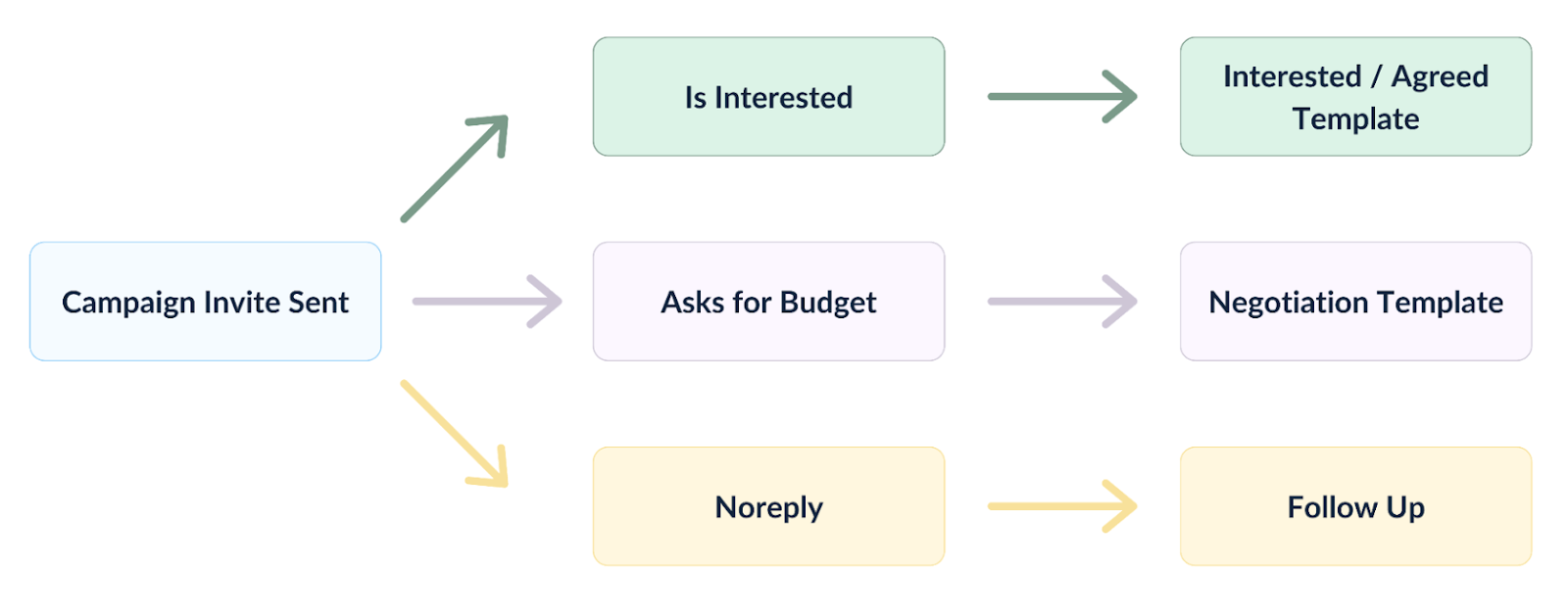
Below you can access our free seasonality campaign templates through which you can access the templates needed for each of the above 3 situations.
Campaign Launch Reminder: Securing On-Time Posts
After all the planning, negotiation, and coordination, you should now have a confirmed list of creators joining your seasonal campaign. But your job isn’t done yet.
The final step before launch is ensuring creators actually post on schedule.
Hi {{ firstname|default(influencer_handle) }},
I hope you are doing well!
Just a quick reminder that our BFCM campaign is starting tomorrow!
Your followers will be able to access the X% sale exclusively through your personal code.
Link: {{custom_link}}
X% Code: {{discount_code}}
Could you please share the link to your post once it’s live? We would love to see it!
Please let me know if you have any questions!
Best,
ENTER YOUR NAME
Plan logistics so products arrive a few days before the campaign start date. Receiving the product right before launch serves as a natural reminder for the creator, triggering content creation and keeping your campaign top of mind.
Maximize ROI Through Campaign Closing
As your campaign nears its end, you have one last — and often most powerful — opportunity to boost conversions. Just like an email with a “Sale ends today” subject line, influencer content timed around closing day leverages urgency and FOMO to drive a final sales spike.
1. Use Urgency to Drive Conversions
Encourage creators to post final reminders as the campaign ends. UGC-style videos where creators say “Offer ends today!” or “Last chance to shop with my code” consistently outperform standard posts, converting hesitant followers into last-minute buyers.
2. Request a Bonus Post Strategically
If you’re aiming to maximize ROI, ask participating creators to share one additional Story or post right before the sale closes, even if it wasn’t part of the original agreement.
Most creators are happy to do it, especially if phrased collaboratively: “Your post performed amazingly - as the campaign ends tomorrow, would you be open to one quick Story reminding followers before it closes?” This extra touchpoint often leads to a free post and a meaningful lift in final sales.
3. Manage the Closing Sequence Smoothly
Your closing-day communication should include:
- A thank-you message for participating.
- Clear campaign end date and reminder to post.
- Links, discount codes, and any new creative assets.
- A positive tone — gratitude first, logistics second.
This keeps things professional while reinforcing your brand as a trusted partner.
4. When to Extend a Campaign
If performance is strong or customers keep requesting access, a short extension (2–3 days) can sustain momentum. Communicate transparently and respectfully with creators: “We received so many requests from customers who missed the sale that we decided to extend it until Wednesday.”
5. Final ROI Optimization Tips
- Plan early so creators can post closer to your campaign’s final 48 hours.
- Track conversions daily — the last 1–2 days often deliver 20–30% of total revenue.
- Use influencer dashboards in Influencer Hero to identify which creators drive those late spikes and re-prioritize them for future seasonal pushes.
Below is the template you can use at campaign closing.
Hi {{ firstname|default(influencer_handle) }},
I hope you are doing fantastic! I just wanted to let you know that our BFCM campaign is ending today. It would be great if you could give your followers one last chance to get their gift in time.
You can give your followers final access to the offer by using your link and code below :)
Link: {{custom_link}}
{{discount_code_perc}} Code: {{discount_code}
Let me know if you have any questions!
Best,
ENTER YOUR NAME
Final Thoughts on Seasonality Campaigns
Seasonality campaigns are where influencer marketing performance peaks. After months of discovery, outreach, and testing, these are the moments when your data, relationships, and systems come together to deliver exponential ROI.
By activating your top-performing creators during key retail periods, bundling multiple posts for stronger frequency, and managing every touchpoint — from invitations to campaign closing — with precision, brands routinely achieve 5× to 10× ROAS or higher.
The secret isn’t volume, it’s timing, structure, and consistency.
When urgency aligns with tested creators and clear incentives, influencer marketing transforms from a content channel into a predictable revenue driver.
In the next chapter, we’ll go beyond theory and walk through a real-life BFCM influencer campaign that generated over $700K in sales and 8.4× ROAS, showing step-by-step how this system performs in action.
Key Takeaways
- Seasonality campaigns leverage natural consumer urgency for the highest ROI.
- Start planning 6–8 weeks in advance for logistics, creative, and influencer scheduling.
- Forecast ROI using data from Phase 1 and allocate budgets based on creator performance tiers.
- Combine exclusivity, urgency, and clarity in campaign invitations to maximize opt-ins.
- Send pre-launch reminders and closing-day posts to drive higher posting rates and conversions.
- Track all results and automate future re-engagement through your CRM to build long-term efficiency.
Continue learning: How to Leverage Influencer UGC for Whitelisting, Paid & Organic Social
Summary
This is some text inside of a div block.
This is some text inside of a div block.
Pricing/Month
Shopify Reviews
This is some text inside of a div block.
This is some text inside of a div block.
This is some text inside of a div block.
This is some text inside of a div block.
This is some text inside of a div block.
This is some text inside of a div block.
This is some text inside of a div block.
This is some text inside of a div block.
This is some text inside of a div block.
This is some text inside of a div block.
This is some text inside of a div block.
This is some text inside of a div block.
This is some text inside of a div block.
This is some text inside of a div block.
This is some text inside of a div block.
This is some text inside of a div block.
This is some text inside of a div block.
This is some text inside of a div block.
This is some text inside of a div block.
This is some text inside of a div block.
This is some text inside of a div block.
Read More

FAQs
What makes seasonality campaigns so effective for influencer marketing?

Seasonality campaigns align with high-intent retail moments like Black Friday, Valentine’s Day, and Mother’s Day - times when consumers are actively shopping. Pairing these moments with top-performing creators from Phase 1 amplifies urgency, trust, and purchase intent, leading to 5×–10× higher ROAS than evergreen campaigns.
When should brands start planning seasonal influencer campaigns?
Ideally 6–8 weeks before launch. This allows enough time for outreach, negotiation, product shipment, and content creation — while keeping messaging fresh and relevant. Early planning also ensures creators can fit your brand into their publishing calendar before they get booked by competitors.
How should brands allocate their influencer campaign budget?
Base allocation on creator performance tiers:
- High Performers (HPs): Fixed payments (predictable ROI).
- Medium Performers (MPs): Hybrid of fixed + affiliate (balanced risk).
- Low Performers (LPs): Affiliate-only or skip (low ROI).
This tiered approach ensures that you’re maximizing returns without overspending on underperforming segments.
How can I make sure creators post on time during a campaign?
Send a launch reminder 24 hours before the campaign and plan shipments to arrive just before the start date - both act as natural triggers. Track progress in your CRM, and if needed, automate reminders through platforms like Influencer Hero to maintain consistency and accountability.
What are the best ways to boost sales at the end of a campaign?
Leverage FOMO and urgency. Encourage creators to post “last chance” reminders or short UGC videos with CTAs like “Offer ends today” or “Code expires at midnight.” This simple tactic can increase final-day conversions by up to 30%, turning the campaign close into its most profitable window.

Most Popular Blogs


Drive ROI With Influencer Marketing
Join 1,200+ brands and 150+ agencies scaling creator programs with Influencer Hero.