Influencify : Tarifs et Avis 2026

May 19, 2026
|
Published

August 20, 2026
|
Updated

10 minutes
|
Reading

Influencer Performance Marketing Course | VOUCHER: IMC100

Maria Vincenzini
I Author

Drive ROI With Influencers

Global Influencer Database
ALL-IN-ONE platform
CRM, Affiliate, UGC & More
Tarification et avis Influencify en 2026
La tarification d'Influencify est l'une des plus accessibles dans l'espace de découverte d'influenceurs, avec des forfaits payants à partir de 99 $/mois et culminant à 299 $/mois pour le niveau le plus élevé. Il y a aussi une API white-label distincte tarifée sur devis.
La plateforme se positionne sur la taille de la base de données et la flexibilité des crédits — vous payez pour ce que vous recherchez et analysez. Mais le système de crédits, les restrictions de fonctionnalités et les modules complémentaires peuvent façonner le coût réel bien plus que le prix affiché ne le suggère.
Voici la ventilation complète de ce que chaque forfait inclut, où il s'inscrit et comment il se compare à une alternative plus complète.
Tarification d'Influencify en 2026
Influencify propose une facturation mensuelle et annuelle sans contrats à long terme — vous pouvez annuler à tout moment. Ils offrent aussi une garantie « Price Match » : envoyez un devis inférieur d'une autre plateforme et ils le battront de 15 %.
Starter — $99/mois
- 500 crédits par mois
- 1 000 crédits de recherche d'influenceurs
- Analyses d'influenceurs, gestion de campagnes, prospection par e-mail
Le forfait payant le moins cher du marché pour une plateforme avec 250M+ créateurs. Idéal pour les spécialistes du marketing indépendants ou les petites équipes DTC testant le marketing d'influence pour la première fois. Les limitations apparaissent rapidement cependant — 500 crédits s'épuisent vite si vous analysez beaucoup de profils, car chaque découverte et chaque analyse puisent dans le même quota.
Scale — $199/mois
- 1 000 crédits par mois
- 3 000 crédits de recherche d'influenceurs
- Analyses avancées, prospection en masse par e-mail, support prioritaire
Le forfait intermédiaire et le plan « Le plus populaire » d'Influencify. Double les crédits et déverrouille la prospection en masse, qui est le minimum réaliste si vous contactez plus que quelques créateurs par semaine. Le support prioritaire est inclus, ce qui importe car — comme le signalent les avis des utilisateurs — le support d'Influencify peut être lent sur les forfaits inférieurs.
Business — $299/mois
- 3 000 crédits par mois
- 7 000 crédits de recherche d'influenceurs
- Suite d'analyses complète, rapports white-label, gestionnaire de compte dédié
Le forfait publié le plus élevé. Conçu pour les agences ou les équipes en interne exécutant plusieurs campagnes simultanément. Les rapports white-label sont la fonctionnalité clé ici — utile si vous présentez la performance des campagnes aux clients. Le gestionnaire de compte dédié aide à compenser certaines des préoccupations de support signalées dans les avis.
Tarification de l'API Influencify
Influencify offre une API REST white-label distincte pour les agences, plateformes SaaS et places de marché qui veulent intégrer des données d'influenceurs dans leurs propres produits. L'accès API couvre la découverte, les analyses, les démographies du public et la performance des publications sur Instagram, TikTok et YouTube. La tarification est sur mesure et uniquement disponible sur demande, il n'y a pas de prix publié sur le site.
Pour référence, Influencer Hero propose aussi des intégrations d'API personnalisées dans le cadre de son forfait Business, ce n'est donc pas unique à Influencify mais bon à savoir si l'accès API est sur votre liste.
Aperçu d'Influencify
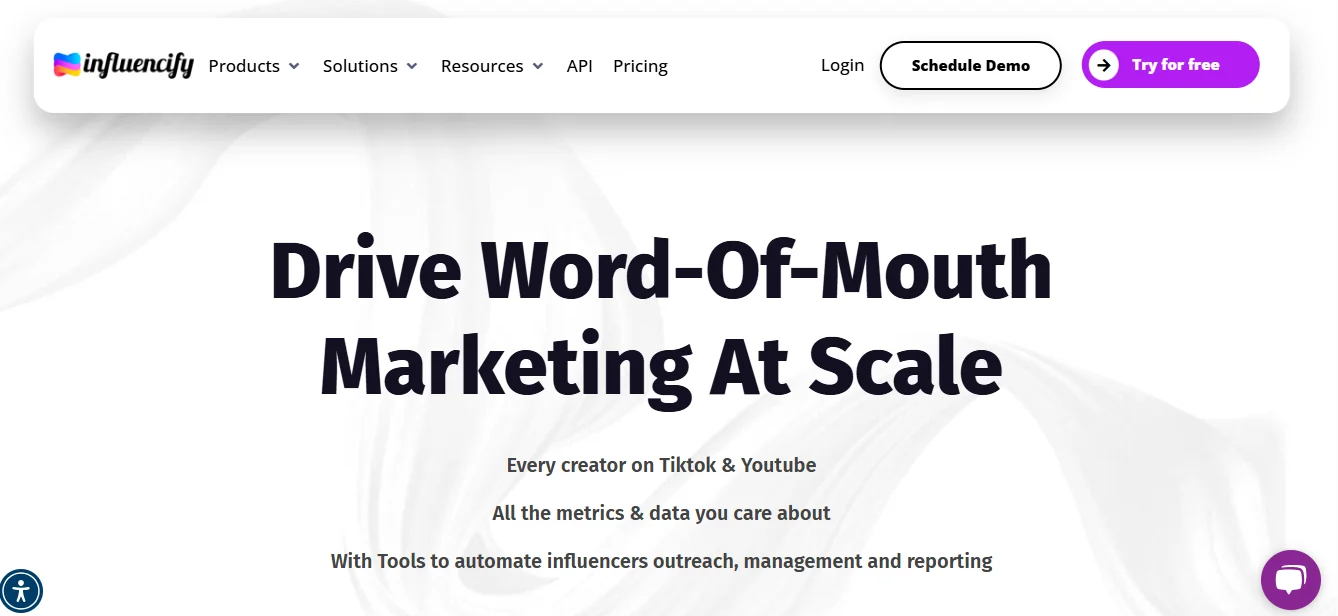
Influencify est une plateforme de découverte et d'analyse d'influenceurs en libre-service avec une base de données de 250M–300M créateurs sur Instagram, TikTok et YouTube. Elle est construite autour de deux missions principales : trouver les bons créateurs (y compris ceux qui suivent déjà votre marque) et analyser la qualité de leur audience avant de les contacter. La plateforme privilégie plus la découverte et l'audit que l'exécution complète de campagnes — la prospection est incluse, mais des fonctionnalités comme le suivi d'affiliation, l'attribution ROI avancée et les intégrations de style Shopify sont limitées ou absentes.
Meilleures fonctionnalités d'Influencify
- Influential Fans Scanner : Identifie les influenceurs qui suivent déjà votre marque sur Instagram ou interagissent avec vos publications. C'est la fonctionnalité la plus souvent citée par les critiques — elle met en avant des créateurs qui sont déjà des leads chauds plutôt que des cibles d'approche commerciale, ce qui se traduit généralement par des taux d'acceptation plus élevés.
- Analyse du chevauchement d'audience : Estime le pourcentage de chevauchement entre les audiences de deux influenceurs avant de les engager tous les deux. Vous évite de payer deux fois pour atteindre les mêmes personnes, particulièrement pertinent lors d'une campagne très spécialisée avec plusieurs créateurs dans le même secteur.
- Détection des faux abonnés : Utilise la vision par ordinateur et la modélisation de l'engagement pour signaler les comptes de followers gonflés et l'activité des bots. C'est devenu standard sur la plupart des plateformes de découverte, mais l'implémentation d'Influencify est l'un de ses atouts en matière de crédibilité et est directement liée à la vue des données démographiques de l'audience.
- Recherche de profils similaires : Une fois que vous avez trouvé un créateur performant, la recherche de profils similaires met en avant des profils comparables en fonction des modèles d'audience et de contenu. Utile pour développer ce qui fonctionne sans avoir à relancer la découverte à partir de zéro.
- Export en CSV et JSON : Export complet des résultats de recherche et des données de contact, y compris les e-mails si disponibles. C'est un véritable atout par rapport aux plateformes fermées — vous possédez les données et pouvez les intégrer dans votre propre stack d'outreach si vous préférez gérer l'outreach en dehors d'Influencify.
Avis sur Influencify
Influencify a une présence limitée sur G2 (un avis sur l'annonce principale) mais une couverture plus forte sur Capterra et AppSumo, où elle atteint 4,35/5 sur 37 avis AppSumo vérifiés. Les utilisateurs louent régulièrement la profondeur des filtres de recherche, le scanner Influential Fans et la taille de la base de données.
La faiblesse récurrente est le système de crédits. Les nouveaux utilisateurs le trouvent confus — chaque découverte, chaque analyse, chaque action consomme des crédits, et les plans d'entrée de gamme s'épuisent rapidement. Comme l'a dit un critique Capterra : « chaque étape coûte 1 crédit donc… découvrir 12 influenceurs coûte 1 crédit, analyser 1 influenceur coûte 1 crédit tu vois. » Le support client et les frictions d'annulation reviennent aussi régulièrement dans les avis Trustpilot et AppSumo.
Le sentiment sur Reddit et les forums penche vers « bon outil pour débuter, mais tu le dépasses » — utile pour la découverte, moins adapté à la gestion complète des campagnes à grande échelle.
Influencify vs Influencer Hero Tarification
L'écart tarifaire est significatif, et il reflète la différence dans ce que fait réellement chaque plateforme. Influencify commence à $99/mois et est construite autour de la découverte, l'analytique et l'outreach basique — vous payez pour les crédits et la profondeur de recherche. Influencer Hero commence à $649/mois parce que la plateforme couvre l'ensemble de la pile opérationnelle : découverte, automatisation de l'outreach, CRM influenceur, workflows de gifting, gestion d'affiliés, traitement des paiements, suivi UGC et intégration Shopify dans un seul système.
Si votre goulot d'étranglement est de trouver et vérifier des créateurs, le tarif d'Influencify est imbattable. Si votre goulot d'étranglement est de gérer 50+ relations actives, de suivre les conversions jusqu'aux créateurs spécifiques, d'automatiser les paiements et de capturer UGC pour réutilisation payante, la couverture opérationnelle d'Influencer Hero est ce qui comble l'écart.
Les utilisateurs d'Influencify qui se développent au-delà de la découverte finissent généralement par assembler un CRM, un outil d'e-mail et une plateforme d'affiliation distincte, ce qui ajoute des coûts et de la complexité en matière d'outils qui n'apparaissent pas dans la ligne d'abonnement mensuel.
Conclusion
Influencify est l'un des moyens les plus abordables d'accéder à une grande base de données de créateurs avec une analytique sérieuse derrière. Le prix de départ de $99 est réel, pas une simple accroche, et le système de crédits vous donne de la flexibilité sur ce que vous dépensez dans votre allocation mensuelle. Pour les marques D2C en phase précoce ou les marketeurs indépendants concentrés sur la recherche et la vérification des créateurs, c'est un point de départ raisonnable.
Ce qui manque, c'est tout ce qui se passe après la découverte. Il n'y a pas de gestion de programme d'affiliation, une infrastructure de suivi de campagne limitée, et le système de crédits peut devenir un goulot d'étranglement à mesure que votre programme se développe. Pour les équipes qui gèrent des programmes d'influence structurés avec plusieurs campagnes, paiements, envois de cadeaux et réutilisation d'UGC, Influencer Hero offre la profondeur opérationnelle dans une seule plateforme. D'autres alternatives intéressantes à considérer selon vos besoins incluent Modash (axé sur la découverte) et GRIN (dirigé par les créateurs, plus lourd pour l'entreprise).
Réservez une démo avec Influencer Hero pour voir à quoi ressemble l'exécution d'un programme d'influence de bout en bout au sein d'une seule plateforme.
Summary
This is some text inside of a div block.
This is some text inside of a div block.
Pricing/Month
Shopify Reviews
This is some text inside of a div block.
This is some text inside of a div block.
This is some text inside of a div block.
This is some text inside of a div block.
This is some text inside of a div block.
This is some text inside of a div block.
This is some text inside of a div block.
This is some text inside of a div block.
This is some text inside of a div block.
This is some text inside of a div block.
This is some text inside of a div block.
This is some text inside of a div block.
This is some text inside of a div block.
This is some text inside of a div block.
This is some text inside of a div block.
This is some text inside of a div block.
This is some text inside of a div block.
This is some text inside of a div block.
This is some text inside of a div block.
This is some text inside of a div block.
This is some text inside of a div block.
Read More

FAQs




Most Popular Blogs


Drive ROI With Influencer Marketing
Join 1,200+ brands and 150+ agencies scaling creator programs with Influencer Hero.