Meilleur logiciel de marketing d'influence pour les vitrines en ligne

March 6, 2026
|
Publié

October 12, 2026
|
Mis à jour

14 Min
|
Lecture

Cours de Marketing de Performance avec Influencers | BON DE RÉDUCTION : IMC100

Lucía Zabala
| Author

Générez du ROI avec les Influencers

Base de données mondiale d'influencers
Plateforme TOUT-EN-UN
CRM, Affiliate, UGC & Plus
Meilleur logiciel de marketing d'influence pour les vitrines
Gérer un programme de creators ne devrait pas nécessiter une douzaine d'onglets ouverts. Pour les fondateurs et les spécialistes du marketing DTC, le défi ne consiste pas seulement à trouver des talents ; il s'agit de gérer la logistique de la découverte, des envois et du suivi des affiliés sans la surcharge manuelle.
Pour les marques sur des plateformes comme Shopify ou WooCommerce, l'objectif est de rendre l'expérience d'achat fluide. C'est là que les vitrines de creators interviennent, permettant à vos influencers de sélectionner leurs produits préférés directement dans votre écosystème. Si vous recherchez le meilleur logiciel de marketing d'influence pour les vitrines, vous avez besoin d'une solution qui comble le fossé entre le contenu des creators et votre processus de paiement en ligne.
Voici 10 plateformes que nous explorerons et qui s'intègrent aux vitrines pour vous aider à évoluer :
Critères d'évaluation
- Intégration et compatibilité avec les vitrines : La manière dont chaque plateforme fonctionne avec les boutiques construites sur des vitrines, soit par le biais d'intégrations natives, soit par des flux de travail compatibles qui s'adaptent aux opérations de commerce électronique existantes.
- Capacités de campagne d'influence : L'étendue dans laquelle chaque plateforme soutient les cas d'usage fondamentaux du marketing d'influence, notamment la découverte de creators, la sensibilisation, la gestion des relations, les campagnes d'envoi et d'amorçage, et les collaborations basées sur l'affiliation.
- Suivi des performances et rapports :La capacité à suivre les performances au niveau des influencers et des campagnes, notamment les conversions, l'attribution des revenus et le retour sur investissement, ce qui est essentiel pour les équipes de commerce électronique concentrées sur les résultats mesurables.
- Automatisation et efficacité du flux de travail : La manière dont la plateforme automatise les tâches chronophages telles que la sensibilisation, la gestion des campagnes, les suivis et les rapports, ce qui est particulièrement important pour les équipes réduites gérant des programmes d'influence à grande échelle.
- Facilité d'utilisation (UX/UI) : L'expérience utilisateur globale, y compris la conception du tableau de bord, la navigation, le processus d'intégration et la courbe d'apprentissage pour les équipes opérant déjà sur des vitrines.
- Scalabilité pour les marques en croissance : La manière dont la plateforme soutient la croissance, des petites équipes exécutant leurs premières campagnes d'influence aux marques DTC établies gérant des centaines ou des milliers de creators.
- Tarification et flexibilité des contrats : La transparence des tarifs, la disponibilité de plans flexibles, et si la plateforme soutient les programmes en croissance sans forcer les engagements à long terme trop tôt.
- Support client et intégration : La disponibilité et la qualité des ressources d'assistance, y compris l'assistance à l'intégration, la documentation, les temps de réponse et le support continu du succès client.
Meilleur logiciel de marketing d'influence pour les vitrines
Pour vous aider à trouver la bonne solution, nous avons comparé les principales plateformes qui offrent des intégrations de vitrines de creators. Certaines sont conçues pour les grandes entreprises mondiales avec des budgets massifs, tandis que d'autres sont conçues pour aider les marques DTC en expansion à automatiser l'intégralité de leur flux de travail à partir d'un seul tableau de bord.
Le tableau suivant offre une vue d'ensemble de la manière dont ces plateformes se comparent en termes de coût, de focus, et de ce qui les distingue réellement sur le marché.
| Plateforme | Meilleure pour | À partir du prix | Différenciateur clé | |
|---|---|---|---|---|
| Influencer Hero | Marques DTC et agences en croissance ayant besoin d'une automatisation complète. | $649/mois | Automatisation tout-en-un (CRM + Gifting + Storefronts) à un prix évolutif. | |
| GRIN | Marques eCommerce d'entreprise avec de grandes équipes internes. | $2 085/mois. $25 000/an, engagement annuel requis | Flux de travail Shopify profondément intégré axé sur la gestion des relations. | |
| Aspire | Marques de taille moyenne à grande priorisant les candidatures entrantes de creators. | $2 300/mois | Place de marché de creators robuste et flux de travail de campagne à grand volume. | |
| Upfluence | Marques axées sur la transformation des clients existants en affiliés. | Environ $1 276/mois | Outil « Live Capture » puissant pour identifier les acheteurs influents sur votre site. | |
| CreatorIQ | Grandes entreprises mondiales nécessitant des données avancées et la gouvernance. | Environ $35 000/mois | Rapports de niveau entreprise et portails de creators en marque blanche. | |
| Modash | Marques axées sur la découverte massive et l'évaluation des creators. | $199/mois | Base de données de plus de 350 millions de creators avec puissants filtres d'audience. | |
| LTK | Marques de mode et de style de vie recherchant une application shopping sélectionnée. | Personnalisé | Accès à l'application shopping LTK propriétaire et à son réseau sélectionné. | |
| Shopify Collabs | Magasins Shopify en phase de démarrage testant leur premier programme de gifting. | Gratuit | Application Shopify native facile à configurer sans frais mensuels. | |
| Later Influence | Équipes combinant la planification des médias sociaux avec la gestion des influencers. | $28 500/an + $5 000 de frais d'intégration | Synchronise le contenu des influencers directement avec les outils de planification des médias sociaux. | |
| Captiv8 | Entreprises ayant besoin d'une écoute sociale profonde et d'informations concurrentielles. | Environ $25 000/an + Complément Affiliate & Storefront : $20 000 - $30 000/mois | Analyse des sentiments alimentée par l'IA et outils de sécurité de marque multi-canaux. |
1. Influencer Hero
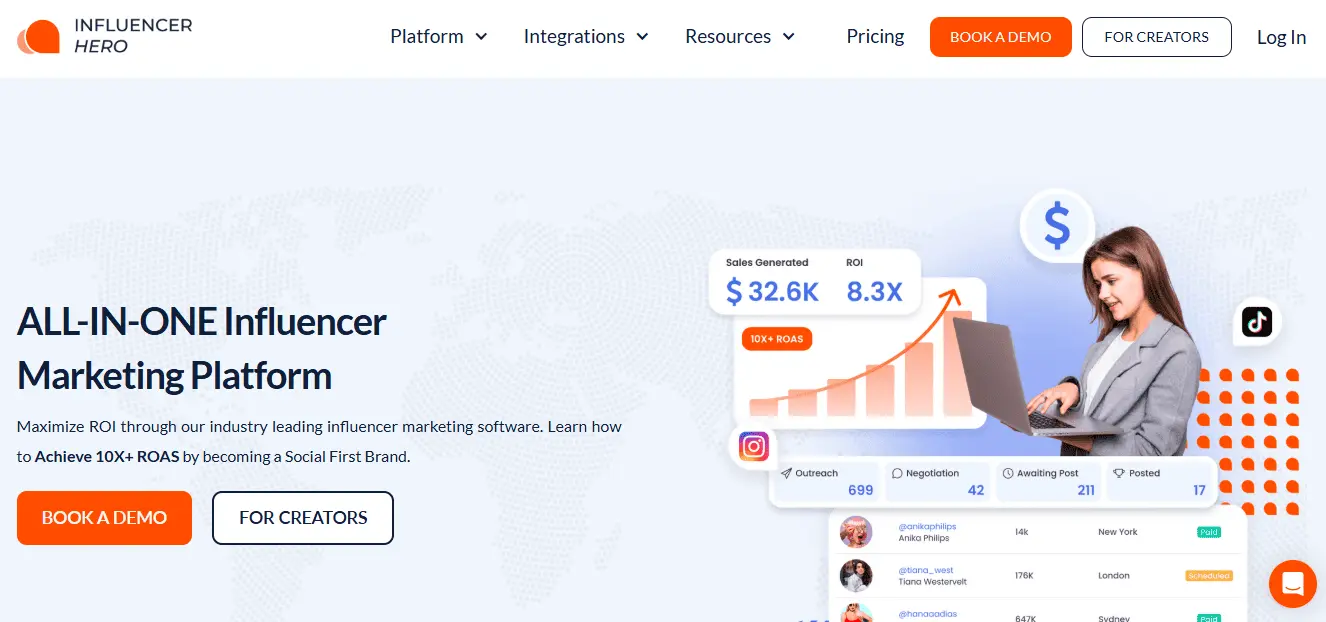
Influencer Hero est une plateforme complète de marketing d'influence qui aide les marques eCommerce à développer les programmes de creators par l'automatisation. Elle centralise la découverte, la prise de contact, le gifting et le suivi des affiliés dans un seul tableau de bord, et se distingue par les storefronts en donnant aux creators des pages shopping personnalisées et hautement convertissantes qui génèrent des ventes directes.
Convient le mieux à : Les marques DTC à croissance rapide et les agences qui doivent gérer des centaines de relations de creators simultanément sans augmenter l'effectif.
Fonctionnement avec les storefronts : Influencer Hero se connecte à votre catalogue de produits et permet aux creators de créer des storefronts personnalisées mettant en vedette leurs produits préférés. La plateforme génère automatiquement des liens d'affiliation traçables, créant une expérience d'achat transparente pour les clients et une attribution claire pour votre marque.
Tarification et engagement : Tous les plans sont basés sur un engagement de 3 mois pour assurer suffisamment de temps pour la mise à l'échelle initiale des campagnes et le suivi du ROI.
- Plan Standard : $649/mois (Contactez jusqu'à 1 000 creators/mois).
- Plan Pro : $1 049/mois (Contactez jusqu'à 5 000 creators/mois).
- Plan Business :$2 490/mois (Contactez jusqu'à 10 000 creators/mois).
- Personnalisé & Agence : Tarification adaptée en fonction de vos besoins spécifiques en termes d'échelle et de volume.
Facilité d'utilisation (UX/UI) : La plateforme est construite selon une philosophie de « clics minimalistes ». Elle propose un tableau de bord intuitif et épuré qui organise l'ensemble du cycle de vie des creators. Des séquences d'e-mail automatisées aux modèles personnalisables, l'interface est conçue pour qu'un seul responsable marketing puisse superviser des flux de travail complexes sans se sentir dépassé.
Support client : Influencer Hero offre un chat en direct 24/7 avec de vraies personnes, un support par e-mail réactif et un Centre d'aide complet avec des tutoriels vidéo. Chaque client se voit attribuer un gestionnaire de compte dédié dès le premier jour pour l'aider dans sa stratégie. Les utilisateurs des plans Pro et Business bénéficient également d'un canal Slack privé pour un support continu et en temps réel.
Fonctionnalités clés :
- Vitrines de creators personnalisables : Donnez aux influencers une URL dédiée où ils peuvent sélectionner leurs produits préférés de votre boutique. Cela maintient le client dans l'écosystème de votre marque tout en fournissant la preuve sociale de la recommandation d'un creator.
- Envoi de produits automatisé : Synchronisez votre boutique Shopify ou WooCommerce pour automatiser l'envoi de colis de relations publiques. Les creators peuvent sélectionner directement leurs tailles ou couleurs préférées, et la plateforme suit automatiquement l'expédition et les publications de contenu ultérieures.
- Suivi des affiliés et du ROI : Chaque vitrine et lien est suivi automatiquement. Vous pouvez consulter les données en temps réel sur les clics, les conversions et le chiffre d'affaires total généré par influencer, ce qui permet d'identifier facilement vos partenaires les plus performants.
- Bibliothèque de contenu UGC : Agrégez automatiquement tous les contenus créés par vos influencers. Cette bibliothèque vous permet de consulter, télécharger et réutiliser du contenu de haute qualité pour vos propres publicités sur les réseaux sociaux ou vos pages de produits, maximisant la valeur de chaque partenariat.
- Découverte avancée et CRM : Recherchez dans une base de données de plus de 250 millions de creators avec des filtres spécifiques pour le taux d'engagement, les données démographiques de l'audience et la localisation. Une fois trouvés, vous pouvez gérer l'ensemble de l'historique des relations dans le CRM intégré.
Limitations d'Influencer Hero : Bien que la configuration de la vitrine soit conçue pour être intuitive, la synchronisation d'un large catalogue de produits complexe pour la première fois peut nécessiter une certaine supervision initiale pour garantir que toutes les variantes sont correctement mappées. De plus, les marques ayant des produits très spécialisés ou techniques peuvent constater qu'elles ont besoin de passer plus de temps à personnaliser les mises en page de leur vitrine pour bien communiquer les spécifications des produits, bien que l'équipe d'assistance soit disponible pour vous aider lors de cette transition.
2. GRIN
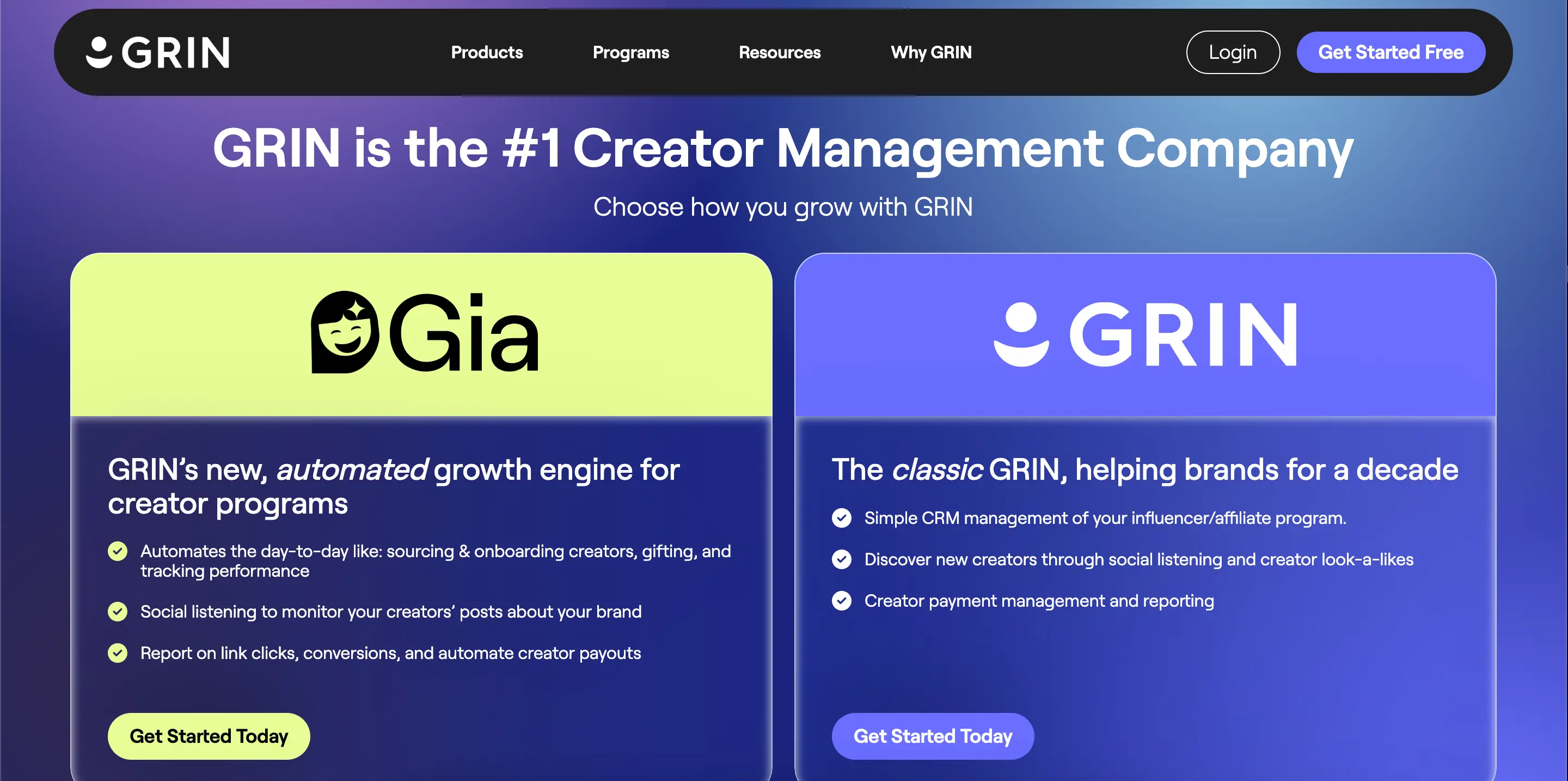
GRIN est une plateforme de gestion de creators de niveau entreprise qui se concentre fortement sur la gestion des relations pour les grandes marques de commerce électronique. Elle est conçue pour traiter les influencers comme de véritables partenaires de marque plutôt que simplement comme des affiliés basés sur des transactions. Bien qu'elle soit historiquement connue pour son approche entreprise très personnalisée, elle a récemment introduit des options en libre-service pour concurrencer les plateformes plus agiles.
Idéal pour : Les grandes marques de commerce électronique disposant d'équipes marketing internes établies qui ont besoin d'une « source unique de vérité » pour des milliers de relations avec des creators et une logistique complexe.
Fonctionnement avec les vitrines : GRIN propose des vitrines de creators par le biais de sa fonction « Creator Shops » (souvent via son intégration CreatorCommerce). Cela permet aux creators de créer des pages de destination co-marquées et shoppables qui vivent au sein de l'écosystème Shopify de la marque. Ces pages permettent aux influencers de sélectionner leurs produits préférés, tandis que GRIN gère l'attribution backend, en s'assurant que chaque vente via la vitrine est suivie et créditée au bon partenaire.
Tarification : GRIN a récemment adopté une approche tarifaire plus flexible, mais commence historiquement à un seuil beaucoup plus élevé que les autres outils.
Plans libre-service/Lite : Récemment annoncés pour commencer autour de $999/mois pour les marques qui souhaitent éviter les contrats à long terme.
Plans Core/Professional : Généralement entre $2 100 et $2 500/mois.
Entreprise :Tarification personnalisée pouvant dépasser $25 000/an, généralement assortie d'un engagement annuel.
Facilité d'utilisation (UX/UI) : Les utilisateurs décrivent généralement la plateforme comme « robuste mais complexe ». Bien que l'interface soit épurée, le grand nombre de fonctionnalités et de paramètres signifie qu'il y a une courbe d'apprentissage importante. Les critiques sur G2 et Reddit mentionnent souvent qu'il faut un membre d'équipe dédié pour véritablement maîtriser le flux de travail et maintenir les données du CRM organisées.
Support client : GRIN est bien réputé pour son intégration personnalisée et ses gestionnaires de compte dédiés pour les niveaux d'entreprise. Cependant, certains utilisateurs sur les sites d'avis ont noté que pour les niveaux non-entreprise, le support peut être plus lent, et la transition de la plateforme vers l'autosuffisance a entraîné certaines difficultés de croissance dans les temps de réponse.
Fonctionnalités clés :
- GIA (GRIN Intelligent Assistant) : Un outil basé sur l'IA qui aide les responsables marketing à rédiger des e-mails de prospection, à trouver des creators « similaires » et à automatiser les tâches CRM répétitives.
- Hub affilié complet : Au-delà des simples liens, le hub permet aux creators de voir leurs propres performances, d'accéder aux briefs créatifs et de gérer leurs paiements dans un portail en marque blanche.
- Écoute sociale et mentions : La plateforme suit chaque fois qu'un creator mentionne votre marque, en tirant automatiquement ce contenu dans une médiathèque pour la gestion des droits et la réutilisation.
- Paiements intégrés et 1099 : Pour les marques basées aux États-Unis, GRIN simplifie le casse-tête fiscal en gérant le traitement des 1099 et les paiements automatisés directement via la plateforme.
- Intégration eCommerce approfondie : GRIN offre l'une des synchronisations les plus transparentes avec Shopify et WooCommerce, gérant tout, du suivi de l'inventaire à l'expédition automatisée des produits de « lancement ».
Limitations de la plateforme : GRIN est souvent cité comme étant « trop de logiciels » pour les petites équipes, ce qui entraîne des fonctionnalités sous-utilisées. De plus, parce qu'elle s'appuie sur une base de données conservée plutôt que sur une extraction sociale en direct, certains utilisateurs constatent que les filtres de découverte peuvent occasionnellement retourner des données de creators obsolètes.
3. Aspire

Aspire est une plateforme de marketing d'influence bien établie qui comble le fossé entre la gestion d'influencers traditionnelle et le commerce social moderne. Elle est particulièrement connue pour son « Marketplace de creators », qui permet aux marques de publier des briefs de campagne et de recevoir des candidatures entrantes de la part de creators intéressés. Récemment, Aspire s'est réorienté fortement vers le côté commercial de l'industrie, en se concentrant sur la transformation du contenu creator en revenus directs.
Idéal pour : Les marques DTC de mid-market et d'entreprise qui souhaitent équilibrer la prospection sortante avec un grand volume de candidatures entrantes de creators.
Comment cela fonctionne avec les vitrines : Les « CreatorStores » d'Aspire sont des expériences de micro-shopping co-marquées qui vivent directement sur le site Shopify de la marque. Contrairement à un lien d'affiliation standard qui dépose un utilisateur sur une page d'accueil, ces vitrines permettent aux creators de sélectionner à la main et de présenter leurs produits préférés aux côtés de leur propre contenu de marque. Cette configuration maintient le client dans l'écosystème de la marque tout en tirant parti de la preuve sociale du creator pour générer des taux de conversion plus élevés et capturer des données propriétaires.
Tarification : Aspire requiert généralement un engagement annuel et est positionnée comme un outil premium.
- Plans échelonnés : Bien qu'ils ne listent pas tous les prix publiquement, l'accès au niveau d'entrée commence généralement autour de $2 499/mois.
- Entreprise : Tarification personnalisée pour les équipes mondiales nécessitant des autorisations avancées, plusieurs poignées de marque et un grand nombre de sièges.
Facilité d'utilisation (UX/UI) : Les utilisateurs félicitent généralement Aspire pour son interface épurée et professionnelle qui facilite l'organisation de diverses étapes de campagne. Cependant, les avis sur G2 et Reddit mentionnent souvent que parce que la plateforme est si riche en fonctionnalités, la configuration initiale et la « courbe d'apprentissage » peuvent être abruptes pour les petites équipes sans gestionnaire d'influencers dédié.
Support client : Aspire est très bien évaluée pour ses équipes de succès client, de nombreux utilisateurs soulignant leur expérience d'intégration « sur mesure ». Ils offrent un gestionnaire de compte dédié pour la plupart des niveaux et fournissent des ressources complètes via leur « Creator Academy », bien que certains comptes plus petits aient signalé des temps de réponse plus lents comparés au support au niveau entreprise.
Fonctionnalités clés :
- CreatorStores™: Des vitrines entièrement personnalisables et hébergées qui permettent aux creators de sélectionner des collections de produits et d'offrir des réductions exclusives directement sur votre boutique Shopify.
- Inbound Marketplace: Une énorme base de données de creators qui peuvent activement « postuler » à vos campagnes, réduisant considérablement le temps consacré aux prospections froides.
- Intégration Ecommerce (Shopify/WooCommerce): Gère facilement la logistique des envois de produits, le suivi des expéditions et la génération de codes promotionnels sans quitter le tableau de bord.
- Bibliothèque de contenu et liste blanche: Gérez facilement les droits d'utilisation et transformez les publications de creators performantes en « Publicités de contenu de marque » sur Meta et TikTok.
- Étapes de flux de travail automatisées: Utilisez un générateur de campagne « modulaire » pour automatiser tout, de la signature de contrats et des formulaires fiscaux (W9/W8) à l'approbation du contenu et aux paiements.
Limitations de la plateforme: Certains utilisateurs ont noté que la plateforme peut parfois sembler « maladroite » lors de la gestion de très grandes listes de creators à différentes étapes de la campagne. De plus, l'exigence d'un contrat annuel et un prix de départ plus élevé peuvent être un obstacle pour les marques en phase de démarrage qui ne sont pas encore prêtes à investir plusieurs milliers de dollars par an.
4. Upfluence
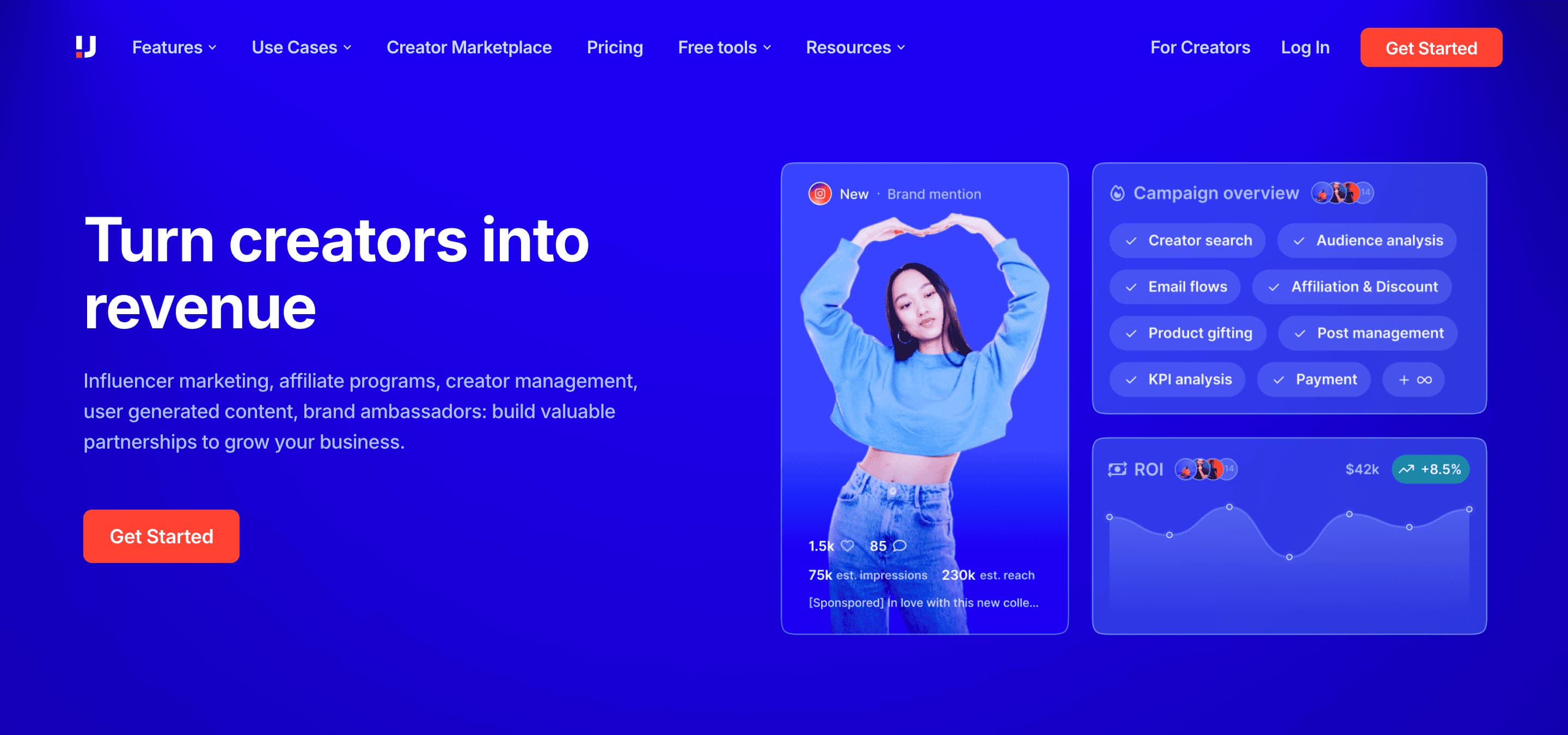
Upfluence est une plateforme de marketing d'influence basée sur les données qui se concentre fortement sur l'intersection du commerce électronique et du marketing d'affiliation. Elle est surtout connue pour son outil « Live Capture », qui aide les marques à identifier les personnes influentes qui achètent déjà sur leur site. En fusionnant une massive base de données de creators avec des données clients propriétaires, elle permet aux marques de transformer leur base de clients existante en une force d'affiliation très performante.
Meilleure utilisation pour: Les marques de commerce électronique établies et les agences qui souhaitent prioriser l'approvisionnement en influencers « client d'abord » et gérer des programmes d'affiliation à grande échelle.
Comment cela fonctionne avec les vitrines: Upfluence s'intègre à votre CMS de commerce électronique (Shopify, WooCommerce, Amazon) pour alimenter le commerce dirigé par les creators. Grâce à sa capacité « Creator Storefronts », les influencers peuvent sélectionner des produits de votre catalogue en direct pour les présenter sur leurs propres pages d'achat dédiées. Cela simplifie le parcours d'une publication de creator à une vente traçable, car Upfluence génère automatiquement des liens d'affiliation uniques et des codes promotionnels pour chaque article que le creator choisit de mettre en avant.
Tarification: Upfluence utilise un modèle de tarification modulaire, mais il nécessite généralement un engagement annuel.
- Plan Growth: Environ 1 276 USD/mois (facturé annuellement).
- Plan Enterprise: Tarification personnalisée, souvent supérieure à 2 000+ USD/mois pour un accès complet à tous les modules et aux fonctionnalités avancées de données.
Facilité d'utilisation (UX/UI): Les utilisateurs décrivent souvent la plateforme comme puissante mais possédant une interface « lourde ». Bien que le tableau de bord soit professionnel et organisé, le grand volume de données et les paramètres modulaires signifient qu'elle peut sembler accablante pour les débutants. Les critiques sur G2 et Capterra suggèrent que la plateforme convient mieux aux utilisateurs à l'aise avec des flux de travail axés sur les données et les rapports détaillés.
Support client: Upfluence offre un onboarding structuré et des représentants de compte dédiés pour les plans de niveau supérieur. Bien que de nombreux utilisateurs félicitent leurs « spécialistes de l'intégration » pour leur soutien, certains commentaires sur Reddit et Capterra mentionnent que l'équipe d'assistance peut être ferme concernant les renouvellements de contrats et que les temps de réponse pour les bogues techniques peuvent varier selon le niveau du plan.
Fonctionnalités clés:
- Outil « Reveal »: Une fonctionnalité unique qui identifie les influencers parmi vos visiteurs de site existants et vos clients, vous permettant de recruter des personnes qui aiment déjà votre marque.
- Intégration native Amazon: L'une des rares plateformes qui offre une intégration profonde avec Amazon Attribution, ce qui en fait un incontournable pour les marques vendant sur la place de marché.
- Sélection de produits automatisée: Les creators peuvent parcourir votre inventaire de magasin en direct et sélectionner leurs propres produits à offrir, ce qui déclenche un flux de travail d'expédition automatisé.
- Prospection alimentée par l'IA (Jace AI): Un assistant qui aide à automatiser les campagnes d'égouttement et à personnaliser les messages de prospection pour améliorer les taux de réponse de la base de données.
- Écoute sociale complète : Suiverez les mentions organiques de votre marque sur les réseaux sociaux pour trouver et récompenser les creators qui parlent de vous sans y être invités.
Limitations de la plateforme : La plainte utilisateur la plus courante concerne le manque de flexibilité contractuelle, car l'engagement obligatoire de 12 mois peut constituer un obstacle pour les marques qui testent le marché. De plus, certains utilisateurs trouvent que la configuration technique initiale — en particulier la synchronisation des données au niveau du panier pour un suivi précis du ROI — est complexe sans l'aide d'un développeur dédié.
5. CreatorIQ

CreatorIQ est une plateforme de marketing d'influence de qualité entreprise conçue pour les grandes sociétés mondiales et les grandes agences qui nécessitent une gouvernance des données sophistiquée et une échelle massive. Reconnue pour sa robuste « Creator Cloud », elle aide les marques à aller au-delà des simples campagnes pour construire des communautés de creators durables, axées sur le contenu. C'est une solution riche en données qui fournit une écoute sociale profonde et des benchmarks concurrentiels aux côtés de ses outils de gestion essentiels.
Meilleur ajustement pour : Les entreprises Fortune 500 et les grandes entreprises qui ont besoin de gérer des programmes de creators complexes, multi-marques avec des exigences rigoureuses en matière de sécurité de marque et de données.
Comment cela fonctionne avec les vitrines : CreatorIQ alimente le commerce grâce à sa fonctionnalité « Creator Stores », qui s'intègre aux principales plates-formes de commerce électronique comme Shopify. Elle permet aux influencers de créer des destinations commerciales personnalisées où ils peuvent organiser leurs produits préférés et accueillir du contenu de marque. La plateforme agit comme centre opérationnel, automatisant la distribution de liens de suivi uniques vers ces vitrines et regroupant les données de conversion dans des rapports de niveau entreprise pour mesurer le ROI sur l'ensemble du parcours.
Tarification : CreatorIQ fonctionne sur un modèle premium basé sur devis qui nécessite généralement un engagement annuel.
- Licence annuelle : Les prix commencent généralement entre 30 000 et 36 000 dollars par an pour un accès entreprise de niveau débutant.
- Entreprise personnalisée : Les niveaux supérieurs pour les équipes mondiales peuvent varier de 50 000 à plus de 100 000 dollars par an, selon les sièges utilisateur, le volume de données et les exigences API.
Facilité d'utilisation (UX/UI) : La plupart des utilisateurs décrivent CreatorIQ comme une plateforme puissante et « féroce » qui dispose d'une interface propre et professionnelle mais qui s'accompagne d'une courbe d'apprentissage abrupte. Bien que le tableau de bord soit moderne, la sheer profondeur des fonctionnalités — de la conformité juridique à l'écoute sociale avancée — peut sembler accablante et « maladroite » pour les petites équipes ou celles habituées à des outils plus agiles et en libre-service.
Support client : En tant que fournisseur d'entreprise, CreatorIQ est connu pour ses équipes d'assistance de haute qualité et dédiées et son intégration structurée. Les utilisateurs mentionnent fréquemment avoir accès à un gestionnaire de succès client (CSM) dédié et à un portail de connaissances détaillé, bien que certains critiques aient noté que le dépannage technique pour les rapports complexes peut parfois impliquer des cycles d'aller-retour plus longs.
Fonctionnalités clés :
- Creator Stores et Commerce Social : Les influencers peuvent créer leurs propres vitrines organisées pour mettre en évidence des lignes de produits spécifiques, avec une attribution en temps réel pour chaque clic et vente.
- Données d'entreprise et écoute sociale : Accédez à des données historiques approfondies et à une écoute sociale en temps réel pour identifier les défenseurs organiques de la marque et surveiller l'activité des concurrents à l'échelle.
- Paiements automatisés et conformité mondiale : Rationalisez les paiements aux creators via « CreatorPay » (prenant en charge PayPal, virements et ACH) tout en gérant les formulaires fiscaux complexes et les contrats juridiques au sein de la plateforme.
- Notation avancée de la sécurité de marque : Un contrôle de qualité alimenté par l'IA qui analyse des années d'historique de creators pour garantir que chaque partenaire s'aligne sur les normes de sécurité de marque et les valeurs corporatives.
- API robuste et intégration de pile technologique : Offre l'un des écosystèmes API les plus matures du secteur, permettant un flux de données transparent entre le programme d'influence et des outils comme Tableau, Looker ou Google Analytics.
Limitations de la plateforme : L'obstacle le plus important pour de nombreuses marques est le coût élevé et le contrat annuel obligatoire, ce qui le rend inaccessible pour les plus petites marques DTC. De plus, les utilisateurs ont signalé que le suivi des affiliés peut parfois sembler manuel par rapport à des outils plus axés sur le commerce, nécessitant une configuration supplémentaire pour obtenir des données de conversion granulaires.
6. Modash

Modash est une plateforme de découverte et de gestion d'influencers conçue pour la rapidité et une mise à l'échelle massive. Sa caractéristique distinctive est une base de données « ouverte » de plus de 250 millions de creators, ce qui signifie que vous n'êtes pas limité aux influencers qui se sont inscrits à un réseau spécifique. Elle se concentre sur l'aide apportée aux marques pour trouver même les creators les plus niche, vérifier leurs audiences pour les faux followers, et gérer la logistique des gifting et du suivi des affiliés via une interface hautement automatisée.
Idéal pour : Les marques eCommerce à croissance rapide qui ont besoin de trouver des creators niche sur les marchés mondiaux et qui recherchent un outil qui privilégie la découverte massive à une marketplace organisée.
Fonctionnement avec les vitrines : Modash s'intègre profondément avec Shopify pour transformer la découverte d'influencers en commerce direct. Bien qu'elle ne propose pas de « vitrines » au sens d'un constructeur de sites Web autonome, elle active les « Pages de creators » et les liens affiliés automatisés. Les influencers peuvent parcourir votre catalogue Shopify en direct via un lien dédié, sélectionner les produits qu'ils souhaitent promouvoir, et Modash générera automatiquement des codes de réduction uniques et des liens de suivi affilié pour leur sélection spécifique, en synchronisant toutes les données de ventes résultantes vers votre tableau de bord ROI.
Tarification : Modash offre une facturation mensuelle ou annuelle flexible, ce qui rend plus accessible pour les marques qui souhaitent éviter les blocages à long terme.
- Essentials : $199/mois. Inclut jusqu'à 100 creators suivis et les fonctionnalités de gifting Shopify de base.
- Performance : $499/mois. Inclut jusqu'à 250 creators suivis, 6 000 recherches de « fans influents » et la gestion complète des affiliés.
- Entreprise : À partir de $14 700/année. Offre des creators illimités, des domaines personnalisés pour les liens de suivi et une gestion du succès dédiée.
Facilité d'utilisation (UX/UI) : Modash est fréquemment louée sur G2 et Reddit pour son interface « propre et fluide ». Les utilisateurs signalent que la plateforme se sent moderne et intuitive, en particulier les outils de recherche et de filtrage, qui permettent aux spécialistes du marketing de naviguer dans une base de données de millions sans le décalage typique des logiciels de niveau entreprise.
Support client : La plateforme est connue pour son chat intégré hautement réactif 24h/24 et 7j/7. Les critiques mentionnent souvent que « l'équipe Modash écoute vraiment », les commentaires des clients étant fréquemment transformés en nouvelles fonctionnalités ou améliorations de flux de travail en quelques semaines.
Caractéristiques clés :
- Base de données massive de 250M+ creators : Recherchez chaque profil public sur Instagram, TikTok et YouTube avec plus de 1 000 followers, en veillant à ce que vous puissiez trouver des creators dans même les créneaux les plus obscurs.
- Outil « Trouvez vos fans » : Scanne automatiquement vos propres followers de marque sur les réseaux sociaux pour identifier les personnes influentes qui aiment déjà vos produits, ce qui rend le recrutement beaucoup plus facile.
- Gifting Shopify automatisé : Envoyez un seul lien « Choix de produit » aux influencers ; ils choisissent leur propre taille, couleur et adresse de livraison, et la commande est automatiquement envoyée à votre magasin Shopify.
- Audit de crédibilité d'audience et contrôle des faux followers : Des audits détaillés pour chaque profil qui montrent le pourcentage de « vrais » followers par rapport aux bots, ainsi que les données démographiques de l'audience comme la localisation, l'âge et le sexe.
- Gestion des affiliés intégrée : Créez, suivez et gérez les commissions pour des milliers de codes de réduction et de liens uniques directement dans la plateforme, y compris les flux de travail de paiement automatisés.
Limitations de la plateforme : Les intégrations eCommerce approfondies de Modash (comme le gifting automatisé et la génération de codes) sont actuellement exclusives à Shopify, ce qui signifie que les marques sur WooCommerce ou Magento peuvent trouver le flux de travail plus manuel. De plus, certains utilisateurs ont noté que la plateforme manque d'outils intégrés de signature de contrat et de licence de contenu, ce qui oblige les équipes à gérer les accords juridiques par le biais d'applications externes.
7. Impact
%2012.22.33%E2%80%AFp.%C2%A0m..png)
Impact.com est un leader mondial de l'automatisation des partenariats, offrant une suite complète pour le marketing d'influence, la gestion des affiliés et le commerce creator. Originalement connue pour ses outils d'affiliation d'entreprise, elle a évolué en destination privilégiée pour les marques cherchant à développer les « partenariats creators » grâce à une approche basée sur les données.
Idéal pour : Les marques DTC de milieu à haut de gamme qui souhaitent gérer les influencers aux côtés des partenaires d'affiliation traditionnels dans un seul écosystème hautement performant.
Fonctionnement avec les vitrines : Impact.com alimente les vitrines grâce à ses fonctionnalités « Creator Pages » et « Shop My Look ». Les creators peuvent construire des pages d'accueil personnalisées et achetables qui hébergent leurs recommandations de produits. La plateforme automatise la génération de liens de suivi et de codes promo, garantissant que chaque vente effectuée via la vitrine d'un creator est correctement attribuée et récompensée en temps réel.
Tarification : Impact.com fonctionne généralement selon un modèle devis avec un accent sur la mise à l'échelle basée sur la performance.
Facilité d'utilisation (UX/UI) : La plateforme est très sophistiquée et professionnelle, bien qu'elle présente une courbe d'apprentissage plus abrupte que les outils plus simples. Son tableau de bord offre une vue granulaire de l'ensemble du cycle de vie des partenariats, de la découverte aux paiements automatisés.
Support client : Impact.com est réputée pour fournir un support considérable, incluant des gestionnaires de succès dédiés pour les tiers entreprise et une robuste « Partnership Experience Academy » pour les utilisateurs en libre-service.
Fonctionnalités clés :
- Creator Pages : Des vitrines entièrement personnalisées et hébergées où les influencers peuvent mettre en avant leurs produits préférés et diriger le trafic directement vers votre processus de paiement.
- Contrats automatisés et paiements : Développez votre programme sans surcharge manuelle en automatisant les structures de commission complexes et les paiements multi-devises.
- Attribution multi-appareils : Utilise une technologie de suivi avancée pour s'assurer que les creators obtiennent le crédit pour les ventes, même si le client passe d'une application sociale mobile à un navigateur de bureau.
- Découverte et recrutement d'influencers : Accédez à un énorme marché vérifié de creators et utilisez des « flux de contrats automatisés » pour les recruter à grande échelle.
Limitations de la plateforme : En raison de ses profondes racines dans le marketing d'affiliation, certains utilisateurs trouvent l'interface de la plateforme plus « chargée de données » et moins « axée sur les réseaux sociaux » par rapport aux plateformes construites exclusivement pour Instagram ou TikTok. De plus, la configuration technique initiale pour le suivi avancé peut nécessiter l'assistance d'une équipe de développement web.
8. Later
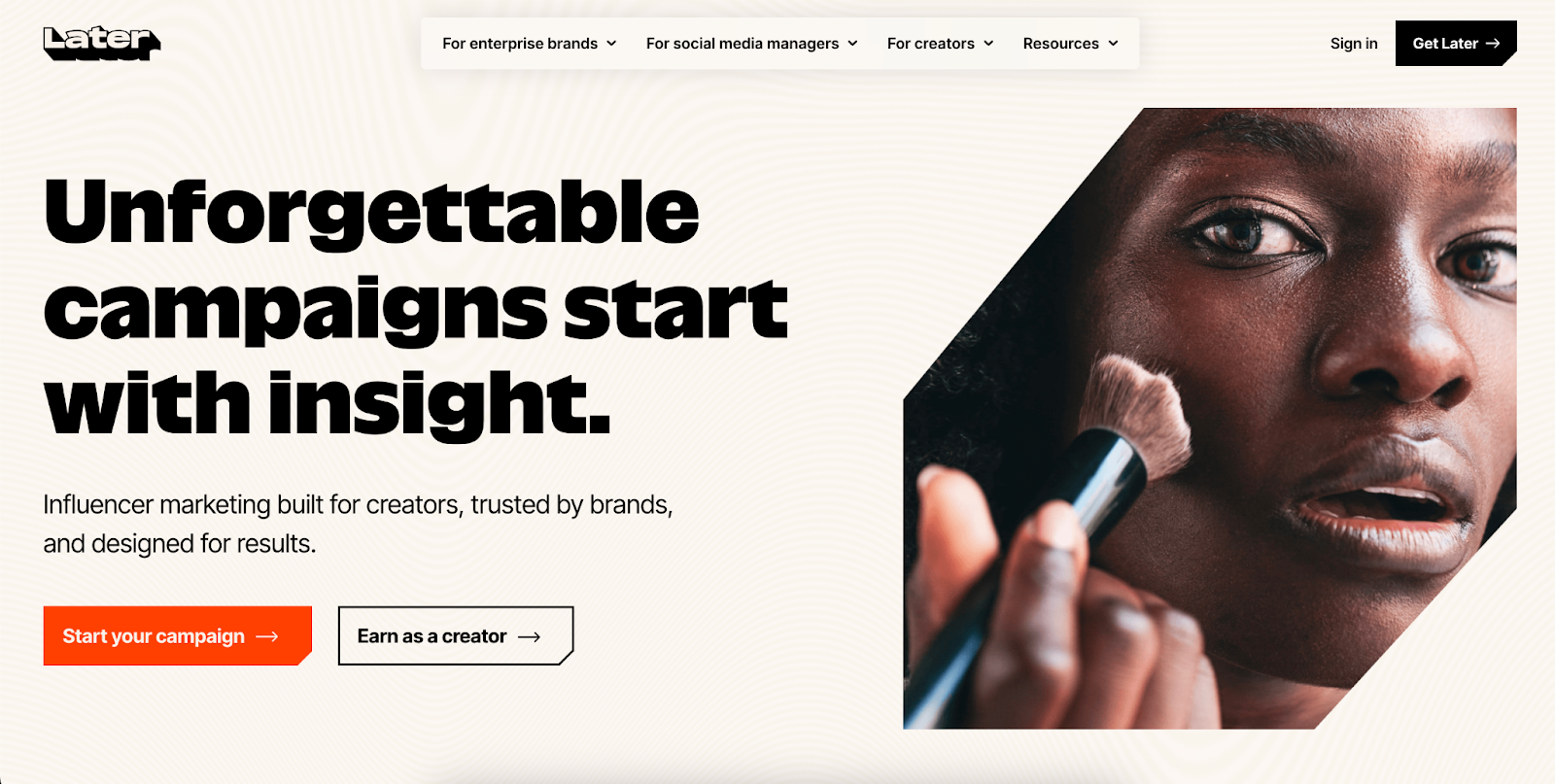
Later est une plateforme d'entreprise qui combine la gestion robuste des influencers de Mavrck avec l'expertise en planification de réseaux sociaux de Later. Elle est conçue pour combler le fossé entre la planification des médias sociaux et la performance des influencers, offrant un flux de travail unifié pour les marques qui souhaitent gérer leur propre présence sur les réseaux sociaux ainsi que leurs partenariats creators.
Idéal pour : Les marques DTC de taille moyenne à grande qui souhaitent gérer la planification du contenu des réseaux sociaux et les campagnes d'influencers dans un seul écosystème.
Fonctionnement avec les vitrines : Later Influence utilise son intégration « Mavely » pour alimenter les vitrines des creators. Les influencers construisent des pages d'achat curées qui renvoient directement vers votre site eCommerce, agissant comme des conseillers personnels numériques. La plateforme suit tous les clics et conversions, fournissant un ROI clair sur les collections de creators qui génèrent le plus de revenus.
Tarification : Later Influence nécessite généralement un abonnement de haut niveau ou un devis personnalisé pour les fonctionnalités complètes des influencers.
Growth Plan : $649/mois (souvent facturé annuellement).
Advanced Plan : $949/mois (souvent facturé annuellement).
Enterprise : Devis personnalisés atteignant $30 000/an et plus selon le volume et les besoins en services gérés.
Facilité d'utilisation (UX/UI) : Les utilisateurs trouvent généralement le style « calendrier » visuel de la plateforme très intuitif pour planifier du contenu. Cependant, les avis G2 suggèrent que le côté gestion des influencers (anciennement Mavrck) est plus profond et plus complexe, nécessitant une formation initiale pour naviguer efficacement dans les différentes étapes de la campagne.
Support client :La plateforme est très bien notée pour son soutien stratégique, avec de nombreux utilisateurs entreprises mentionnant qu'ils sentent que l'équipe Later agit comme une extension de la leur. Les comptes plus petits, cependant, ont noté que le support peut parfois sembler plus automatisé que personnalisé.
Fonctionnalités clés :
- Intégration Mavely : Accédez à un réseau intégré d'« influencers du quotidien » qui utilisent des liens shoppables et des vitrines pour générer des ventes basées sur la performance.
- Calendrier de contenu visuel : Synchronisez les livrables des influencers directement dans le calendrier des médias sociaux de votre marque, ce qui facilite la réutilisation du contenu généré par les utilisateurs.
- Sécurité de marque automatisée : Vérification basée sur l'IA qui analyse l'historique des creators pour détecter les controverses ou les désalignements de marque avant d'envoyer une invitation.
- Analyse comparative des performances : Comparez le ROI de votre campagne aux normes de l'industrie directement dans le tableau de bord pour voir comment vos vitrines se comportent.
- Flux de gestion des droits : Un processus rationalisé pour demander et sécuriser les droits légaux au contenu du creator afin que vous puissiez l'utiliser dans les publicités sociales payantes.
Limitations de la plateforme : Parce que la plateforme est une fusion de deux outils différents (Later et Mavrck), certains utilisateurs signalent que la navigation entre la planification sociale et la gestion des influencers peut parfois sembler désarticulée. De plus, le prix plus élevé des fonctionnalités « Influence » peut être un saut important pour les marques qui utilisent uniquement l'outil de planification basique.
9. Captiv8
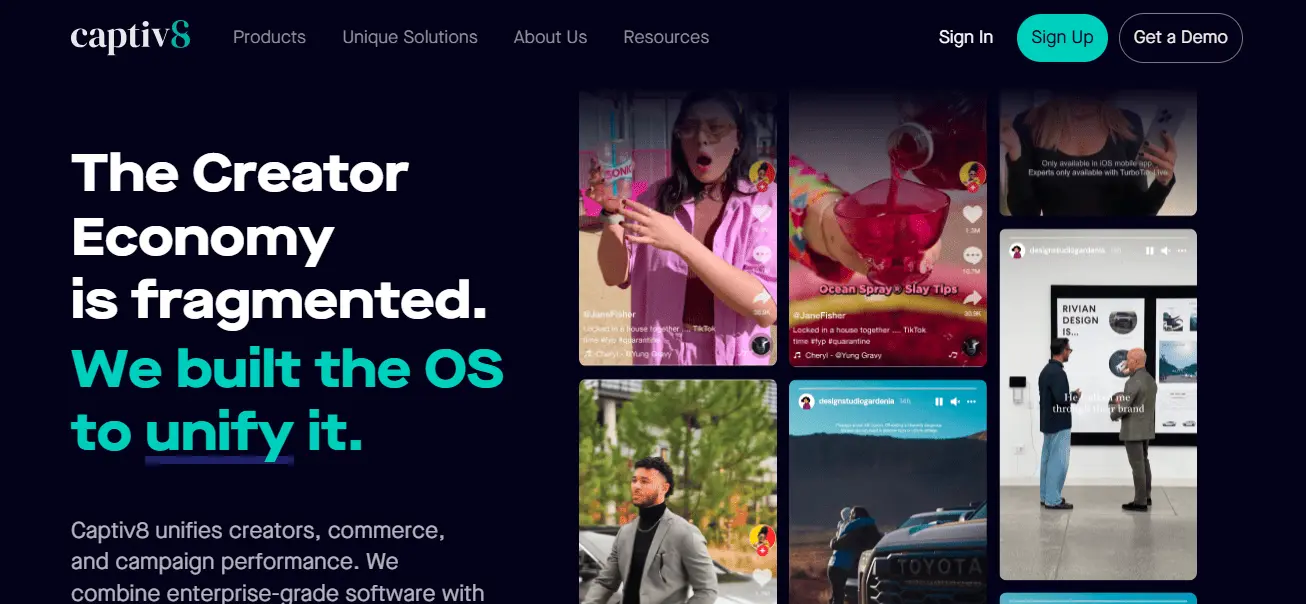
Captiv8 est un poids lourd dans l'espace des influencers en entreprise, récemment renforcé par son acquisition par Publicis Groupe. Il est connu pour son « Social Commerce Engine », qui vise à fermer la boucle entre le message social d'un creator et un achat final. C'est une plateforme axée sur les données qui fournit une très grande envergure, couvrant plus de 15 millions de creators à l'échelle mondiale.
Meilleur ajustement pour : Les grandes marques DTC et les entreprises mondiales qui ont besoin d'une écoute sociale approfondie et de capacités commerciales à haut volume.
Comment cela fonctionne avec les vitrines : Captiv8 propose des « Vitrines de marque » qui servent de pages d'accueil personnalisables et shoppables. Les creators hébergent des galeries de contenu immersives qui s'alignent avec l'esthétique de votre marque, tandis que la plateforme suit le parcours complet de l'impression sociale à l'achat, en fournissant des données de performance transparentes sur l'ensemble de l'entonnoir.
Tarification : Captiv8 est une solution d'entreprise et nécessite généralement un appel de découverte pour la tarification ; ils n'offrent pas de niveau en libre-service à faible coût.
Entreprise standard : Commence généralement à $2 100/mois avec des engagements annuels.
Suite complète : Peut dépasser $40 000/an pour les marques mondiales nécessitant une écoute sociale avancée et des informations concurrentielles.
Facilité d'utilisation (UX/UI) : Les utilisateurs sur G2 et Capterra louent la plateforme pour être un « guichet unique » qui gère tout, de la découverte au paiement. Bien que puissante, l'interface est chargée de données, ce que certains utilisateurs trouvent « déroutante » ou « difficile à naviguer » au cours des premières semaines d'utilisation.
Service client : Connu pour son service « white-glove », Captiv8 fournit des gestionnaires de compte dédiés et un soutien proactif. Les évaluations mettent en évidence leur réactivité aux bogues et leur volonté d'aider les marques à élaborer des stratégies pour les campagnes complexes et multinationales.
Fonctionnalités clés :
- Vitrines de marque alimentées par l'IA : Des expériences d'achat immersives qui utilisent l'IA pour recommander des produits dans la page du creator en fonction du comportement des acheteurs.
- Recherche Velocity : Un moteur de découverte qui utilise des données en temps réel pour trouver des creators « tendance » avant qu'ils deviennent surexposés par d'autres marques.
- Tableau de bord du commerce unifié : Visualisez les ventes d'affiliation, les commandes de cadeaux des influencers et les performances des médias payants en une seule vue.
- Écoute sociale approfondie : Surveillez le sentiment de la marque et les mentions de concurrents sur le Web pour identifier de nouvelles opportunités de creators ou les risques potentiels.
- Paiements mondiaux et conformité fiscale : Un système de paiement automatisé qui gère les différentes devises et la documentation fiscale (W9/W8-BEN) pour les creators internationaux.
Limitations de la plateforme :La contrainte principale est le coût, que les utilisateurs mentionnent fréquemment comme « coûteux » pour les petites agences ou les marques DTC émergentes. Certains critiques notent également que les outils de sensibilisation peuvent sembler un peu « robotisés », ce qui entraîne des taux de réponse plus faibles s'ils ne sont pas fortement personnalisés par l'utilisateur.
10. Affable.ai
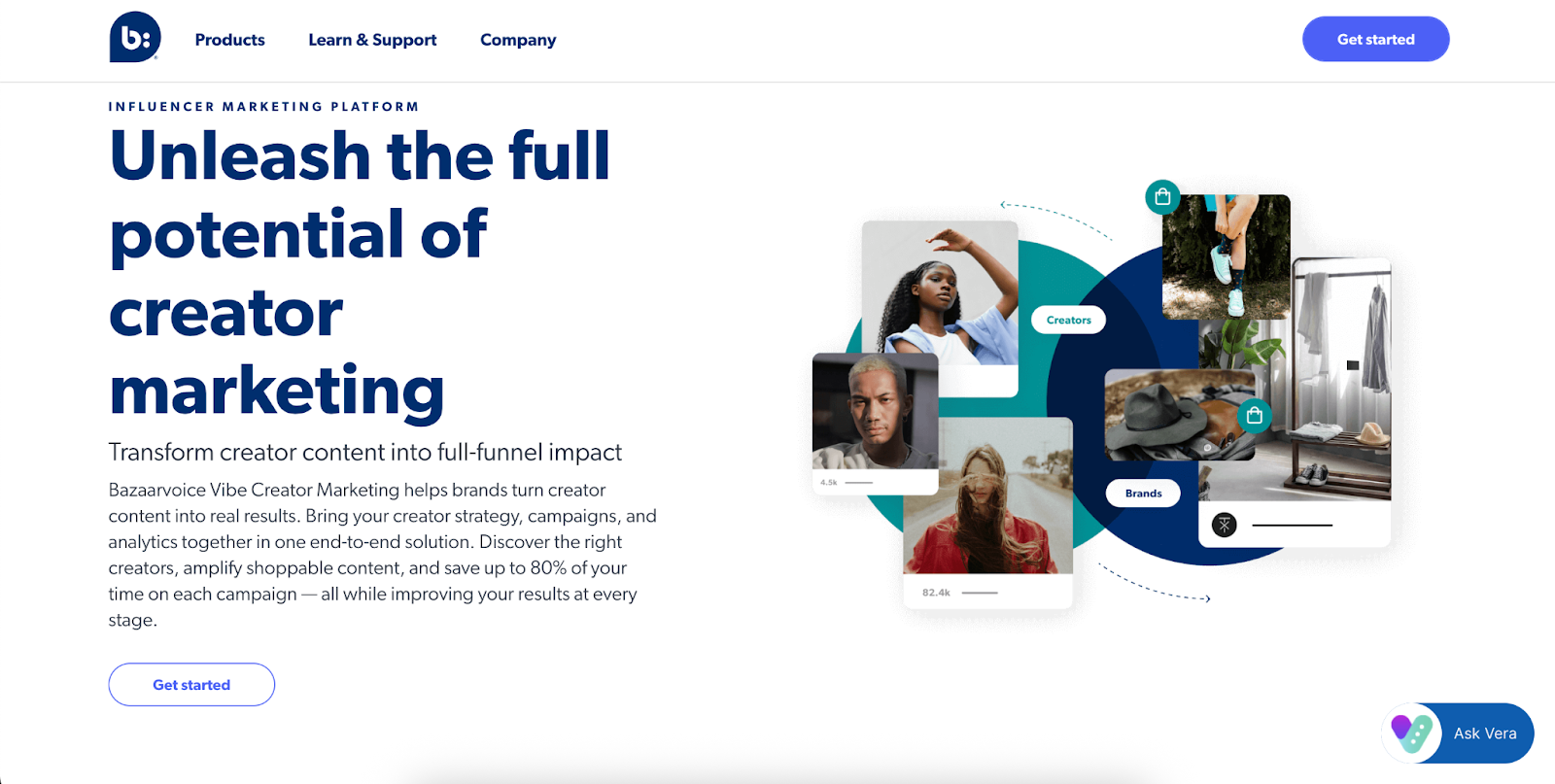
Affable.ai est une plateforme de marketing d'influence basée sur l'IA qui excelle dans la découverte basée sur les données et la gestion automatisée des campagnes. Récemment acquise par Bazaarvoice, elle bénéficie désormais d'un écosystème massif de contenu généré par les utilisateurs (UGC) et de données de vente au détail. Elle est spécifiquement conçue pour aider les marques de commerce électronique à avancer rapidement, en utilisant l'apprentissage automatique pour vérifier les audiences des influencers et s'assurer que chaque partenariat est soutenu par des données de performance concrètes.
Idéal pour : Les marques DTC basées sur les données et les agences en croissance qui ont besoin d'analyses d'audience avancées et d'un haut niveau d'automatisation pour les campagnes mondiales.
Comment cela fonctionne avec les vitrines : Affable.ai s'intègre à Shopify et Magento pour alimenter les « Vitrines achetables ». Les influencers organisent des collections de produits sur des pages d'accueil personnalisées, tandis que la plateforme automatise les codes d'affiliation et les liens de suivi. Cela crée un chemin direct du contenu social à la caisse, capturant les données de ventes en temps réel et le ROI pour chaque vitrine.
Tarification : Affable.ai fonctionne généralement sur la base d'un abonnement avec des devis personnalisés adaptés à la taille de la marque.
- Plan PME : Tarification personnalisée (comprend ~400 analyses d'influencers/mois et jusqu'à 3 utilisateurs).
- Plan Pro : Tarification personnalisée (comprend un volume d'analyse plus élevé et des fonctionnalités avancées de CRM).
- Entreprise : Tarification personnalisée pour les marques mondiales ayant besoin de campagnes illimitées et d'un accès API complet.
Facilité d'utilisation (UX/UI) : Les utilisateurs signalent généralement que la plateforme est « logique et efficace ». L'interface de découverte est très bien notée pour sa simplicité, permettant aux spécialistes du marketing d'appliquer plus de 20 filtres sans que le tableau de bord ne semble encombré. Cependant, certains nouveaux utilisateurs ont noté que la profondeur des rapports d'IA peut prendre quelques sessions pour être pleinement comprise.
Support client : La plateforme est connue pour son processus d'intégration solide et ses gestionnaires de compte dédiés pour la plupart des plans. Les utilisateurs soulignent fréquemment la réactivité de l'équipe sur le chat en direct et sa volonté d'aider à configurer un suivi complexe pour les campagnes multi-régions.
Fonctionnalités clés :
- Vérification d'audience alimentée par l'IA : Détectez automatiquement les « faux followers » et les modèles d'engagement suspects pour s'assurer que le trafic de votre vitrine provient de véritables clients potentiels.
- Syndication de contenu achetable : Grâce à son intégration Bazaarvoice, vous pouvez syndiquer le contenu des creators les plus performants directement sur vos pages de détail des produits (PDP) pour augmenter la conversion sur site.
- Benchmarking concurrentiel : Surveillez les stratégies d'influencers de vos concurrents, y compris les creators avec lesquels ils travaillent et la façon dont leur engagement se compare au vôtre.
- Capture automatique de contenu : Ne manquez jamais un message ; la plateforme capture et enregistre automatiquement les Stories Instagram, les TikToks et les Reels, même après qu'ils aient expiré sur la plateforme sociale.
- Intégration directe du commerce électronique : Synchronisez votre magasin Shopify ou Magento pour gérer l'ensemencement de produits et la gestion des affiliés sans saisie manuelle de données.
Limitations de la plateforme : Bien que la découverte par IA soit de classe mondiale, certains utilisateurs ont signalé que les options de personnalisation de la « Vitrine » sont moins flexibles que les constructeurs web dédiés, ce qui signifie qu'elles peuvent ressembler davantage à des pages d'accueil standard qu'à des expériences de marque complètement immersives. De plus, les outils de sensibilisation automatisée nécessitent occasionnellement un « préchauffage » manuel pour éviter les filtres de spam des influencers.
Comment choisir le bon logiciel de marketing d'influence pour les vitrines
La sélection d'une plateforme dépend du point de friction dans votre flux de travail actuel. Voici comment catégoriser votre recherche en fonction des objectifs spécifiques de votre marque :
Marques axées sur la performance (suivi de l'entonnoir complet) : Recherchez des plateformes qui connectent la découverte à la caisse avec des vitrines de creators et une attribution de bout en bout, afin que vous puissiez mesurer un ROI clair.
Marques orientées vers la découverte et la sensibilisation :Privilégier les grandes bases de données de creators avec des filtres solides et un contrôle d'audience pour trouver rapidement des talents de niche. Les vitrines sont secondaires.
Marques qui augmentent le gifting et l'affiliation : Choisissez des outils avec des intégrations CMS approfondies pour automatiser l'ensemencement des produits et les paiements. Les vitrines agissent comme des centres libre-service où les creators peuvent sélectionner des produits et suivre les revenus.
Réflexions finales
Choisir le meilleur logiciel de marketing d'influence pour les vitrines signifie trouver un équilibre entre la flexibilité des creators et l'automatisation de back-end. Bien que le bon choix dépende de votre échelle spécifique et de votre CMS, l'objectif reste le même : réduire les frictions entre la recommandation d'un creator et l'achat d'un client. En utilisant des vitrines dédiées, vous allez au-delà des liens d'affiliation basiques et créez une expérience professionnelle et commercialisable qui génère de meilleurs taux de conversion et un ROI plus clair.
Influencer Hero est la solution idéale pour les marques DTC cherchant à dimensionner ce processus. Il combine la découverte avancée et le gifting automatisé avec des vitrines personnalisables qui se synchronisent directement avec votre catalogue de produits, ce qui en fait le moyen le plus efficace de gérer un programme de creators axé sur la performance. Prêt à voir comment nos vitrines peuvent dimensionner votre programme ? Réservez une démo ici pour commencer.
Résumé
Ceci est un texte à l'intérieur d'un bloc div.
Ceci est un texte à l'intérieur d'un bloc div.
Tarification/Mois
Avis Shopify
Ceci est du texte à l'intérieur d'un bloc div.
Ceci est un texte à l'intérieur d'un bloc div.
Ceci est un texte à l'intérieur d'un bloc div.
Ceci est du texte à l'intérieur d'un bloc div.
Ceci est un texte à l'intérieur d'un bloc div.
Ceci est un texte à l'intérieur d'un bloc div.
Ceci est du texte à l'intérieur d'un bloc div.
Ceci est un texte à l'intérieur d'un bloc div.
Ceci est un texte à l'intérieur d'un bloc div.
Ceci est du texte à l'intérieur d'un bloc div.
Ceci est un texte à l'intérieur d'un bloc div.
Ceci est un texte à l'intérieur d'un bloc div.
Ceci est du texte à l'intérieur d'un bloc div.
Ceci est un texte à l'intérieur d'un bloc div.
Ceci est un texte à l'intérieur d'un bloc div.
Ceci est du texte à l'intérieur d'un bloc div.
Ceci est un texte à l'intérieur d'un bloc div.
Ceci est un texte à l'intérieur d'un bloc div.
Ceci est du texte à l'intérieur d'un bloc div.
Ceci est un texte à l'intérieur d'un bloc div.
Ceci est un texte à l'intérieur d'un bloc div.
Lire la suite

Questions fréquemment posées
Qu'est-ce que les vitrines de creators et pourquoi en avez-vous besoin ?

Une vitrine de creator est une page d'accueil personnalisée sur votre site où les influencers organisent leurs produits préférés. Elles génèrent des conversions plus élevées que les liens génériques en exploitant la preuve sociale et en offrant une expérience d'achat transparente et co-marquée. Influencer Hero automatise ces pages, garantissant qu'elles se synchronisent toujours avec votre inventaire en direct.
Puis-je suivre le ROI exact de chaque vitrine d'influencer ?
Oui. Les plateformes axées sur la performance offrent un suivi en temps réel de chaque vente, clic et valeur moyenne de commande (VMC) générée via une vitrine spécifique. Bien que les outils d'entreprise comme CreatorIQ offrent des données approfondies, Influencer Hero fournit un tableau de bord rationalisé qui relie l'activité de la vitrine directement à vos résultats.
Comment fonctionne le processus de gifting produit avec les vitrines ?
Les principales plateformes s'intègrent à votre magasin (Shopify, WooCommerce, etc.) pour automatiser la logistique. Vous envoyez un « lien de sélection » au creator, il choisit ses articles préférés, et une commande d'expédition est générée automatiquement. Influencer Hero simplifie ce processus en gérant l'ensemble de la boucle d'exécution sans saisie manuelle de données.
Est-il difficile de gérer les vitrines pour un grand nombre de creators ?
Pas avec la bonne automatisation. Les plateformes modernes vous permettent de lancer des centaines de vitrines simultanément à l'aide de modèles. Influencer Hero se distingue ici en mettant à jour dynamiquement ces pages lorsque les produits sont en rupture de stock, afin que vos creators promotionnent toujours les stocks disponibles.
Quel est le meilleur logiciel pour les vitrines d'une marque DTC en croissance ?
Influencer Hero est le meilleur choix pour les marques qui ont besoin d'un équilibre entre la puissance et la simplicité. Bien que des options d'entreprise comme Aspire soient robustes, elles exigent souvent des contrats à long terme et des frais élevés. Influencer Hero propose une suite tout-en-un — découverte, CRM et vitrines — conçue pour évoluer avec vos revenus.



Les Articles les Plus Populaires


Boostez votre ROI grâce au marketing d'influence
Rejoignez plus de 1 200 marques et 150+ agences qui font croître leurs programmes creators avec Influencer Hero.