
Le meilleur logiciel de marketing d'influence pour Amazon

February 27, 2026
|
Publié

October 12, 2026
|
Mis à jour

14 Min
|
Lecture

Cours de Marketing de Performance avec Influencers | BON DE RÉDUCTION : IMC100

Lucía Zabala
| Author

Générez du ROI avec les Influencers

Base de données mondiale d'influencers
Plateforme TOUT-EN-UN
CRM, Affiliate, UGC & Plus
Meilleur logiciel de marketing d'influence pour Amazon
Pour les fondateurs DTC et les spécialistes du marketing eCommerce, Amazon est souvent la « boîte noire » ultime en matière de performance des influencers. Vous savez qu'un message d'un creator génère une augmentation des ventes, mais sans lien direct entre le message social et Amazon Seller Central, vous devinez lesquels les influencers génèrent réellement un ROI et lesquels génèrent simplement du buzz.
Pour les marques qui opèrent dans l'écosystème Amazon/DTC, le bon logiciel ne trouve pas seulement des creators, il les transforme en une force de vente mesurable.
Dans ce guide, nous avons rassemblé le logiciel de marketing d'influence suivant pour Amazon qui s'intègre directement à la place de marché pour vous aider à suivre les revenus d'affiliation et à rationaliser les flux de travail :
Comment nous avons évalué le logiciel de marketing d'influence pour Amazon
Pour créer cette liste, nous avons évalué les plateformes de marketing d'influence en fonction de la façon dont elles soutiennent les marques eCommerce utilisant Amazon.
Les critères se sont concentrés à la fois sur la compatibilité d'intégration et la capacité à exécuter des campagnes d'influence axées sur la performance à grande échelle.
Critères d'évaluation
- Intégration et compatibilité avec Amazon : La façon dont chaque plateforme fonctionne avec les magasins construits sur Amazon, soit par le biais d'intégrations natives, soit par des flux de travail compatibles qui s'intègrent aux opérations eCommerce existantes.
- Capacités de campagne d'influence : La mesure dans laquelle chaque plateforme prend en charge les cas d'utilisation principaux du marketing d'influence, y compris la découverte de creators, la prise de contact, la gestion des relations, les campagnes de cadeaux et d'ensemencement, et les collaborations basées sur l'affiliation.
- Suivi et rapports de performance : La capacité à suivre la performance au niveau de l'influencer et de la campagne, y compris les conversions, l'attribution des revenus et le ROI, ce qui est essentiel pour les équipes eCommerce axées sur des résultats mesurables.
- Automatisation et efficacité des flux de travail : La façon dont la plateforme automatise les tâches chronophages telles que la prise de contact, la gestion de campagnes, les suivi et les rapports, ce qui est particulièrement important pour les petites équipes gérant des programmes d'influencers à grande échelle.
- Facilité d'utilisation (UX/UI) : L'expérience utilisateur globale, y compris la conception du tableau de bord, la navigation, le processus d'intégration et la courbe d'apprentissage pour les équipes qui opèrent déjà sur Amazon.
- Scalabilité pour les marques en croissance : La façon dont la plateforme prend en charge la croissance, des petites équipes exécutant leurs premières campagnes d'influence aux marques DTC établies gérant des centaines ou des milliers de creators.
- Tarification et flexibilité des contrats : La transparence des tarifs, la disponibilité de plans flexibles et si la plateforme soutient les programmes en croissance sans forcer des engagements à long terme trop tôt.
- Support client et intégration : La disponibilité et la qualité des ressources d'assistance, y compris l'aide à l'intégration, la documentation, les délais de réponse et le support continu du succès client.
Meilleur logiciel d'influence pour Amazon
Le choix du bon logiciel pour votre programme d'influence axé sur Amazon dépend de vos priorités : la découverte, l'automatisation ou l'attribution approfondie. Bien que de nombreuses plateformes offrent des outils d'influence généralistes, seules quelques-unes disposent d'intégrations intégrées qui communiquent directement avec Amazon Seller Central pour suivre les ventes et le ROI en temps réel.
| Plateforme | Idéal pour | Tarif à partir de | Avantage clé |
|---|---|---|---|
| Influencer Hero | Les marques DTC ayant besoin d'une suite d'automatisation et de suivi tout-en-un. | $649/mois | Plateforme de marketing d'influence tout-en-un avec attribution Amazon native, envoi automatisé de cadeaux et prospection. |
| Levanta | Marketing d'affiliation Amazon pur et gestion des commissions. | $750/mois | Conçu spécifiquement pour le bonus de parrainage de marque Amazon. |
| Grin | Les marques du segment intermédiaire axées sur la gestion des relations complexes. | Gratuit / à partir de $399/mois | CRM hautement personnalisé pour faire évoluer les grandes communautés de creators. |
| Aspire | Les marques d'entreprise exécutant des programmes d'ambassadeurs à grande échelle. | Non divulgué, environ 2 000 à $5 000/mois | Outils robustes de concession de licences de contenu et de création communautaire. |
| Impact.com | Les grands vendeurs souhaitant gérer tous les partenariats en un seul endroit. | Personnalisé | Intégration API approfondie avec Amazon Seller Central. |
| Upfluence | Les marques à croissance rapide recherchant l'appariement client-creator. | Non divulgué, environ $2 000/mois | Identifie les influencers de votre propre liste de clients Amazon. |
| CreatorIQ | Les grandes entreprises mondiales ayant besoin d'analyses prédictives du ROI. | Non divulgué. environ 35 000 à $200 000/an | Prévisions de données avancées et rapports de qualité entreprise. |
| Modash | Les marques axées sur la découverte à haut volume pour les catégories de niche. | $199/mois | Énorme base de données de plus de 350 millions de creators pour un dépistage rapide. |
| HypeAuditor | Les marques privilégiant l'authenticité du public et la prévention de la fraude. | Non divulgué. environ 10 000 à $60 000/an | IA de classe mondiale pour détecter les faux followers et les bots. |
| Traackr | Les marques orientées vers les relations ayant besoin de données de performance à long terme. | Non divulgué, environ $32 500/an | Calculateurs de budget détaillés basés sur le ROI historique des creators. |
1. Influencer Hero
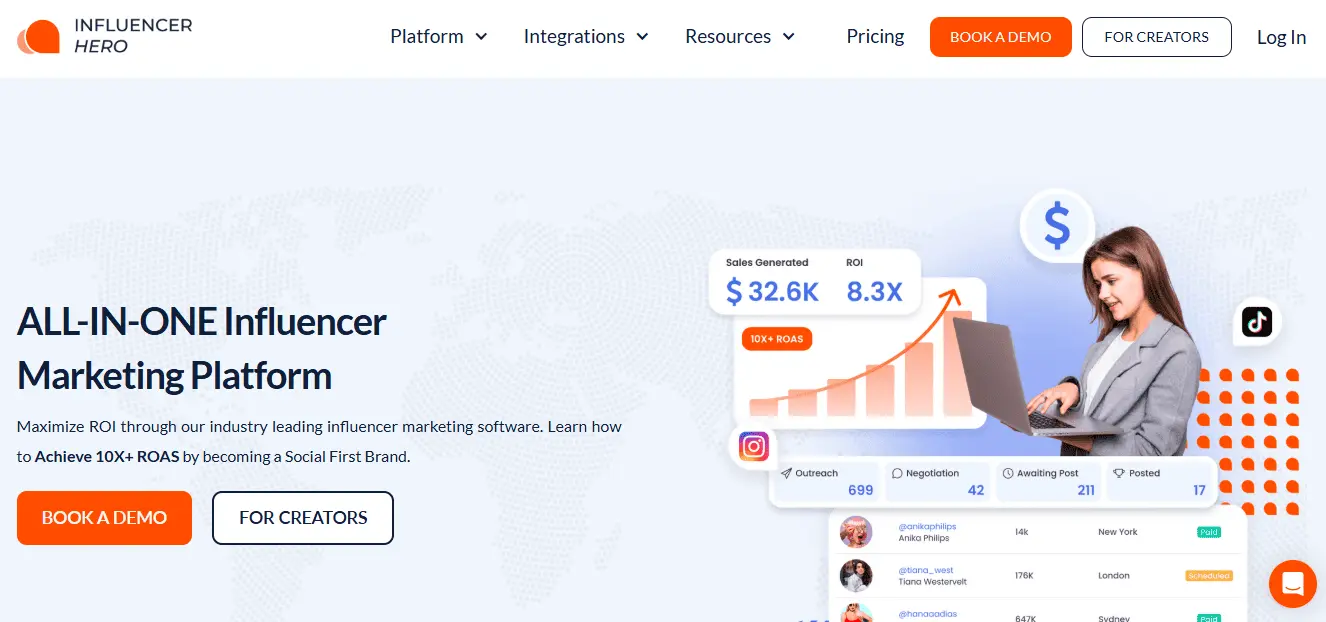
Influencer Hero est une plateforme de marketing d'influence de bout en bout conçue pour les marques eCommerce qui ont besoin d'une visibilité complète de la prospection aux revenus. Pour les vendeurs Amazon, elle connecte les campagnes d'influencers directement aux données d'attribution Amazon, ce qui en fait l'un des meilleurs logiciels de marketing d'influence pour les marques Amazon axées sur le suivi des ventes réelles, pas seulement l'engagement.
Convient mieux à :
Les marques DTC et nativement Amazon qui souhaitent développer les campagnes d'influencers en reliant chaque partenariat creator directement au chiffre d'affaires Amazon. Particulièrement forte pour les équipes axées sur la performance priorisant l'attribution, le suivi des affiliés et la clarté du ROI.
Comment cela fonctionne avec Amazon :
Influencer Hero s'intègre directement à votre magasin Amazon via Amazon Attribution, vous permettant de générer des liens traçables pour chaque influencer et campagne. Lorsque les creators génèrent du trafic vers Amazon, les données de ventes sont automatiquement intégrées dans Influencer Hero, ce qui vous permet de voir quels influencers génèrent des clics, des conversions et des revenus au niveau des commandes.
Au lieu de vérifier manuellement le Seller Central ou de jongler avec des feuilles de calcul, votre équipe peut gérer la découverte, la prospection, l'envoi de produits, le suivi des affiliés et la création de rapports de revenus Amazon dans un seul CRM centralisé. Cela transforme Amazon d'un canal de vente « boîte noire » en un moteur de performance mesurable au sein de votre flux de travail d'influencer.
Tarification & Engagement :
Influencer Hero propose des plans qui s'adaptent à la taille de votre programme, avec un engagement de 3 mois.
- Plan Standard : À partir de $649/mois. Vous permet de contacter jusqu'à 1 000 creators par mois.
- Plan Pro : À partir de $1 049/mois. Vous permet de contacter jusqu'à 5 000 creators par mois.
- Plan Business : À partir de $2 490/mois. Vous permet de contacter jusqu'à 10 000 creators par mois.
- Personnalisé & Agence : Tarification personnalisée selon les besoins de votre marque.
Facilité d'utilisation (UX/UI) :
Influencer Hero est connu pour son design intuitif et centré sur les campagnes. Le tableau de bord est simplifié et conçu autour de flux de travail clairs, permettant aux équipes de passer de la découverte à la prospection au suivi des revenus Amazon sans changer d'outils. Les séquences d'e-mails automatisées, les tableaux CRM structurés et les modèles d'e-mails personnalisables réduisent le travail manuel et rendent les programmes d'influencers Amazon à haut volume gérables, même pour les petites équipes.
Service client :
Le service client est l'un des plus grands atouts d'Influencer Hero.
- Chat en direct 24h/24 et 7j/7 avec des humains
- Support e-mail réactif
- Centre d'aide complet avec guides écrits et tutoriels vidéo
- Gestionnaire de compte dédié inclus dès le premier jour (tous les plans)
- Consultations stratégiques optionnelles pour guider la croissance Amazon
- Les utilisateurs du plan Pro ont accès à un canal Slack privé pour un support plus rapide et continu
Cette approche pratique est particulièrement précieuse pour les marques Amazon mettant en place le suivi Attribution et les flux de travail d'affiliés pour la première fois.
Fonctionnalités clés :
- Suivi des revenus Amazon Attribution : Générez des liens Amazon Attribution uniques par influencer et intégrez automatiquement les données de ventes au niveau des commandes dans la plateforme. Cela permet une visibilité claire sur les clics, les conversions et les revenus générés par chaque creator, au-delà des métriques de vanité vers un ROI Amazon mesurable.
- CRM centré sur les campagnes avec visibilité des revenus : Contrairement aux CRM d'influencers génériques, Influencer Hero relie chaque étape de la campagne (contacté → négocié → publié → conversion) directement à la performance des revenus Amazon. Les équipes peuvent rapidement identifier les creators rentables et augmenter les partenariats en conséquence.
- Prospection automatisée & Flux d'e-mails multi-étapes : Envoyez une prospection en masse ou individuelle avec des suivis automatisés déclenchés par l'étape de la campagne. Pour les vendeurs Amazon gérant des programmes basés sur des commissions, cela rend le recrutement à haut volume gérable sans augmenter les effectifs.
- Suivi des affiliés & des commissions conçu pour les vendeurs Amazon : Créez des liens personnalisés et des structures de commissions liés aux campagnes Amazon. Suivez la performance au niveau des influencers et gérez les paiements tout en gardant l'attribution des ventes centralisée.
- Collecte de contenu UGC + Augmentation basée sur la performance : Collectez automatiquement le contenu des influencers et connectez-le à la performance des ventes Amazon. Cela permet aux marques d'identifier les creators les plus convertisseurs et de réutiliser leur contenu pour les publicités, les publications Amazon ou les médias payants externes, fermant la boucle entre le contenu et le commerce.
Limitations d'Influencer Hero :
La configuration initiale peut nécessiter des conseils : La connexion d'Amazon Attribution et la structuration appropriée des campagnes peuvent nécessiter un support d'intégration, en particulier pour les marques nouvelles au suivi des influencers Amazon. L'équipe de succès client assiste activement lors de la configuration pour garantir une configuration de suivi appropriée.
2. Levanta

Levanta est une plateforme native d'Amazon dédiée au marketing d'influence et à l'affiliation, conçue spécifiquement pour les marques qui vendent sur Amazon. Contrairement aux outils d'influence traditionnels qui adaptent le suivi Amazon dans leurs systèmes, Levanta est conçue autour de l'infrastructure d'affiliation d'Amazon dès le départ—ce qui en fait une solution spécialisée pour augmenter les revenus générés par les creators directement sur Amazon. Les marques axées sur Amazon et les agrégateurs qui génèrent la majorité de leurs revenus via Amazon et souhaitent augmenter les ventes d'affiliation générées par les creators. Particulièrement adapté aux marques exécutant des partenariats basés sur la performance plutôt que de simples dons ou campagnes de sensibilisation. Levanta opère directement dans l'écosystème Amazon en tirant parti de l'infrastructure d'affiliation et d'attribution d'Amazon. Les marques intègrent leur catalogue Amazon dans Levanta, définissent les structures de commission et invitent les creators à des partenariats de type affiliation. Les creators reçoivent des liens traçables liés aux listes de produits Amazon, et Levanta consolide les données de performance—clics, conversions et revenus—dans un seul tableau de bord. Au lieu d'exécuter des campagnes d'influence séparément des rapports d'affiliation Amazon, Levanta devient la couche opérationnelle qui connecte le recrutement de creators, la gestion des commissions et le suivi des revenus Amazon dans un seul flux de travail. Plan Démarrage : Conçu autour des étapes de croissance des vendeurs Amazon. (Les tarifs exacts peuvent varier en fonction du GMV et du volume de creators.) Levanta Gold : $750/mois Enterprise : Tarification personnalisée Levanta fonctionne généralement sur un modèle d'abonnement mensuel, bien que les accords d'entreprise puissent inclure des engagements annuels selon la portée. Certains plans peuvent également inclure des frais basés sur la performance selon le volume de commissions. Les utilisateurs décrivent généralement Levanta comme simple et concentré, notamment comparé aux plateformes d'influence plus larges. Comme elle est conçue spécifiquement pour les flux de travail d'affiliation Amazon, le tableau de bord évite les fonctionnalités inutiles et se concentre sur la synchronisation des catalogues, la gestion des commissions et les rapports de performance. Certains utilisateurs mentionnent que, bien qu'elle soit claire et efficace pour les cas d'usage Amazon, elle manque de la flexibilité de création de campagnes visuelles des CRM d'influence marketing plus traditionnels. Les retours concernant le support client sont généralement positifs, notamment pour l'intégration axée sur Amazon. Les marques soulignent une gestion de compte réactive et une assistance pratique lors de la configuration des structures de commission et de l'intégration des creators. Comme la plateforme est plus spécialisée et axée sur Amazon, les équipes de support ont tendance à être bien informées sur le Seller Central, l'attribution et la mécanique des affiliations—ce qui est particulièrement utile pour les marques transitionnant depuis la gestion manuelle des affiliés. Focus Uniquement Amazon : Levanta est hautement spécialisée pour Amazon, ce qui signifie qu'elle manque d'outils CRM d'influence plus larges, de gestion de campagnes multi-plateformes ou d'intégrations de commerce électronique non-Amazon. Les marques exécutant des programmes hybrides DTC + Amazon peuvent avoir besoin d'outils supplémentaires.Profil Idéal :
Fonctionnement avec Amazon :
Tarification :
Facilité d'Utilisation (UX/UI) :
Support Client :
Fonctionnalités Clés :
Limitations de la Plateforme :
Fonctionnalités de campagne d'influencers moins traditionnelles : Elle est construite principalement autour des revenus d'affiliation plutôt que des workflows d'influencers complets (par exemple, les approbations de contenu avancées, la gestion approfondie des UGC ou les outils de amplification payante multi-canaux).
3. GRIN
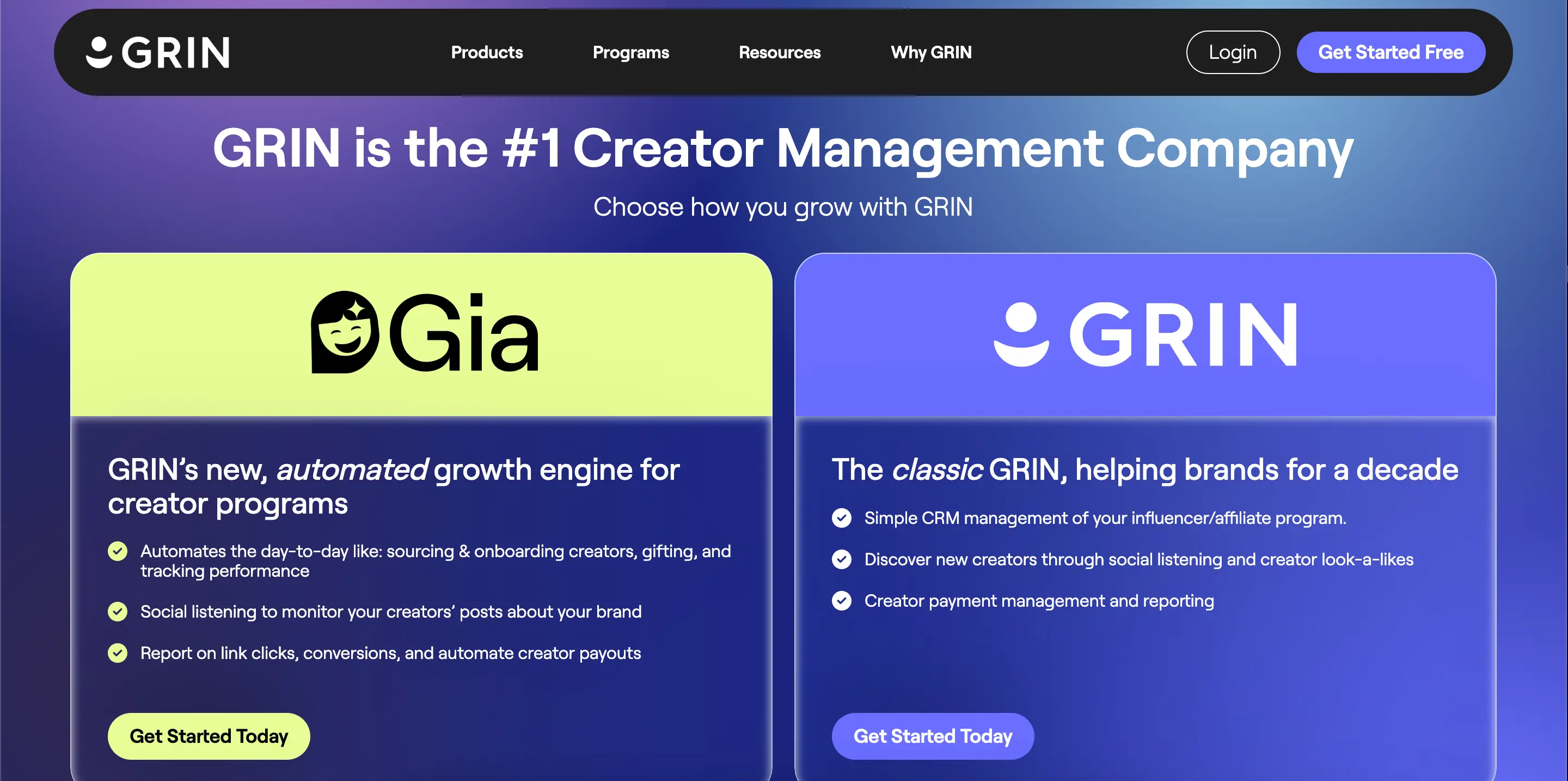
GRIN est une plateforme complète de marketing d'influence construite principalement pour les marques DTC et e-commerce. Elle combine la découverte de creators, la CRM, le gifting, le suivi des affiliés, la gestion des UGC et les paiements dans un seul système centralisé. Bien qu'historiquement la plus forte pour les marques Shopify, GRIN est de plus en plus utilisée par les vendeurs Amazon cherchant à connecter les campagnes d'influencers aux revenus basés sur les places de marché.
Meilleur pour :
Les marques DTC et Amazon de taille moyenne à grande qui souhaitent gérer les relations avec les influencers à long terme plutôt que de mener des campagnes ponctuelles. Particulièrement forte pour les équipes qui privilégient la structure CRM, la collecte des UGC et les partenariats de style affilié à grande échelle.
Comment cela fonctionne avec Amazon :
GRIN s'intègre directement à Amazon, permettant aux marques de suivre les revenus des affiliés et les conversions générées par les campagnes d'influencers. En pratique, les marques utilisent GRIN pour découvrir et recruter des creators, envoyer des produits, gérer les contrats et générer des liens d'affiliation traçables liés aux listes Amazon.
Les données de performance—clics, conversions et revenus—peuvent ensuite être analysées dans GRIN aux côtés des métriques d'engagement. Cela permet aux marques Amazon de gérer les relations avec les creators et l'attribution des revenus dans le même système au lieu de séparer les workflows CRM des rapports Amazon.
Tarification :
- Plan gratuit
- Lite : $399/mois
- Essentials : $699/mois
- Growth : $1 149/mois
- Complete : $1 799/mois
Facilité d'utilisation (UX/UI) :
Les utilisateurs décrivent souvent GRIN comme puissant mais complexe. La plateforme est riche en fonctionnalités, notamment autour des pipelines CRM, de l'automatisation du gifting et des bibliothèques de contenu, ce qui la rend très capable pour les équipes structurées.
Cependant, certains utilisateurs mentionnent une courbe d'apprentissage lors de l'intégration en raison de la profondeur des fonctionnalités. Une fois correctement configurée, de nombreuses marques la trouvent efficace pour gérer les relations à long terme avec les creators et les grands programmes d'influencers.
Support client :
Le support client est fréquemment cité comme l'une des forces de GRIN. Les marques se voient assigner des managers d'intégration et de succès client dédiés, particulièrement au cours des 30 à 60 premiers jours.
Les utilisateurs apprécient les conseils stratégiques et la réactivité des équipes d'assistance, bien que certains notent que les temps de réponse peuvent varier selon le niveau de compte. Les clients de niveau entreprise signalent généralement un service plus personnalisé.
Fonctionnalités clés :
- Partenariats de creators illimités : GRIN ne limite pas le nombre d'influencers avec lesquels une marque peut travailler. Cela la rend particulièrement attrayante pour les vendeurs Amazon qui mettent à l'échelle des programmes de style affilié où le volume et les tests auprès de plusieurs creators sont essentiels pour l'optimisation des performances.
- Intégration e-commerce approfondie : GRIN s'intègre nativement à Amazon, permettant l'ensemencement de produits, la génération de liens d'affiliation et le suivi des revenus au sein d'un seul système. Pour les marques, cela signifie que les ventes des places de marché générées par les influencers peuvent être liées à des creators spécifiques sans dépendre uniquement des tableaux de bord dorsaux d'Amazon.
- Bibliothèque UGC avec gestion des droits médias intégrée : Tout le contenu des influencers—y compris les posts et les Stories—est automatiquement stocké dans une bibliothèque de contenu centralisée. Les droits de réutilisation des médias sont intégrés dans les accords des creators, simplifiant le processus de réutilisation des contenus les plus performants pour les publicités ou les créations de listes Amazon.
- Assistant intelligent GRIN (Gia) : Gia est l'assistant alimenté par l'IA de GRIN, conçu pour mettre en surface les creators les plus adaptés, suggérer des améliorations de sensibilisation et rationaliser la gestion des campagnes. Il agit comme une couche d'amélioration stratégique plutôt qu'un outil d'automatisation basique.
- Paiements in-app et suivi des commissions d'affiliation : GRIN permet aux marques de gérer les paiements des influencers directement par la plateforme (via l'intégration PayPal) tout en suivant les revenus des affiliés et les conversions. Cela centralise la gestion des commissions pour les campagnes basées sur Amazon sans nécessiter de systèmes de paiement séparés.
Limitations de la plateforme :
Coût d'entrée élevé et engagement annuel : Avec des prix commençant autour de $25 000/an et une exigence de contrat de 12 mois, GRIN peut ne pas être accessible aux petits vendeurs Amazon ou aux marques en phase de démarrage.Courbe d'apprentissage et complexité : Bien que puissante, la plateforme peut sembler accablante pour les petites équipes qui ne nécessitent pas de flux de travail CRM avancés ou d'infrastructure de programme d'influencers à grande échelle.
4. Aspire
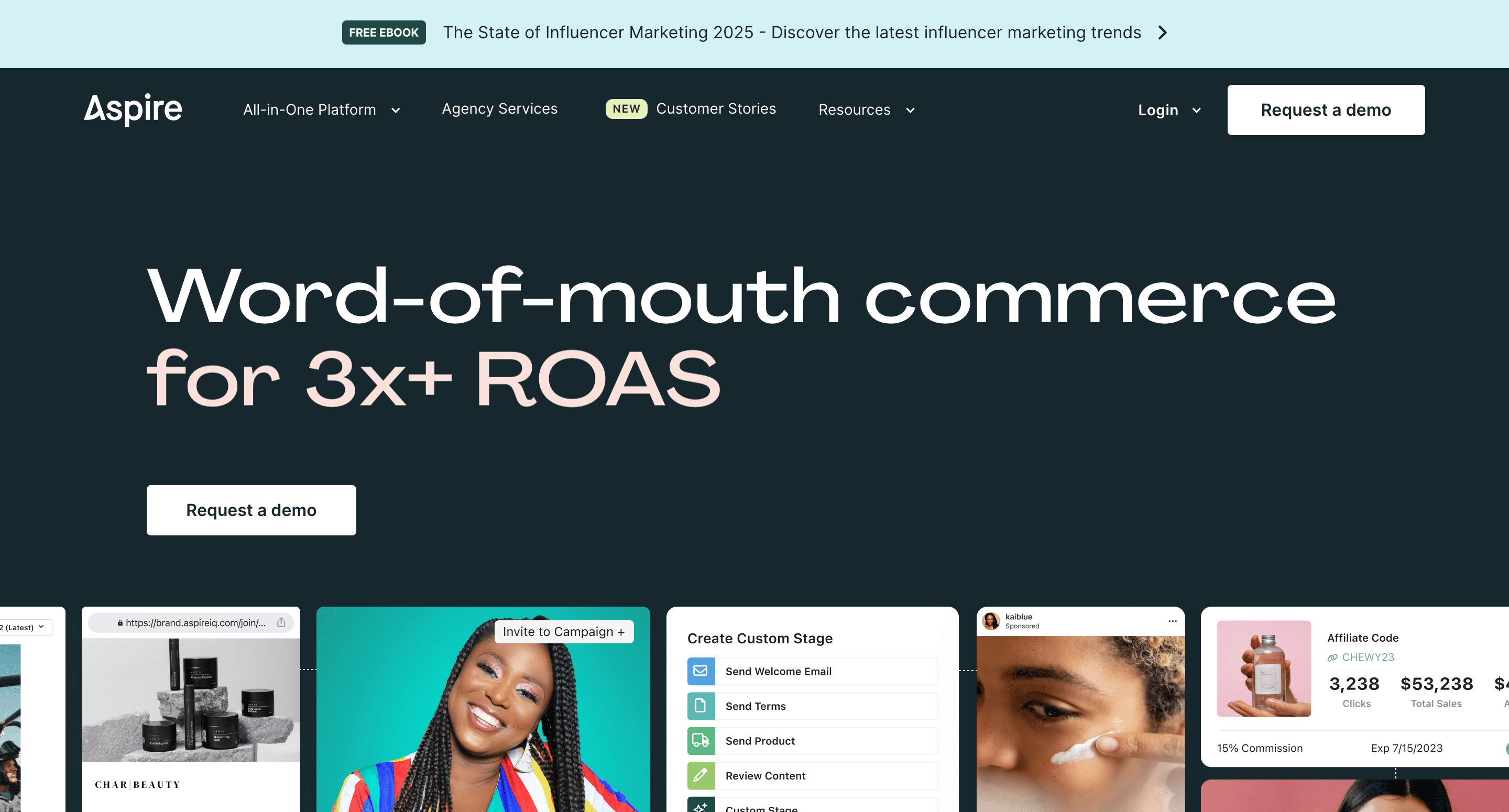
Aspire est une plateforme de marketing d'influence complète conçue pour rationaliser l'ensemble du cycle de vie des creators—de la découverte et du recrutement aux contrats, aux envois de produits, au suivi des affiliés et aux rapports. Connue pour son automation de flux de travail solide et sa grande place de marché de creators entrants, Aspire est largement utilisée par les marques de commerce électronique gérant des campagnes d'influencers structurées et multiphases.
Idéal pour :
Les marques DTC et Amazon de taille moyenne à entreprise qui souhaitent des flux de travail de campagne structurés, des candidatures de creators entrants et des suivi automatisés. Particulièrement puissant pour les marques évolutives des programmes d'envoi de produits et d'affiliation liés aux ventes de produits.
Comment cela fonctionne avec Amazon :
Aspire s'intègre dans une pile axée sur Amazon principalement par le biais du suivi de style affilié et des campagnes axées sur les produits. Les marques utilisent Aspire pour découvrir ou recruter des creators, envoyer des produits, gérer des contrats et générer des liens traçables liés aux annonces Amazon.
Le contenu des influencers génère du trafic vers les pages de produits Amazon, tandis qu'Aspire consolide les données de performance—clics, conversions et ventes—dans les tableaux de bord des campagnes. Cela permet aux marques Amazon de gérer la communication des creators, les approbations et le suivi des performances dans un seul système centralisé au lieu de séparer les opérations CRM des rapports Amazon.
Tarification :
Aspire fonctionne selon un modèle de contrat annuel échelonné, avec des tarifs personnalisés en fonction du volume de creators et de l'accès aux fonctionnalités.
Sa tarification n'est pas divulguée, autour de 2 000 - $5 000/mois.
Facilité d'utilisation (UX/UI) :
Les utilisateurs décrivent souvent Aspire comme bien structuré et visuellement intuitif, appréciant particulièrement ses tableaux de flux de travail de style Kanban et les suivi automatisés. Le pipeline de campagne—invitation → contrat → envoi de produits → approbation → suivi—est clair et facile à naviguer une fois configuré.
Certaines petites équipes mentionnent que bien que l'interface soit épurée, le nombre de fonctionnalités peut sembler accablant au départ. Cependant, la plupart des avis notent que les conseils d'intégration aident à réduire la courbe d'apprentissage initiale.
Support client :
Le support client est fréquemment mis en avant comme un différenciateur majeur. Aspire assigne un Chef de mise en œuvre pendant les 30 premiers jours et un Chef de succès client dédié pour la stratégie continue et l'optimisation.
Les utilisateurs mentionnent régulièrement un support réactif, des vérifications proactives et des conseils pratiques—particulièrement utiles lors de la configuration des intégrations Shopify ou de la structuration des flux de travail d'affiliation liés aux campagnes Amazon.
Caractéristiques clés :
- Place de marché de creators entrants (1M+ creators) : Aspire offre l'une des plus grandes places de marché de creators entrants, où les influencers postulent activement aux campagnes des marques. Cela réduit la dépendance aux prospections à froid et est particulièrement précieux pour les marques Amazon ayant besoin d'un volume constant de creators pour les lancements de produits ou les poussées saisonnières.
- Intégrations de données propriétaires : Aspire exploite les partenariats de données propriétaires avec des plateformes comme Meta et TikTok, plutôt que de s'appuyer uniquement sur des données publiques extraites. Cela augmente la confiance dans la démographie des audiences et la précision de l'engagement lors de la sélection des creators pour générer du trafic vers Amazon.
- Automation de flux de travail structuré : Le pipeline de campagne complet de la plateforme comprend des suivi automatisés, la génération de contrats, les actions en masse et le suivi des approbations de contenu. Pour les vendeurs Amazon gérant des programmes d'affiliation continus, cette structure aide à gérer plusieurs creators simultanément sans perdre la visibilité sur les livrables.
- Suivi des envois de produits et des ventes : Pour les marques Amazon avec des stratégies hybrides DTC + place de marché, cela permet aux campagnes de type affiliation et à la réalisation de produits de fonctionner correctement tout en générant du trafic externe vers les annonces Amazon.
- Bibliothèque de contenu et suivi d'utilisation :
Limitations de la plateforme :
Contrat annuel et coûts d'entrée plus élevés : Avec des tarifs à partir d'environ $2 300/mois et nécessitant un engagement de 12 mois, Aspire peut être prohibitif pour les petits vendeurs Amazon ou les marques en phase initiale.
Plus adapté au DTC qu'à Amazon pur : Bien qu'il supporte les workflows d'affiliation, les intégrations les plus profondes d'Aspire sont axées sur Shopify. Les marques opérant exclusivement sur Amazon sans couche DTC peuvent ne pas tirer pleinement parti des fonctionnalités d'automatisation du commerce électronique de la plateforme.
5. Impact.com

Impact.com est une plateforme de gestion des partenariats au niveau entreprise qui prend en charge les programmes d'affiliation, d'influence, d'ambassade et de parrainage dans un seul système unifié. Plutôt que d'être uniquement un CRM d'influencers, Impact est construit en tant que moteur d'automatisation des partenariats plus large, ce qui le rend populaire auprès des marques qui considèrent les influencers comme des partenaires de performance au sein d'une stratégie d'affiliation plus large.
Meilleur pour :
Les marques Amazon d'entreprise et à croissance élevée qui souhaitent gérer les influencers, affiliés, éditeurs et autres partenaires de performance dans un seul système centralisé. Particulièrement adapté pour les marques priorisant la croissance basée sur les commissions et l'évolutivité mondiale.
Fonctionnement avec Amazon :
Impact.com s'intègre à une pile basée sur Amazon principalement via les workflows de suivi des affiliations et d'attribution. Les marques utilisent Impact pour recruter des influencers en tant qu'affiliés, générer des liens traçables vers les annonces Amazon et gérer les structures de commission en fonction des performances.
Les creators promeuvent les produits Amazon à l'aide de liens traçés, et Impact consolide les clics, les conversions et les calculs de paiement dans un seul tableau de bord de performance. Au lieu de gérer le recrutement des influencers séparément de la création de rapports d'affiliation, les marques Amazon peuvent centraliser le recrutement, les contrats, le suivi et les paiements de commissions dans un cadre de partenariat structuré.
Tarification :
- Starter : $30/mois
- Essentials : $500/mois
- Pro : $2 500/mois
- Enterprise : Sur devis
Facilité d'utilisation (UX/UI) :
Les utilisateurs décrivent souvent Impact comme puissant mais complexe. L'interface est riche en données et conçue pour les spécialistes du marketing de performance plutôt que pour les équipes légères d'influencers.
Bien que les tableaux de bord et les rapports soient hautement personnalisables, les nouveaux utilisateurs mentionnent parfois une courbe d'apprentissage raide lors de la configuration. Une fois configurée, les marques gérant de grands écosystèmes d'affiliation ou d'influencers signalent qu'elle devient un système centralisé et efficace.
Support client :
Les commentaires sur le support client sont généralement positifs au niveau entreprise. Les marques reçoivent souvent des gestionnaires de compte dédiés et des spécialistes en intégration.
Cependant, certains utilisateurs du marché intermédiaire notent que les délais de réponse peuvent varier selon le niveau de contrat. Les comptes plus importants reçoivent généralement davantage de conseils stratégiques et de support de mise en œuvre pratique.
Fonctionnalités clés :
- Gestion unifiée des partenariats : Impact dépasse le marketing d'influence, ce qui permet aux marques de gérer les affiliés, creators, ambassadeurs, éditeurs et partenaires B2B dans un seul système. Pour les marques Amazon, cela signifie que les partenariats d'influencers peuvent fonctionner dans le même cadre de performance que les programmes d'affiliation plus grands.
- Automatisation avancée des commissions et des contrats : Les marques peuvent créer des structures de commission dynamiques en fonction de la catégorie de produit, de la géographie, du niveau de performance ou de la période promotionnelle. C'est particulièrement utile pour les vendeurs Amazon avec des marges variables entre les ASIN qui souhaitent un contrôle granulaire des paiements.
- Rapports et attribution au niveau entreprise : Impact fournit des modèles d'attribution multi-touchs et des tableaux de bord de rapports personnalisables. Les marques orientées Amazon peuvent comparer les revenus Amazon générés par les influencers à côté d'autres canaux payants pour comprendre l'impact total du partenariat.
- Infrastructure de paiement mondiale :Impact automatise les paiements des partenaires dans plusieurs devises et régions. Cela en fait une solution bien adaptée pour les marques Amazon opérant à l'international qui ont besoin d'une distribution de commissions conforme et scalable.
- Outils de protection contre la fraude et de conformité : La plateforme comprend une détection intégrée des fraudes et des contrôles de sécurité de marque. Pour les vendeurs Amazon exécutant de grands programmes d'affiliation, cela ajoute une couche de protection contre le trafic invalide ou les violations de politique.
Limitations de la plateforme :
Coût élevé et engagement annuel : Impact est positionnée comme une solution d'entreprise, ce qui la rend moins accessible pour les petits et moyens vendeurs Amazon. Le contrat annuel requis et les frais basés sur la performance peuvent augmenter considérablement le coût total.
Plus axée sur l'affiliation que sur les influencers : Bien qu'elle supporte les partenariats avec les influencers, Impact est fondamentalement une plateforme d'affiliation et de partenariat, pas un véritable CRM d'influencers avec des workflows de contenu approfondis, une gestion de contenu généré par les utilisateurs ou une automatisation centrée sur les creators.
6. Upfluence

Upfluence est une plateforme tout-en-un de marketing d'influence et d'affiliation conçue pour aider les marques de commerce électronique à gérer la découverte, la prospection, l'exécution de campagnes, le suivi des affiliés et les paiements dans un seul système. Elle est particulièrement connue pour ses intégrations profondes avec Shopify et Amazon, ce qui en fait une option solide pour les marques qui souhaitent que les campagnes d'influence soient directement liées au chiffre d'affaires.
Meilleur pour :
Les marques de commerce électronique et Amazon de taille moyenne à grande qui souhaitent une solution influencer + affiliation de bout en bout avec un suivi solide du ROI. Particulièrement utile pour les marques cherchant à convertir les clients existants en creators et affiliés.
Comment cela fonctionne avec Amazon :
Upfluence s'intègre directement à Amazon pour suivre les ventes générées par les influencers, les liens d'affiliation et la performance des campagnes. Les marques recrutent des creators dans Upfluence, génèrent des liens traçables liés aux annonces Amazon et surveillent les conversions et les revenus au sein de la plateforme.
Au lieu de gérer la prospection des influencers séparément des rapports Amazon, Upfluence centralise la découverte, la communication, la configuration des affiliés et l'attribution des revenus. Cela permet aux marques Amazon de mesurer quels creators génèrent réellement des ventes sur la marketplace – pas seulement des métriques d'engagement.
Tarification :
Upfluence fonctionne sur un modèle de contrat annuel avec une facturation mensuelle. Son tarif n'est pas divulgué, environ $2 000/mois
Facilité d'utilisation (UX/UI) :
Les utilisateurs décrivent généralement Upfluence comme riche en fonctionnalités et complète. Le tableau de bord centralise la recherche d'influencers, la gestion de la relation client, la gestion des affiliés et les rapports au même endroit, ce qui réduit le changement d'outils.
Cependant, certains utilisateurs mentionnent une courbe d'apprentissage lors de la configuration initiale en raison de la profondeur des fonctionnalités. Les nouveaux utilisateurs trouvent parfois les workflows de création de campagnes légèrement rigides ou moins modifiables une fois lancés.
Support client :
Les retours sur le support client sont largement positifs, particulièrement lors de l'intégration et de la mise en œuvre. Les marques notent que les gestionnaires de compte sont utiles lors de la configuration des intégrations (notamment Shopify et Amazon).
Certains avis mentionnent des retards occasionnels dans la résolution des problèmes techniques, mais en général, le support est considéré comme fiable et réactif pour les comptes de taille moyenne à grande.
Fonctionnalités clés :
- Intégrations de revenus Amazon + Shopify : Upfluence s'intègre à la fois avec Amazon et Shopify, permettant aux marques de suivre les ventes générées par les campagnes d'influence et d'affiliation. Cela la rend particulièrement puissante pour les marques hybrides opérant sur les canaux DTC et marketplace.
- Assistant de campagne IA (« Jace AI ») : Upfluence inclut un assistant IA qui aide à automatiser la prospection et la messagerie des campagnes. Il supporte les flux de courrier électronique en masse et les séquences d'automatisation, rendant le recrutement de creators à grand volume plus scalable.
- Gestion intégrée des affiliés et des commissions : Les marques peuvent créer des codes d'affiliation personnalisés, suivre les liens et définir les modèles de compensation au sein de la plateforme. Le suivi des commissions et les paiements peuvent être gérés directement, réduisant la dépendance aux outils d'affiliation externes.
- Écoute sociale et recherche de marché :Upfluence inclut des outils d'écoute sociale qui permettent aux marques d'identifier les contenus tendance et de voir quels posts génèrent l'engagement. Cela ajoute une couche stratégique au-delà de la simple découverte d'influencers.
Limitations de la plateforme :
Engagement annuel et coûts plus élevés : Upfluence nécessite un contrat d'un an complet, ce qui peut limiter la flexibilité pour les petits vendeurs Amazon. Il n'y a pas d'option d'annulation mensuelle.
Courbe d'apprentissage pour les nouveaux utilisateurs : Bien que complète, la plateforme peut sembler complexe au début. Certains utilisateurs notent que certains éléments de campagne ne peuvent pas être modifiés après la configuration, ce qui peut réduire la flexibilité pendant les campagnes actives.
7. CreatorIQ

CreatorIQ est une plateforme de marketing d'influence au niveau entreprise conçue pour les marques mondiales gérant des programmes complexes de creators multi-marchés. Elle prend en charge l'ensemble du cycle de vie des influencers—découverte, CRM, gestion de campagne, paiements et rapports—tout en offrant des intégrations de données approfondies et des tableaux de bord d'analyse personnalisables.
Meilleur adapté pour :
Les grandes marques Amazon, les entreprises mondiales et les agrégateurs gérant des programmes influencers à haut volume sur plusieurs régions. Particulièrement performante pour les marques nécessitant des rapports au niveau exécutif, une infrastructure de conformité et des flux de travail évolutifs.
Comment cela fonctionne avec Amazon :
CreatorIQ s'intègre dans une pile axée sur Amazon en permettant aux marques de gérer le recrutement d'influencers, les contrats, les approbations de contenu et le suivi de type affilié dans un seul système. Les marques génèrent des liens traçables liés aux listes Amazon et mesurent la performance de la campagne via des tableaux de bord personnalisables.
En pratique, CreatorIQ agit comme la couche opérationnelle : les équipes marketing gèrent les creators, les approbations et les rapports de performance au sein de la plateforme, tandis qu'Amazon reste le canal de vente principal. Cela centralise le flux de travail des influencers et l'analyse des revenus plutôt que de s'appuyer uniquement sur les outils de rapports natifs d'Amazon.
Tarification :
CreatorIQ fonctionne sur un modèle de contrat annuel strict, avec une tarification non divulguée, d'environ $35 000 - $200 000 par an.
Facilité d'utilisation (UX/UI) :
Les utilisateurs décrivent souvent CreatorIQ comme puissante et hautement personnalisable, mais conçue davantage pour les équipes d'entreprise que pour les petites entreprises. Le tableau de bord est riche en données, avec des filtres détaillés, des analyses avancées et des balises CRM structurées.
Du fait de sa profondeur, certains utilisateurs mentionnent un processus d'intégration plus abrupt. Cependant, une fois configurée, les équipes gérant des campagnes mondiales apprécient la flexibilité et les capacités de rapports prêts pour les cadres.
Support client :
CreatorIQ fournit des gestionnaires d'implémentation dédiés et des équipes de succès client, que les clients d'entreprise louent fréquemment. Les marques soulignent les conseils stratégiques proactifs, l'intégration structurée et le support de gestion de compte cohérent.
Étant donné son orientation d'entreprise, le support est généralement pratique et consultatif plutôt que self-service, ce qui est bénéfique pour les marques Amazon gérant de grands écosystèmes d'influencers.
Fonctionnalités clés :
- Découverte de creators au niveau entreprise (Aucun opt-in requis) : CreatorIQ permet aux marques de rechercher des profils de creators publics sans nécessiter de bases de données opt-in. Les filtres avancés incluent les données démographiques, les mentions de marques passées, les mots-clés de contenu et les attributs d'audience—idéal pour les marques Amazon ciblant des catégories de produits de niche.
- Rapports exécutifs personnalisables et intégrations API : La plateforme se connecte directement aux API Meta, TikTok et YouTube pour les données de performance en temps réel. Les marques peuvent créer des tableaux de bord prêts pour les cadres montrant la performance de la campagne, l'engagement et l'attribution des revenus—utile pour les équipes Amazon rendant compte à la direction ou aux investisseurs.
- CRM structuré et approbations en une feuille : CreatorIQ inclut un système CRM robuste avec balisage, notes personnalisées, segmentation des creators et feuilles d'approbation partageables. Les parties prenantes peuvent examiner les influencers et les détails de la campagne sans se connecter—rationalisant l'alignement interne pour les lancements de produits.
- Paiements intégrés et conformité fiscale : La plateforme gère les paiements des influencers directement au sein du système et traite la documentation IRS et la conformité. Pour les marques Amazon travaillant avec de grands volumes de creators mondialement, cela réduit la charge opérationnelle.
- Bibliothèque de contenu et suivi de l'utilisation :Tous les actifs de campagne sont collectés automatiquement et stockés dans une bibliothèque de contenu centralisée. Les marques peuvent suivre les droits d'utilisation et télécharger le contenu pour le réutiliser dans les publicités ou les ressources créatives Amazon.
Limitations de la plateforme :
Coût élevé et positionnement entreprise : Avec des plans commençant à $35 000/an et augmentant considérablement, CreatorIQ est généralement inaccessible pour les petits vendeurs Amazon.
Configuration complexe et nécessitant beaucoup de ressources : La puissance de la plateforme s'accompagne de complexité. Les petites équipes peuvent trouver que la profondeur de la personnalisation et des rapports est accablante si elles ne nécessitent pas une infrastructure de niveau entreprise.
8. Modash

Modash est une plateforme de découverte de creators et de marketing d'influence construite autour de l'une des plus grandes bases de données d'influencers publics du marché. Elle se concentre sur la découverte, la prospection, le suivi d'affiliation et les intégrations eCommerce basées sur Shopify, se positionnant comme un outil axé sur les performances pour les marques qui souhaitent des résultats mesurables des campagnes d'influence.
Meilleur pour :
Les marques eCommerce et Amazon en croissance qui privilégient la découverte de creators à grande échelle et les partenariats de style affilié. Particulièrement performant pour les marques qui souhaitent des filtres de recherche puissants et une prospection évolutive sans s'engager dans une tarification de niveau entreprise.
Comment cela fonctionne avec Amazon :
Modash n'a pas d'intégration native Amazon mais s'inscrit dans une pile basée sur Amazon par le biais de flux de travail de suivi de style affilié. Les marques utilisent Modash pour découvrir et recruter des creators, gérer la prospection et générer des liens traçables qui dirigent le trafic vers les listes Amazon.
Le suivi des performances (clics, engagement et revenus d'affiliation) peut être surveillé dans Modash en association avec des outils d'affiliation ou d'attribution externes. En pratique, les marques Amazon utilisent Modash principalement pour l'approvisionnement en creators et la gestion de campagnes, tandis que Amazon Attribution ou les tableaux de bord d'affiliation gèrent le suivi final des ventes.
Tarification :
- Essentials : $199/mois
- Performance : $499/mois
- Enterprise : $14 700/an
Facilité d'utilisation (UX/UI) :
Les utilisateurs décrivent fréquemment Modash comme propre, moderne et facile à naviguer. Ses filtres de recherche et la structure de sa base de données sont souvent mis en avant comme intuitifs et rapides par rapport aux plateformes plus lourdes au niveau entreprise.
Parce que la plateforme se concentre sur un ensemble de fonctionnalités plus restreint (découverte, prospection, suivi), elle tend à sembler moins accablante que les outils tout-en-un au niveau entreprise. Cependant, certains utilisateurs notent que les fonctionnalités avancées d'automatisation des flux de travail sont plus limitées par rapport aux plateformes plus grandes.
Support client :
Le support client est généralement salué pour sa réactivité et ses conseils d'intégration. De nombreux utilisateurs signalent des démonstrations utiles et des réponses rapides de l'équipe Modash.
Par rapport aux plateformes entreprise, le support est davantage axé sur le produit plutôt que consultatif stratégiquement, mais la satisfaction globale à l'égard de la qualité du support est élevée.
Fonctionnalités clés :
- Base de données de 350M+ creators publics (Pas d'inscription requise) : Modash offre un accès à l'une des plus grandes bases de données d'influencers disponibles, construite entièrement sur des données publiques. Cela permet aux vendeurs Amazon de rechercher au-delà des places de marché avec inscription et d'identifier les creators de niche dans des catégories de produits spécifiques.
- Filtrage avancé et découverte par IA : Les marques peuvent filtrer les creators par localisation du public, taux d'engagement, démographie, mots-clés de niche et même style visuel en utilisant la recherche « décrivez une vibe » alimentée par l'IA. Ceci est particulièrement utile pour les vendeurs Amazon ciblant des segments d'acheteurs très spécifiques.
- Outils Lookalike et « Find Your Fans » : Modash peut identifier des creators similaires aux influencers les plus performants et même surface les influencers qui suivent déjà votre marque. Cela aide les marques Amazon à trouver des prospects chauds susceptibles de se convertir mieux dans les campagnes d'affiliation.
- Automatisation d'affiliation : Pour les marques hybrides DTC + Amazon, cela permet aux flux de travail de distribution de produits et d'affiliation de fonctionner en douceur tandis qu'Amazon reste le canal de vente principal.
- Suivi des campagnes et des performances en temps réel :Les marques peuvent surveiller les impressions, la portée, l'engagement, les ventes d'affiliation (via Shopify) et les performances au niveau des creators dans un tableau de bord centralisé. L'analyse intégrée des faux abonnés aide également à valider la qualité des influencers avant le partenariat.
Limitations de la plateforme :
Pas d'intégration Amazon native : Modash ne s'intègre pas directement à Amazon. Les marques vendant exclusivement sur Amazon doivent s'appuyer sur des systèmes de suivi externes pour une attribution complète des revenus.
Outils de flux de travail d'entreprise limités : Comparée à des plateformes plus grandes comme CreatorIQ ou GRIN, Modash offre moins d'automatisations CRM avancées, d'outils de gestion des contrats et de flux d'approbation de contenu.
9. HypeAuditor

HypeAuditor est une plateforme d'analyse d'influencers et de gestion de campagnes, connue pour ses capacités avancées d'analyse de la qualité de l'audience et de détection des fraudes. Originellement construite comme un outil d'audit d'influencers, elle a évolué en une solution complète de gestion de campagnes avec des fonctionnalités de découverte, de sensibilisation, de CRM et de suivi des performances sur plusieurs plateformes sociales.
Meilleur adapté pour :
Les marques Amazon et de commerce électronique qui donnent la priorité au contrôle des influencers, à l'authenticité de l'audience et à la sécurité de la marque avant de mettre à l'échelle les campagnes. Particulièrement fort pour les marques préoccupées par les faux abonnés, l'engagement gonflé ou l'analyse des concurrents.
Comment cela fonctionne avec Amazon :
HypeAuditor s'inscrit dans une pile basée sur Amazon en aidant les marques à identifier des influencers de haute qualité, à gérer les sensibilisations et à générer des liens de campagne suivis qui génèrent du trafic vers les listes Amazon. Les marques utilisent ses outils d'analyse pour vérifier les creators, puis exécutent des campagnes structurées avec des mesures de performance suivies.
Bien que HypeAuditor ne soit pas natif à Amazon, il supporte des flux de travail de style affiliation où les liens des influencers redirigent le trafic vers les pages de produits Amazon. Les marques peuvent analyser l'engagement et la performance des campagnes dans HypeAuditor, tandis que l'attribution finale au niveau des commandes est gérée par Amazon Attribution ou la création de rapports d'affiliation.
Tarification :
HypeAuditor utilise une tarification personnalisée, généralement structurée sur des contrats annuels. Il offre un essai gratuit de 24 à 48 heures et sa tarification est non divulguée, autour de $10,000 - $60,000 /y
Facilité d'utilisation (UX/UI) :
Les utilisateurs décrivent fréquemment HypeAuditor comme riche en données et très analytique. Les tableaux de bord de la plateforme fournissent des métriques détaillées au niveau des influencers, y compris les scores de qualité de l'audience et les informations d'affinité avec la marque.
Certains utilisateurs mentionnent que l'interface peut sembler dense en raison du volume d'analyses disponibles. Cependant, les équipes axées sur la performance et la validation apprécient la disposition structurée et les options de filtrage détaillées.
Service client :
Les commentaires sur le service client sont généralement positifs, notamment lors de l'intégration. Les utilisateurs soulignent les équipes d'assistance compétentes qui aident à interpréter les analyses et à guider la configuration des campagnes.
Les clients d'entreprise reçoivent souvent des gestionnaires de compte dédiés, tandis que les comptes plus petits peuvent davantage s'appuyer sur le support par ticket. Dans l'ensemble, la réactivité et le professionnalisme sont fréquemment loués.
Fonctionnalités clés :
- Qualité avancée de l'audience et détection des fraudes : HypeAuditor est surtout connue pour son système de scoring détaillé d'authenticité de l'audience, incluant la détection des faux abonnés et les évaluations de qualité du compte. Les marques peuvent filtrer les creators en fonction de la crédibilité de l'audience, ce qui est particulièrement précieux pour les vendeurs Amazon axés sur les campagnes d'affiliation basées sur le ROI.
- Découverte d'influencers alimentée par l'IA : La plateforme permet aux marques de filtrer les creators par démographie, engagement, niche, langue, mentions de marque et même collaborations avec des concurrents. L'analyse de catégories alimentée par l'IA évalue les bios, les légendes, les images et les vidéos pour aller au-delà de la simple correspondance par mots-clés.
- Outils de suivi des concurrents et d'écoute sociale : Les marques peuvent surveiller quels influencers travaillent avec les concurrents ou mentionnent des mots-clés et des hashtags spécifiques. Cela donne aux vendeurs Amazon un aperçu des tendances des creators au niveau de la catégorie avant de lancer des poussées de produits.
- CRM d'outreach et de gestion de campagnes intégrés : HypeAuditor supporte la messagerie en masse, les modèles de courriels personnalisés, les cartes d'influencers avec des directives de contenu et la gestion des contrats. Les flux de travail des campagnes permettent aux marques de gérer les approbations et de suivre les performances des publications dans un seul système.
- Rapports de performance et analytique : La plateforme suit l'engagement, la portée, les impressions et les métriques d'affiliation comme les clics et les conversions. Des rapports personnalisables aident les marques à évaluer le ROI des campagnes et à comparer les performances des influencers sur plusieurs campagnes.
Limitations de la plateforme :
Pas d'intégration native à Amazon : HypeAuditor ne s'intègre pas directement à Amazon pour le suivi des revenus au niveau des commandes. Les marques doivent s'appuyer sur Amazon Attribution ou des tableaux de bord d'affiliation externes pour les rapports de ventes finales.
Interface riche en analyses : Bien que puissante, la profondeur des analyses peut être accablante pour les petites équipes ou les marques à la recherche d'une solution d'outreach d'influencers légère.
10. Traackr
Traackr est une plateforme d'influencer marketing d'entreprise axée sur l'analyse comparative des performances, l'optimisation des budgets et la mesure du ROI. Contrairement aux plateformes centrées uniquement sur l'automatisation de l'outreach, Traackr se positionne comme un moteur de décision basé sur les données, aidant les marques à comprendre quels creators, campagnes et marchés génèrent le meilleur rendement.
Meilleur adapt pour :
Les marques Amazon d'entreprise et mondiales qui privilégient l'allocation des budgets, l'analyse comparative du ROI et le suivi des performances des influencers à long terme. Particulièrement fort pour les marques gérant plusieurs marchés ou lignes de produits où l'efficacité financière importe plus que l'outreach en grand volume.
Fonctionnement avec Amazon :
Traackr s'inscrit dans une pile basée sur Amazon en aidant les marques à identifier les creators très performants, à gérer les campagnes et à mesurer les performances selon les KPI clés avant et après que le trafic n'atteigne Amazon. Les influencers génèrent du trafic vers les listes Amazon en utilisant des liens suivis ou des structures d'affiliation, tandis que Traackr centralise l'engagement, la portée, le coût et les métriques de ROI.
Pour les vendeurs Amazon, cela signifie que les décisions de campagne (qui augmenter, qui mettre en pause, où allouer le budget) sont prises dans Traackr, tandis que les données finales d'achat sont rapprochées via Amazon Attribution ou la déclaration d'affiliation. Traackr agit comme la couche de performance stratégique au-dessus du moteur de ventes d'Amazon.
Tarification :
Traackr utilise un modèle de contrat annuel personnalisé. Sa tarification n'est pas divulguée, environ $32 500/an
Facilité d'utilisation (UX/UI) :
Les utilisateurs décrivent généralement Traackr comme structuré et professionnel, félicitant particulièrement ses tableaux de bord de rapports et ses outils d'analyse comparative. L'interface est conçue autour des métriques de performance et des informations financières plutôt que simplement de la découverte d'influencers.
Cependant, comme il se concentre fortement sur l'analyse et la comparaison de données, certains utilisateurs mentionnent une courbe d'apprentissage lors de la première navigation dans les modules de rapports. Les équipes familiarisées avec les analyses du marketing de performance ont tendance à s'adapter plus rapidement.
Support client :
Le support client reçoit des retours positifs, en particulier des clients d'entreprise. Les marques mettent en avant des gestionnaires de compte compétents et des processus d'intégration structurés.
Comme Traackr dessert principalement les grandes organisations, le support tend à être consultatif et stratégique plutôt que purement technique. Certains utilisateurs notent que la qualité des réponses est forte mais étroitement liée au niveau de compte.
Fonctionnalités clés :
- Score de vitalité de marque (BVS) : Le score propriétaire de vitalité de marque de Traackr combine la visibilité, l'engagement et la confiance de marque dans un seul indice de performance. Cela aide les marques Amazon à analyser comparativement leur impact d'influencers par rapport aux concurrents et à suivre l'élan de marque sur les campagnes.
- Analyse comparative et optimisation avancées du ROI et des budgets : La plateforme suit le CPC, le CPE, le CPV, la portée, le taux d'engagement et le ROI sur les campagnes. Pour les vendeurs Amazon allouant des budgets d'influencers sur plusieurs ASIN ou régions, cela permet des décisions d'investissement plus éclairées.
- Historique et analyse comparative des performances des influencers : Traackr stocke les données de campagne historiques et permet des comparaisons côte à côte entre les creators et les marchés. Cela aide les marques à identifier les meilleurs acteurs à long terme plutôt que de s'appuyer sur des métriques de campagne ponctuelles.
- CRM d'entreprise et flux de travail de gifting : Les marques peuvent gérer les relations avec les creators, l'ensemencement de produits et le suivi des affiliations dans un CRM centralisé. Le balisage structuré et les notes permettent aux équipes de coordonner les efforts entre les départements et les marchés.
- Rapports exportables et prêts pour la direction :Les rapports de Traackr sont conçus pour les présentations aux parties prenantes, avec des options d'exportation granulaires et des visuels d'évaluation comparative en temps réel. Ceci est particulièrement précieux pour les marques Amazon signalant le ROI des influencers à la direction ou aux investisseurs.
Limitations de la plateforme :
Coût d'entrée élevé et orientation vers les entreprises : Avec une tarification commençant à $32 500 par an, Traackr ne convient pas aux petits vendeurs Amazon ou aux marques en phase de démarrage.
Plus axée sur l'analyse que sur la sensibilisation : Bien qu'elle prenne en charge les fonctionnalités CRM et de sensibilisation, la force principale de Traackr réside dans l'évaluation comparative et l'analyse de performance plutôt que dans l'automatisation du recrutement d'influencers à haut volume.
Comment choisir le bon logiciel de marketing d'influence pour Amazon
Le choix de la bonne plateforme dépend moins de la taille de la marque que de la façon dont le marketing d'influence se connecte à votre stratégie de revenus Amazon.
Marques orientées vers les revenus : Si Amazon est un canal de vente principal, privilégiez les plateformes offrant un suivi complet qui relie directement l'activité des influencers aux revenus Amazon attribués et au ROI.
Marques orientées vers la découverte : Si le suivi des ventes se fait ailleurs, choisissez des outils axés sur la découverte et la sensibilisation des influencers pour soutenir les lancements, les campagnes saisonnières ou les tests de niche.
Marques orientées vers les cadeaux et les programmes d'affiliation : Pour l'ensemencement à grande échelle ou les programmes d'affiliation, recherchez une gestion CRM, de codes et de commissions robuste, idéalement intégrée aux données de performance Amazon.
Réflexions finales
Le choix du meilleur logiciel de marketing d'influence pour Amazon dépend en fin de compte de la façon dont votre marque aborde la croissance. Certaines plateformes se spécialisent dans la découverte et la sensibilisation à grande échelle, d'autres se concentrent sur le recrutement d'affiliés ou l'évaluation comparative d'entreprise. Cependant, pour les marques axées sur Amazon qui se soucient de l'impact mesurable sur les revenus, pas seulement des impressions ou de l'engagement, le différenciateur clé est la façon dont la plateforme relie l'activité des influencers directement à la performance des ventes Amazon.
Parmi les options disponibles, Influencer Hero se distingue comme le meilleur choix pour l'intégration Amazon, combinant le CRM des influencers, la gestion de campagne, les flux de travail d'affiliation et l'attribution des revenus Amazon dans un système cohésif. Prêt à voir comment cela fonctionne ? Réservez une démo ici.
Résumé
Ceci est un texte à l'intérieur d'un bloc div.
Ceci est un texte à l'intérieur d'un bloc div.
Tarification/Mois
Avis Shopify
Ceci est du texte à l'intérieur d'un bloc div.
Ceci est un texte à l'intérieur d'un bloc div.
Ceci est un texte à l'intérieur d'un bloc div.
Ceci est du texte à l'intérieur d'un bloc div.
Ceci est un texte à l'intérieur d'un bloc div.
Ceci est un texte à l'intérieur d'un bloc div.
Ceci est du texte à l'intérieur d'un bloc div.
Ceci est un texte à l'intérieur d'un bloc div.
Ceci est un texte à l'intérieur d'un bloc div.
Ceci est du texte à l'intérieur d'un bloc div.
Ceci est un texte à l'intérieur d'un bloc div.
Ceci est un texte à l'intérieur d'un bloc div.
Ceci est du texte à l'intérieur d'un bloc div.
Ceci est un texte à l'intérieur d'un bloc div.
Ceci est un texte à l'intérieur d'un bloc div.
Ceci est du texte à l'intérieur d'un bloc div.
Ceci est un texte à l'intérieur d'un bloc div.
Ceci est un texte à l'intérieur d'un bloc div.
Ceci est du texte à l'intérieur d'un bloc div.
Ceci est un texte à l'intérieur d'un bloc div.
Ceci est un texte à l'intérieur d'un bloc div.
Lire la suite

Questions fréquemment posées
Quel est le meilleur logiciel de marketing d'influence pour les vendeurs Amazon?

Le meilleur logiciel de marketing d'influence pour les vendeurs Amazon est celui qui connecte les campagnes d'influencers directement au suivi des revenus Amazon—pas seulement aux métriques d'engagement. Des plateformes comme Influencer Hero se démarquent parce qu'elles combinent la découverte de creators, la sensibilisation, le CRM, la gestion d'affiliation et le suivi Amazon Attribution dans un seul système. D'autres outils peuvent supporter la sensibilisation ou les flux de travail d'affiliation, mais peu offrent une intégration Amazon complète.
Le logiciel de marketing d'influence peut-il suivre les ventes réelles sur Amazon ?
Oui, mais toutes les plateformes ne le font pas nativement. Certains outils s'appuient sur des tableaux de bord d'affiliation externes, tandis que d'autres s'intègrent à Amazon Attribution pour mesurer les clics, les conversions et les revenus. Les plateformes telles que Influencer Hero sont conçues pour connecter directement les performances des influencers aux données de ventes Amazon, offrant une meilleure visibilité du ROI par rapport aux outils de découverte uniquement.
Quelle est la différence entre les outils d'affiliation Amazon et les plateformes de marketing d'influence ?
Les outils d'affiliation Amazon se concentrent principalement sur la génération de liens traçables et la gestion des commissions. Les plateformes de marketing d'influence vont plus loin en gérant la découverte de creators, la prospection, les workflows de campagne, les approbations de contenu et le suivi des performances. Des solutions comme Influencer Hero combinent les deux approches, permettant aux marques de gérer les relations avec les influencers tout en suivant les revenus générés par Amazon au même endroit.
Avez-vous besoin d'outils séparés pour la prospection d'influencers et le suivi Amazon ?
Pas nécessairement. Certaines marques utilisent un outil pour la prospection et s'appuient sur Amazon Seller Central ou les tableaux de bord d'affiliation pour le suivi. Cependant, les plateformes intégrées comme Influencer Hero éliminent le besoin de systèmes multiples en centralisant la prospection, la configuration des affiliés et la mesure de la performance Amazon dans un seul flux de travail.
Quel logiciel est le meilleur pour développer les programmes d'influencers Amazon à long terme ?
Pour une montée en charge à long terme, les marques devraient privilégier les plateformes qui offrent des flux de travail CRM structurés, la gestion des commissions et la visibilité des revenus liés à Amazon. Bien que certains outils se spécialisent dans la découverte ou les modèles d'affiliation uniquement, des plateformes comme Influencer Hero sont mieux adaptées aux programmes Amazon axés sur la performance qui nécessitent une optimisation continue et une croissance mesurable.




Les Articles les Plus Populaires


Boostez votre ROI grâce au marketing d'influence
Rejoignez plus de 1 200 marques et 150+ agences qui font croître leurs programmes creators avec Influencer Hero.