Vyrill Pricing & Review
October 6, 2026
|
Published

July 30, 2026
|
Updated

10 minutes
|
Reading

Influencer Performance Marketing Course | VOUCHER: IMC100

I Author
Drive ROI With Influencers

Global Influencer Database
ALL-IN-ONE platform
CRM, Affiliate, UGC & More
Vyrill Pricing & Review
Vyrill pricing starts at $249/month for the Starter plan and goes up to $499/month for Growth, with custom Enterprise pricing on request. Pay annually and you'll get 20% off, dropping those tiers to $199 and $399/month.
Unlike most platforms in this category, Vyrill actually publishes its prices — no demo required to see the numbers.
But the bigger question isn't the price. It's whether Vyrill does what you think it does, because it's a very different kind of tool than a typical influencer platform. Here's the full breakdown.
Vyrill Pricing
Starter — $249/month
• Up to 40 videos managed
• In-video search, individual video analysis, and advanced filters
• Video commerce carousel + 2 years of video storage
Starter covers the core of what Vyrill does: discovering, analyzing, and merchandising user-generated video. It's aimed at smaller eCommerce brands testing shoppable video, but it leaves out the deeper analytics — no sentiment, demographics, or competitor insights at this tier.
Growth — $499/month
• Up to 100 videos managed
• Everything in Starter, plus Brand Video Insights (sentiment, demographics, SEO keywords)
• Competitor insights, "Ask Vyrill" AI agent, and 4 years of storage
Growth is where the AI features kick in. You get the "Ask Vyrill" marketing agent, competitor benchmarking, and multi-platform review syndication. This is the tier most brands serious about UGC video will need, which makes the real entry cost closer to $499 than $249.
Enterprise — Custom
• Unlimited videos managed and unlimited storage
• API integration and multi-platform syndication
• Phone support alongside email and live chat
Enterprise unlocks unlimited volume and the only tier with API access. Pricing is quote-based and aimed at larger retailers or agencies running video at scale. If API access matters to you, note it's gated entirely behind this top tier.
API pricing
Vyrill offers a video API, but it's bundled into the Enterprise plan rather than priced separately — you'll need a custom quote. (Influencer Hero also offers API access for teams that need to build on top of the platform.)
Vyrill Overview
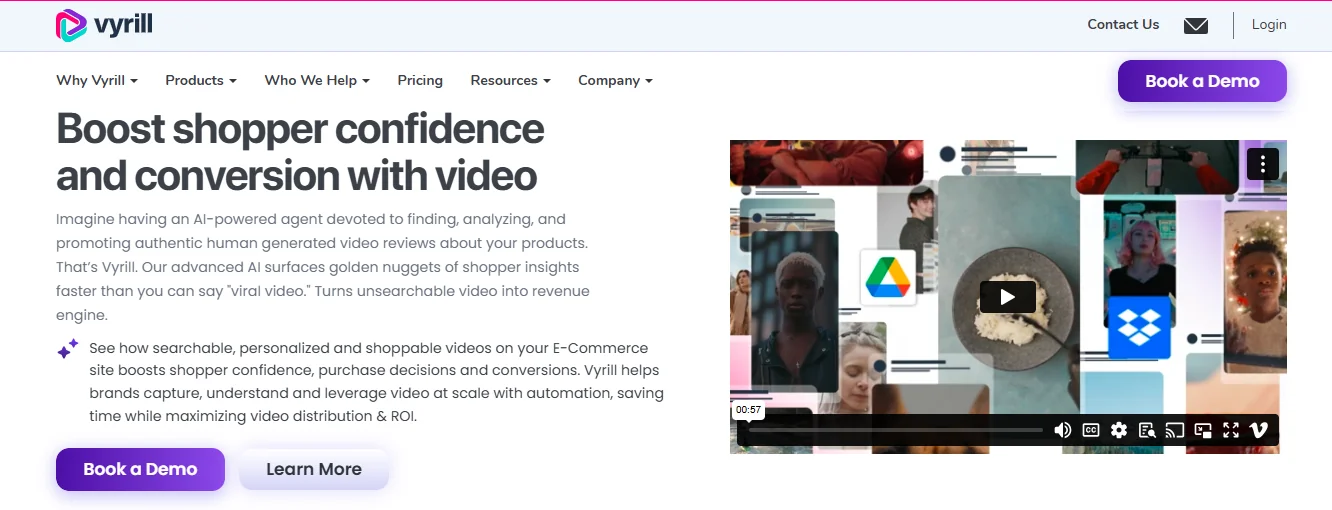
Vyrill is an AI-powered video commerce and UGC intelligence platform, founded in 2015 in San Francisco by Ajay Bam and Barbara Rosario. It's a small, seed-stage company, and it's not a conventional influencer marketplace — it specializes in finding, analyzing, licensing, and merchandising user-generated video, primarily from YouTube. The core pitch is its "in-video" search engine, which scans speech, text, and footage to surface relevant videos and score them for relevance.
Vyrill Best Features
• In-Video AI Search: Vyrill's standout feature analyzes the actual content inside a video — audio, on-screen text, and footage — across more than 70 filters. This lets brands match thousands of YouTube videos to a product catalog by category, brand, or competitor, rather than relying on titles and tags alone.
• Video Commerce Carousels: The platform turns user-generated video into shoppable carousels you can embed on a Shopify storefront. The goal is converting browsers into buyers by surfacing authentic video reviews at the point of purchase.
• Video Insights & Sentiment Analysis: On the Growth tier and up, Vyrill analyzes videos across multiple dimensions including sentiment, demographics, and brand safety flags like nudity or sensitive language. It generates keyword reports and sentiment breakdowns that would take a team days to compile manually.
• UGC Discovery & Licensing: Creators can list videos with their own licensing fees, and brands can discover and license that content directly, with payments settled via PayPal. This gives brands a lower-cost route to authentic video than producing it in-house.
• "Ask Vyrill" AI Agent: Growth and Enterprise users get an AI marketing assistant that answers questions and surfaces recommendations based on collected video data. It's positioned as a way to pull insights without digging through dashboards manually.
Vyrill Reviews
Here's the honest picture: Vyrill has almost no public review footprint. There's no G2 or Capterra star rating to point to — listings exist, but they sit empty with no verified user reviews.
For a buyer, that's a real consideration. With a small, seed-stage company and no independent review base, you're relying mostly on the demo and your own trial rather than peer validation.
The features it does advertise are genuinely useful for a narrow video-commerce use case — but the lack of third-party proof means you should test it thoroughly before committing to an annual plan.
Vyrill vs Influencer Hero Pricing
On price alone, Vyrill is cheaper — $249/month undercuts Influencer Hero's $649 entry plan. But the two tools aren't solving the same problem, so the lower number doesn't tell you much on its own.
Vyrill is built to do one thing well: find, analyze, and merchandise user-generated video, mostly from YouTube, for Shopify storefronts. It doesn't handle influencer discovery across Instagram and TikTok, has no outreach automation, and explicitly doesn't integrate with a CRM. Influencer Hero covers that full operation — creator discovery across every major platform, outreach automation, an influencer CRM, gifting, affiliate management, and end-to-end ROI tracking.
So the real decision is about the job you're hiring the tool for. If you only need shoppable video reviews, Vyrill is the cheaper, focused pick.
Final Thoughts
Vyrill is a capable, affordable tool for a specific job — turning user-generated video into searchable, shoppable content for eCommerce brands. Its in-video AI search and Shopify carousels are genuinely differentiated, and the published pricing makes it easy to evaluate without a sales call.
The limits are scope and maturity. As a niche video-commerce tool with no real review base and no influencer outreach or CRM features, it won't replace a full influencer marketing platform. For brands that need to run discovery, outreach, affiliate, and reporting in one place, Influencer Hero is the more complete option, while tools like Modash and GRIN are worth a look for discovery depth or eCommerce-focused workflows. To see the full platform in action, book a demo with Influencer Hero.
Blog Post: Comparison
Summary
This is some text inside of a div block.
This is some text inside of a div block.
Pricing/Month
Shopify Reviews
This is some text inside of a div block.
This is some text inside of a div block.
This is some text inside of a div block.
This is some text inside of a div block.
This is some text inside of a div block.
This is some text inside of a div block.
This is some text inside of a div block.
This is some text inside of a div block.
This is some text inside of a div block.
This is some text inside of a div block.
This is some text inside of a div block.
This is some text inside of a div block.
This is some text inside of a div block.
This is some text inside of a div block.
This is some text inside of a div block.
This is some text inside of a div block.
This is some text inside of a div block.
This is some text inside of a div block.
This is some text inside of a div block.
This is some text inside of a div block.
This is some text inside of a div block.
Read More

FAQs





Most Popular Blogs


Drive ROI With Influencer Marketing
Join 1,200+ brands and 150+ agencies scaling creator programs with Influencer Hero.