Linkr Pricing And Review in 2026

May 18, 2026
|
Published

August 19, 2026
|
Updated

10 minutes
|
Reading

Influencer Performance Marketing Course | VOUCHER: IMC100

María Vincenzini
I Author

Drive ROI With Influencers

Global Influencer Database
ALL-IN-ONE platform
CRM, Affiliate, UGC & More
Linkr Pricing & Review in 2026
Linkr pricing starts at €199/month for the entry-level Search & Communicate plan, with tiers going up to €1,990/month for the Whitelabel Enterprise solution. If you pay annually, you can save anywhere from 17% to 25% depending on the plan you choose.
This article breaks down every Linkr plan in detail: what's included, what's missing, and how it stacks up against Influencer Hero if you're weighing your options.
Linkr Pricing in 2026
All plans can be cancelled monthly (except the Whitelabel plan). Linkr also offers a 7-day free trial — no credit card required.
Search & Communicate - €199/month (or €149/month annually)
- Unlimited influencer search within Linkr's verified network
- Advanced filters: gender, geography, industry, audience demographics, engagement, past cooperations
- Influencer list management, notes, and AI-powered daily recommendations
- Real-time chat with influencers on web and mobile
This is Linkr's entry plan, built for brands that want to discover and connect with influencers but aren't yet ready to manage full campaigns through the platform. You can search, shortlist, and message — but payments, campaign management, and product seeding are all locked behind higher tiers. Good for testing the network, limited for running anything end-to-end.
Influencer Relationship Management - €349/month (or €289/month annually)
- Create and manage individual influencer cooperations and multi-influencer campaigns
- Smart pricing suggestions and negotiation tools
- Influencer payments and automated invoicing
- Cooperation history, ratings, and import/export functionality
- Priority customer support
The IRM plan is where actual campaign management kicks in. You can build campaigns, negotiate proposals, pay influencers, and track cooperation history. The automated invoicing is a practical time-saver for teams handling multiple creators at once. That said, eCommerce integrations — product gifting, discount codes, commission tracking — are still off the table at this tier.
Product & eCommerce Integration - €699/month (or €559/month annually)
- Everything in IRM, plus:
- Product inventory integration with shop systems (Shopify, Shopware)
- Automated product sample seeding and inventory sync
- Barter deals and performance-based compensation
- Discount codes and automated sales commission tracking
- No platform fee on cooperation payments
- Customizable brand ambassador program
This is Linkr's most complete self-service tier, and the one most relevant for DTC brands running product seeding or affiliate-style campaigns. The native discount code generation and commission tracking is genuinely useful — it removes a lot of manual work. Worth noting: Linkr's Shopify app is no longer listed on the Shopify App Store, so current shop integrations are handled directly through the platform.
Whitelabel Enterprise - €1,990/month (or €1,549/month annually)
- Fully customizable platform: custom branding, domain, login/signup pages
- Multi-channel, multi-language, multi-country configuration
- Private influencer database
- API access
- Dedicated customer success manager
The Whitelabel plan is designed for agencies and enterprise brands that want to run influencer marketing under their own brand identity. It's a meaningful leap in both price and capability — API access and a private database make it viable for organizations running large, custom workflows.
API pricing: Linkr includes API access exclusively in the Whitelabel Enterprise tier. There's no standalone API plan. Influencer Hero, by contrast, offers API access as part of its standard platform plans — worth factoring in if API integration is a near-term need.
Linkr Overview
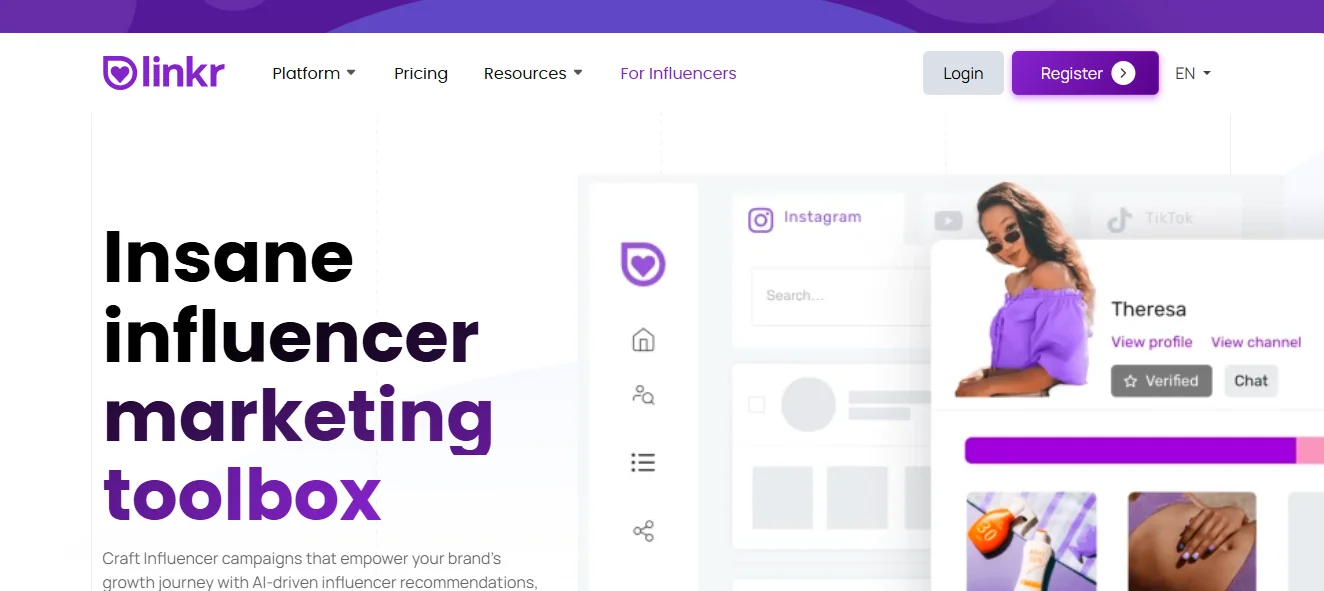
Linkr is a Munich-based influencer marketing platform built primarily for small-to-mid-sized brands and eCommerce businesses looking for a structured way to manage creator collaborations. Its core strength is in simplifying the end-to-end workflow for brands working with micro and nano influencers (from discovery to payment) without requiring a large marketing team to operate it. The platform is particularly popular with Shopify and Shopware merchants in European markets, and its modular pricing means brands can start lean and add features as their campaigns scale.
Linkr Best Features
- Modular, scalable pricing structure: Rather than forcing users into a single all-in plan, Linkr lets brands pay for exactly what they need. You can start with discovery-only and layer in CRM, payments, and eCommerce features as your campaigns mature. For smaller teams that aren't ready to commit to a full-stack tool, this reduces upfront cost.
- Native eCommerce integrations for product seeding: On the Product & eCommerce plan, Linkr connects directly to your Shopify or Shopware backend to automate product sample orders and inventory syncing. Brands can run gifting campaigns without manually tracking what's been sent or to whom — the platform handles fulfillment logistics alongside campaign management.
- Automated discount code generation and commission tracking: For brands running sales-commission campaigns, Linkr auto-generates personalized discount codes per influencer and calculates earned commissions in real time. This eliminates one of the most tedious parts of affiliate-style influencer programs: reconciling who drove what.
- Flexible compensation models: Linkr supports fixed-price campaigns, barter/product-only deals, performance-based compensation, bidding mode, and hybrid variants. The range of compensation types gives brands flexibility to run different campaign types within a single platform — useful when testing what works with a new creator audience.
- Real-time chat and cooperation management: Rather than relying on email threads, Linkr gives brands and creators a dedicated chat channel within the platform. Cooperation proposals, briefings, and pricing negotiations all happen in one place, keeping a clear record of every interaction per creator.
Linkr Reviews
Linkr holds a 4.6/5 rating on the Shopify App Store and a 4.8/5 across app stores overall, which reflects consistently strong feedback for a platform of its size. Users repeatedly highlight ease of use, fast onboarding, and responsive customer support — particularly the team's willingness to help with first campaigns via Zoom.
The most common praise centers on how quickly brands can get a micro-influencer campaign live. One reviewer noted: "We had contact with over 30 influencers on the first day." The platform's structured briefing and proposal tools clearly reduce the usual back-and-forth friction.
On the critical side, users flag limited advanced analytics and a relatively small influencer network compared to larger platforms. A few reviewers mention that the platform's depth doesn't scale well once brands move beyond simple gifting or barter campaigns and need more sophisticated reporting. Reddit sentiment is sparse — Linkr doesn't have much of a community presence outside its core European user base, which itself signals it hasn't fully broken into the broader global market.
Linkr vs Influencer Hero Pricing
Linkr's entry plan is the more affordable option for brands at the early stages of influencer marketing — especially those running campaigns primarily in European markets. The monthly cancellation flexibility is a genuine differentiator for teams not ready to lock in.
The gap widens when you look at what each platform delivers at the mid and upper tiers. Influencer Hero is built to handle the full influencer marketing operation: AI-powered influencer discovery across a much larger database, outreach automation, influencer CRM, gifting, affiliate and commission tracking, Shopify integrations, ROI reporting, and workflow automation — all within a single platform.
Linkr's eCommerce tier covers some of this ground, but brands that need outreach at scale, cross-platform campaign management, or deeper analytics will quickly run into the platform's ceiling.
Final Thoughts
Linkr is a solid option for small brands and European DTC businesses looking for a simple, affordable way to run micro-influencer campaigns. The modular pricing keeps entry costs low, the eCommerce integrations are practical, and the platform’s straightforward setup makes it easy to launch campaigns without needing a dedicated influencer marketing team.
That said, as influencer programs grow, Linkr’s limitations become more noticeable. Brands managing larger creator networks, multi-channel campaigns, or needing deeper outreach automation, attribution, and reporting will likely outgrow the platform quickly. The jump to the Whitelabel enterprise tier is also significant, without much flexibility in between.
Influencer Hero is built to support brands beyond the testing phase — combining large-scale creator discovery, automated outreach, CRM, gifting, affiliate tracking, and advanced ROI reporting in one platform. Alternatives like Modash or Aspire are also worth considering depending on whether discovery depth or creator relationship management is your main priority.
Ready to scale your influencer program beyond basic campaigns? Book a demo with Influencer Hero and see how it works in practice.
Summary
This is some text inside of a div block.
This is some text inside of a div block.
Pricing/Month
Shopify Reviews
This is some text inside of a div block.
This is some text inside of a div block.
This is some text inside of a div block.
This is some text inside of a div block.
This is some text inside of a div block.
This is some text inside of a div block.
This is some text inside of a div block.
This is some text inside of a div block.
This is some text inside of a div block.
This is some text inside of a div block.
This is some text inside of a div block.
This is some text inside of a div block.
This is some text inside of a div block.
This is some text inside of a div block.
This is some text inside of a div block.
This is some text inside of a div block.
This is some text inside of a div block.
This is some text inside of a div block.
This is some text inside of a div block.
This is some text inside of a div block.
This is some text inside of a div block.
Read More

FAQs




Most Popular Blogs


Drive ROI With Influencer Marketing
Join 1,200+ brands and 150+ agencies scaling creator programs with Influencer Hero.