Lefty Pricing & Review in 2026

October 6, 2026
|
Published

August 19, 2026
|
Updated

10 minutes
|
Reading

Influencer Performance Marketing Course | VOUCHER: IMC100

María Vincenzini
I Author

Drive ROI With Influencers

Global Influencer Database
ALL-IN-ONE platform
CRM, Affiliate, UGC & More
Lefty Pricing & Review in 2026
Lefty pricing isn't listed on the company's website — you have to book a demo to get a quote tailored to your team size and campaign volume. Based on previously published tiers and user reports, plans start at around €590/month and climb to €3,490/month for the top tier.
That puts Lefty firmly in the premium bracket, which makes sense given its client list: Chanel, Dior, Sephora, and H&M.
Below we break down each tier, what you actually get, what real users say, and how it stacks up against Influencer Hero.
Lefty Pricing in 2026
A note before the breakdown: Lefty no longer shows these numbers publicly. The pricing below reflects tiers reported across review sites and user accounts, and the entry point of €590/month is the figure most consistently cited. Your actual quote will depend on seats, campaign caps, and add-ons negotiated during the demo.
Standard — €590/month
- 1 user account
- 1 active campaign
- 50 audience reports per month
The entry plan is built for a single user running one campaign at a time. It includes onboarding and phone/chat support, but it locks you out of competitive analytics entirely. Fine for a small brand testing the waters, restrictive the moment you need a second seat.
Pro — €990/month
- 2 user accounts
- 5 active campaigns
- Unlimited audience reports + competitive analytics access
Pro is where most growing teams land. You get unlimited audience reports and the ability to run five campaigns in parallel, plus access to competitive benchmarking. Still no dedicated account manager, so support is shared.
Premium — €1,690/month
- 5 user accounts
- 10 active campaigns
- Dedicated account manager
This tier adds a dedicated account manager and bumps you to five seats and ten concurrent campaigns. It's aimed at established marketing teams running always-on influencer programs across markets.
Premium (top tier) — €3,490/month
- 10 user accounts
- 25 active campaigns
- Everything in Premium, scaled up
The top tier is the enterprise option — ten seats and twenty-five campaigns. Everything scales by volume rather than by feature, so you're mostly paying for capacity and the account manager relationship.
One thing to watch: competitive benchmarking reports are often billed as an add-on even on paid tiers, with each report covering up to five competitors. Budget for that separately if competitor tracking is a core reason you're buying.
Lefty Overview
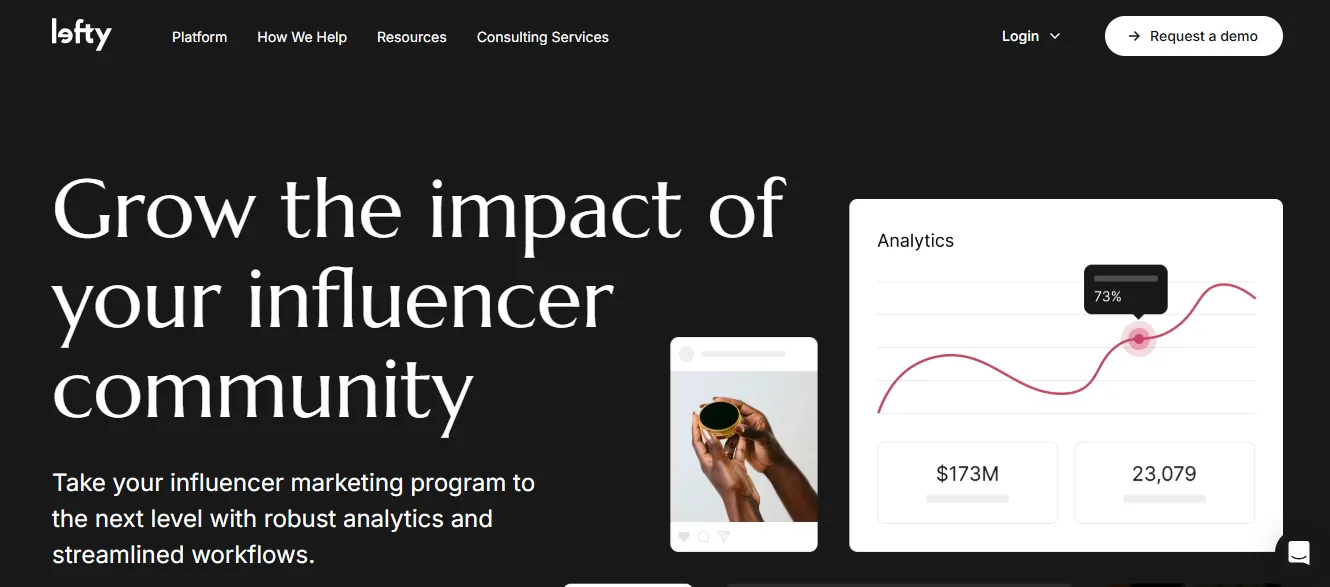
Lefty is an influencer marketing platform built for luxury and lifestyle brands, founded in Paris in 2015 by Thomas Repelski, Roman Berenstein, and Christian Rivasseau. It's known for Earned Media Value (EMV) tracking and competitive benchmarking, and counts Chanel, Dior, Sephora, Louis Vuitton, and Tommy Hilfiger among its clients. The platform leans heavily toward Instagram, though it tracks across multiple social networks.
Lefty Best Features
- Influencer Discovery: Lefty indexes a database of 30M+ creator profiles, surfacing accounts that meet a minimum follower threshold and updating the data in real time. You can filter by audience demographics, engagement rate, and location to narrow down a shortlist that fits a campaign.
- Automated Campaign Tracking & Reporting: Once a campaign is live, Lefty automatically collects posts and stories across networks without requiring influencers to do anything manually. It then generates reports with EMV calculated per influencer, so you can see which creators actually drove value.
- Competitive Benchmarking: This is Lefty's signature feature. You can monitor competitors' influencer activity, visibility, and content strategy, and see which creators they're partnering with — useful for spotting gaps and avoiding influencer overlap.
- Gifting & Affiliate Management: Lefty's Shopify integration lets you sync product inventory, send gifts, auto-create fulfillment orders, and generate discount codes for affiliates. It ties influencer-driven sales back to specific creators for eCommerce brands.
- Forecasting: The forecast tool estimates the results you can expect from working with a specific creator before you commit. Reviewers call this out as a genuine planning advantage, since it makes budget allocation more strategic than guesswork.
Lefty Reviews
Lefty holds a strong 4.7/5 on G2 across roughly 78 reviews, and its support team is its most praised asset — quality of support scores a near-perfect 9.8. Users consistently highlight the intuitive interface, the ease of setup, and how well EMV tracking and campaign management are handled in one place.
The recurring complaint is reporting. As one reviewer notes, the data shows estimations rather than actual reach and impression numbers, and competitive reports reflect a static snapshot that ages quickly. A few users also wish discovery leaned harder on AI for smarter, brand-fit recommendations.
Worth noting: despite Lefty's luxury-enterprise positioning, the majority of its G2 reviews come from small-business users — and high pricing is the most common reason brands cite for looking elsewhere.
Lefty vs Influencer Hero Pricing
On entry pricing, the two land close — Lefty's €590 and Influencer Hero's $649 are in the same range. The difference is what happens after the demo: Lefty's quote is negotiated around seats and campaign caps, while Influencer Hero publishes its tiers, so you know the number before you talk to sales. Lefty's core strength is its EMV analytics and competitive benchmarking for luxury brands.
Where the two diverge is operational scope. Influencer Hero is built to run the whole workflow — outreach automation, an influencer CRM, gifting, affiliate management, and Shopify integration for tracking actual sales rather than estimated EMV. For DTC and eCommerce teams scaling outreach to hundreds of creators, that end-to-end automation and direct ROI tracking covers ground Lefty's analytics-first approach leaves to manual work.
Final Thoughts
Lefty is a polished, analytics-heavy platform that earns its reputation among luxury and lifestyle brands. Its EMV tracking, competitive benchmarking, and excellent support are real strengths — but the hidden pricing, add-on costs for competitor reports, and estimation-based reporting are worth weighing before you commit.
For brands that want predictable pricing and a platform that handles discovery, outreach, CRM, affiliate, and real sales tracking in one place, Influencer Hero is the more complete alternative for scaling an influencer program. Tools like Modash and GRIN are also worth a look depending on whether you prioritize discovery depth or eCommerce-first workflows. To see how the full platform works, book a demo with Influencer Hero.
Summary
This is some text inside of a div block.
This is some text inside of a div block.
Pricing/Month
Shopify Reviews
This is some text inside of a div block.
This is some text inside of a div block.
This is some text inside of a div block.
This is some text inside of a div block.
This is some text inside of a div block.
This is some text inside of a div block.
This is some text inside of a div block.
This is some text inside of a div block.
This is some text inside of a div block.
This is some text inside of a div block.
This is some text inside of a div block.
This is some text inside of a div block.
This is some text inside of a div block.
This is some text inside of a div block.
This is some text inside of a div block.
This is some text inside of a div block.
This is some text inside of a div block.
This is some text inside of a div block.
This is some text inside of a div block.
This is some text inside of a div block.
This is some text inside of a div block.
Read More

FAQs





Most Popular Blogs


Drive ROI With Influencer Marketing
Join 1,200+ brands and 150+ agencies scaling creator programs with Influencer Hero.