Fohr Pricing & Review in 2026

May 27, 2026
|
Published

August 19, 2026
|
Updated

10 minutes
|
Reading

Influencer Performance Marketing Course | VOUCHER: IMC100

Maria Vincenzini
I Author

Drive ROI With Influencers

Global Influencer Database
ALL-IN-ONE platform
CRM, Affiliate, UGC & More
Fohr Pricing & Review in 2026
Fohr pricing starts at $20,000 per year for the Essential tier and scales up from there, with annual contracts required and no public pricing for higher tiers. Every plan is custom-quoted based on which of Fohr's four service models you need — self-serve software, ambassador management platform, managed services, or custom-built technology.
That puts Fohr in a different bucket from most influencer marketing platforms. It's priced as an enterprise solution, designed around an opt-in creator network of 180k+ verified influencers, and built more like an agency-tech hybrid than a pure SaaS tool.
Here's the breakdown of what's included at each service tier, what reviewers actually say (and the gaps in the public review data), and how the cost stacks up against running an in-house program through Influencer Hero.
Fohr Pricing in 2026
Fohr does not publish a tiered pricing page like a typical SaaS platform. The $20K/year Essential floor is the publicly known starting point — every other engagement is custom-quoted, and annual commitments are standard across all tiers.
Discovery (Essential — $20,000/year)
- Self-serve software access
- Search across Fohr's 180k+ opt-in creator network
- Verified audience and engagement data (via direct API connections)
- Campaign brief templates with moodboards, deliverables, and contracts
- Content review and approvals workflow
- Reporting and analytics on completed campaigns
The entry tier at $20K/year is for brands that want to run influencer campaigns themselves using Fohr's platform and creator network. Best for mid-market brands that have an internal influencer marketing team but want verified data and a curated creator pool rather than a massive unfiltered database. The annual commitment is the main friction point — you can't test the platform on a monthly basis before committing.
AMP — Ambassador Management Platform (Custom)
- Custom-branded microsite hosted and operated by Fohr
- Tools to recruit existing customers as brand ambassadors
- Application flow, content review, and metrics dashboard
- Influencer onboarding and management workflow
The AMP product is built for brands that want to operate a long-term ambassador program with their own branded experience rather than a generic platform interface. Pricing isn't published, but this is a step up from Discovery in both scope and cost. Best for brands turning loyal customers into a structured ambassador program — beauty, fitness, wellness, and lifestyle brands typically fit this profile.
Managed Services (Custom)
- Fohr's team handles full campaign execution end-to-end
- Strategy, creator sourcing, contract negotiation, content approvals, reporting
- Powered by Fohr's proprietary platform underneath
- Performance forecasting from Fohr's predictive analytics model (over a decade of data)
This is Fohr's done-for-you offering. You hand over campaign execution to Fohr's team — they've run 5,000+ influencer campaigns and have $80M+ in payout data to inform forecasting. Best for brands without internal influencer marketing headcount, or enterprise teams that need agency-level support but want platform-grade data underneath. CEO James Nord has publicly disclosed Fohr pays out $20M+/year to influencers on TikTok alone, which gives a sense of campaign volume.
Custom Technology (Custom)
- Fully bespoke platform built on Fohr's infrastructure
- Designed around a specific business workflow or vertical use case
- Typically reserved for enterprise clients with unique requirements
The top of the stack. Custom builds are quoted individually and only make sense for brands with genuinely non-standard needs (multi-brand portfolios, specific compliance requirements, white-label client offerings). Not relevant pricing-wise for most readers, but worth knowing it exists.
API and Integrations
Fohr provides verified creator data pulled directly from platform APIs — Instagram, TikTok, and YouTube — which is one of the main reasons brands pay the premium. The data is reliable specifically because creators have opted in and connected their accounts. Fohr does not publicly market an open developer API for external integrations the way some platforms do. Influencer Hero offers an open API at its own pricing tiers if you need that integration depth.
Fohr Overview
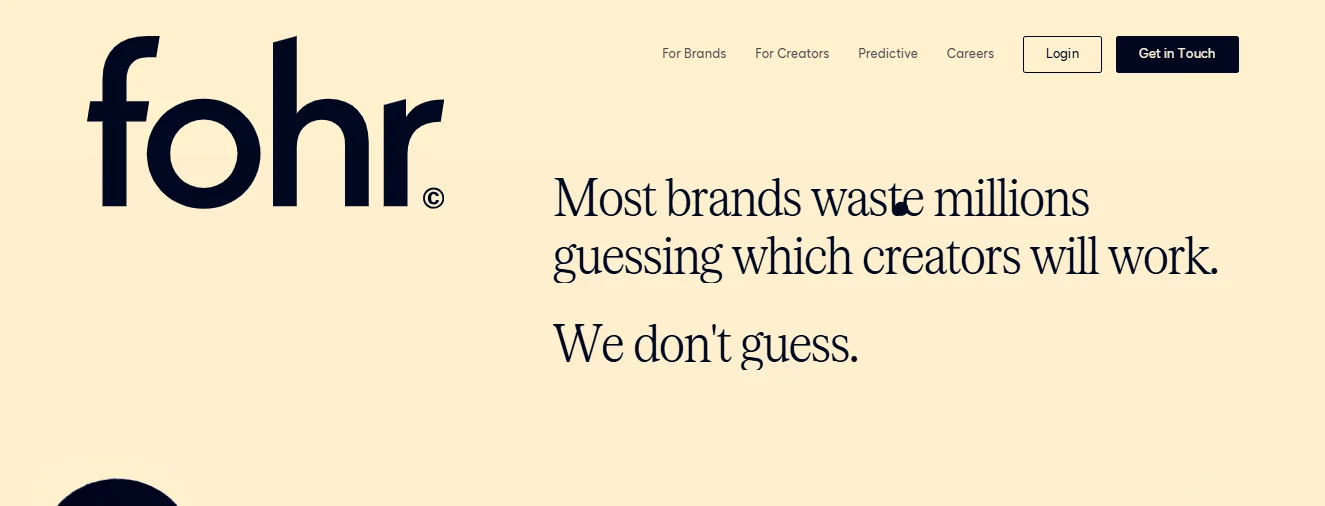
Fohr was founded in 2013 in New York and is one of the oldest influencer marketing companies in the space. It's positioned as an agency-tech hybrid — Fohr runs campaigns directly for major brands using its own proprietary platform, and licenses access to that platform for brands that want to run programs in-house. The client roster skews enterprise: major beauty, fashion, and lifestyle brands that need verified data and agency-grade execution.
The core differentiator is the opt-in network. Every creator on Fohr (180k+ total) has explicitly signed up and connected their platform accounts via API. That means verified engagement, real audience demographics, and accurate metrics — but it also means the creator pool is smaller and curated, not the millions-of-profiles database that some competitors offer.
Fohr Best Features
- Opt-in verified creator network (180k+): Every influencer on the platform has signed up directly and connected their social accounts via API. This eliminates the audience-data accuracy problem common with scraped-database platforms. The trade-off is reach: a brand looking for emerging or niche creators outside Fohr's ecosystem won't find them here.
- Predictive performance analytics: Fohr launched a predictive platform that forecasts campaign performance with what the company reports as 90%+ accuracy, based on 13 years of historical data and $80M+ in influencer payout records. For brands evaluating creators before committing budget, this kind of pre-launch forecasting is unusual at this scale and is one of Fohr's stronger technical differentiators.
- Bulletin (opt-in creator landing pages): Custom landing pages where creators can opt into brand opportunities directly. Brands use Bulletin to collect creator applications, gather first-party data, or surface specific attributes for matching. This is useful for ambassador recruitment specifically — it generates inbound interest rather than relying entirely on outbound outreach.
- Collaborative CRM and content approvals: Shared creator lists, internal notes, team-level views, and a content review workflow where creators upload work for brand approval directly in the platform. Assets are downloadable for repurposing. This is the operational layer that separates Fohr from pure-discovery tools — it covers the in-flight campaign management most platforms make you handle in spreadsheets.
- Editable campaign brief templates: Briefs include moodboards, deliverables, creative direction, contracts, and payment terms in a single editable template. For agencies managing multiple brand campaigns simultaneously, this standardization speeds up campaign setup and reduces back-and-forth on terms.
Fohr Reviews
Fohr has a 5.0/5 rating on G2 from 6 verified reviews — a strong score on a small sample. Worth flagging directly: several of those reviews appear to be from creators using the platform rather than brand-side buyers, which skews the rating optimistic for brand evaluation purposes. Look at the reviewer titles (Digital Creator, Content Creator) when reading G2 to filter for brand-side perspective.
Brand-side feedback that does exist is consistent on the strengths: verified data, agency-quality execution, and the campaign brief workflow. One brand-side reviewer notes Fohr "strikes the perfect balance between sophistication and user-friendliness on the brand side" and praises the gifting program workflow. Another flags the platform's standout feature as the influencer survey tool for finding creators who already love the brand.
The flagged weaknesses surface in third-party reviews and brand discussions. The opt-in network limitation is the most common — "As much as we wish it was not an opt-in network, so we could access more creators," notes one G2 reviewer directly. Multiple brand-side reviewers cite limited customization, discovery accuracy issues with niche or emerging creators outside the Fohr ecosystem, and pricing being out of reach for smaller or growth-stage brands. The opt-in model also restricts creators on the supply side — some creators on industry forums note that most Fohr listings are unpaid or gifting-only, which affects who's actively engaged on the platform.
Fohr vs Influencer Hero Pricing
Fohr's Essential plan at $20,000/year is roughly 2.5x the annual cost of Influencer Hero's Standard plan ($7,788/year on monthly billing, or roughly $5,452 with the 30% yearly discount). For brands evaluating cost alone, Influencer Hero is the more accessible entry point — but the comparison isn't just about price. The platforms operate on fundamentally different creator-access models.
Fohr's value proposition is concentrated in its opt-in network: 180k creators with verified data who've explicitly signed up. Influencer Hero takes the opposite approach with a 250M+ creator database that includes both opt-in and public-profile data, supported by audience analytics, AI-powered outreach with personalization, an integrated CRM, Shopify-connected gifting, affiliate management, UGC capture, and ROI reporting.
For brands that want to discover and engage creators outside any single opt-in ecosystem — micro, niche, or emerging creators specifically — the broader database matters more than the verified-only network. Influencer Hero also offers monthly billing flexibility, which Fohr doesn't.
For a full feature-by-feature breakdown, the Fohr Alternatives article covers the trade-offs in detail.
Final Thoughts
Fohr's pricing makes sense for what it is: an enterprise-grade hybrid of agency services and proprietary tech, with verified creator data as the core differentiator. For brands with $20K+/year budget that want either a curated opt-in network or a managed-service partner with real campaign data underneath, Fohr is a defensible choice — and the predictive analytics platform is a genuine technical edge that newer SaaS tools haven't matched.
The harder question is whether the trade-offs make sense for most brands. The opt-in network restriction means you'll miss creators outside Fohr's ecosystem, the annual contract and $20K floor put it out of reach for growth-stage brands, and the lack of monthly billing reduces flexibility. Influencer Hero is the more complete option for brands that want broader creator access, monthly commitment flexibility, and end-to-end campaign tools at a fraction of the entry cost. Other alternatives in the space worth knowing include Modash (discovery-heavy with a 350M+ database) and CreatorIQ (enterprise SaaS), though both have their own scope and pricing trade-offs.
Book a demo with Influencer Hero to see how a broader-database platform compares to an opt-in network model.
Summary
This is some text inside of a div block.
This is some text inside of a div block.
Pricing/Month
Shopify Reviews
This is some text inside of a div block.
This is some text inside of a div block.
This is some text inside of a div block.
This is some text inside of a div block.
This is some text inside of a div block.
This is some text inside of a div block.
This is some text inside of a div block.
This is some text inside of a div block.
This is some text inside of a div block.
This is some text inside of a div block.
This is some text inside of a div block.
This is some text inside of a div block.
This is some text inside of a div block.
This is some text inside of a div block.
This is some text inside of a div block.
This is some text inside of a div block.
This is some text inside of a div block.
This is some text inside of a div block.
This is some text inside of a div block.
This is some text inside of a div block.
This is some text inside of a div block.
Read More

FAQs




Most Popular Blogs


Drive ROI With Influencer Marketing
Join 1,200+ brands and 150+ agencies scaling creator programs with Influencer Hero.