

August 29, 2025

10 Min
Case Study: How Beau Bottles Drove $82K in Sales and Viral UGC Using Influencer Hero






You launch a new ad, and the results look great. Click-through rates are strong, conversion rates improve, and your return on ad spend moves in the right direction.
Then performance starts to slip. The audience hasn't changed, the offer is the same, and the landing page still converts.
So what happened?
In many cases, the answer is ad creative fatigue. Your audience has seen the same creative too many times, and it no longer captures attention.
Knowing when to refresh your ad creative matters. Refresh too early, and you may replace an asset that still has value. Wait too long, and rising Cost per Acquisition and weaker ad performance can hurt campaign results.
The challenge is that there is no universal refresh schedule. The right timing depends on your audience, budget, platform, and creative strategy.
This guide will show you how to:
Creative fatigue is the gradual decline in an ad creative's ability to capture attention and drive results after the same audience has seen it repeatedly. As people become familiar with the visuals, messaging, or format, they are less likely to engage or take action.
The campaign, offer, and audience targeting may remain unchanged. The ad creative itself is what loses attention and persuasive power.
Creative fatigue can affect every stage of your ad campaign. As people stop responding to the same ad creative, engagement drops, and performance becomes less efficient.
Common signs include:
Remember, one weak metric does not automatically mean your creative is fatigued. Look for a consistent pattern across multiple performance metrics before deciding it's time to refresh your creative.
Creative fatigue and audience fatigue can look very similar because both lead to weaker campaign performance. The difference is where the problem starts. One comes from the creative, while the other comes from the audience. Knowing which one you're dealing with helps you choose the right fix.
It is easy to confuse the two because they can produce similar ad performance trends. A fresh creative may improve results for a short time, but it will not solve a campaign where the audience has already reached audience saturation.
So, the first step is identifying where the decline actually begins.
Even the strongest creative assets have a limited lifespan. This doesn't mean they're poorly made. People simply respond differently after seeing the same message several times.
Once you understand why that happens, it becomes easier to decide when a creative needs refreshing and when it doesn't.
The first few times someone sees your ad, it feels new. The hook grabs attention, and the visuals encourage people to stop scrolling. After repeated audience exposure, that reaction starts to fade.
People begin to recognize familiar openings, visuals, and ad copy. Instead of paying attention, they scroll past because they already know what to expect.
Research published in the Journal of Advertising Research found that attention declines with repeated ad exposure.And the decline becomes even steeper when the same ad appears within short time periods.
This doesn't mean repetition is always harmful. Seeing an ad several times can improve brand recall in the early stages of a campaign. The problem begins when additional impressions stop creating interest and start blending into everything else in the feed.
At that point, your creative hasn't necessarily become bad. It has simply become too familiar to capture attention.
Campaigns reach ad creative fatigue sooner when every asset looks or sounds similar. Your audience may start treating different ads as the same message when they repeatedly use the same:
Changing the headline or caption alone rarely creates enough variety. When the opening scene, message, and overall concept stay the same, people recognize the pattern and lose interest before they engage with the ad.
Platforms also look for creative variety. Meta's Andromeda Update has introduced creative similarity signals that identify ads with highly similar visuals or messaging.
Small edits that look different to you may still be grouped as similar, which can limit how much fresh attention those ads receive.
Creative fatigue sets in faster when every variation follows the same pattern, even if the surface details change.
A creative that performs well with a small budget may not deliver the same results as your campaign grows. More spend usually means more ad impressions, which increases audience exposure in a shorter period.
The same applies to audience size. Smaller or highly targeted audience segments can reach high ad frequency much sooner than broader audiences. As a result, people see the same creative more frequently, making fatigue appear earlier.
Aggressive scaling can also shorten the time between launch and fatigue. A creative that looked like a winner during the learning phase may start losing momentum once delivery expands across a larger share of your audience.
This does not mean scaling always causes ad creative fatigue.
Strong creatives can continue performing well at higher spend levels. Scale simply reveals fatigue sooner because more people see the same creative within a shorter period, which makes performance changes easier to spot.
There is no perfect timeline for refreshing ad creative. Many brands use three to four weeks as a starting point, but actual creative lifespan varies. Some ads perform for months, while others lose momentum within days.
Rules such as "replace every ad after two weeks" ignore how different campaigns work.
Refresh timing can change based on:
Ad format can also influence how quickly you should review creative performance. Practitioner guidance from AdLibrary suggests the following review windows:
Note: These are review windows instead of replacement deadlines. A high-spend Reels campaign targeting a small audience may fatigue within days, while a static image shown to a broad audience at lower spend can remain effective for several weeks.
Your performance metrics should tell you when an ad needs attention. Review several signals together, including:
Look at the pattern behind the numbers.
Rising ad frequency with a falling click-through rate may show that the creative is losing attention. A stable click-through rate with a rising CPA may point to the offer, landing page, or conversion process instead.
A decline across several creative assets may suggest audience saturation rather than one fatigued creative. One poor day is also not enough reason to replace an ad.
Compare each creative against its own historical performance. This gives you a more useful reference point than a universal performance benchmark.
Performance dashboards only show part of the picture. Audience response can reveal changes before your main ad metrics fall sharply.
Watch for:
These signals become much easier to spot when you combine audience feedback with platform data.
Meta provides detailed creative-level insights that can help you detect declining engagement early.
If you manage multiple campaigns, ad sets, and creative assets, it can become time-consuming to review those trends consistently. A Meta ads agency can help connect performance data with ongoing creative testing.
A fatigued ad does not always need a full replacement. The core idea may still work, so start with small changes before moving to a new concept.
Test one or two updates at a time:
Small, controlled changes make it easier to see what improved performance. Large edits across the hook, format, offer, and landing page can hide the real cause of any improvement.
Pro tip: Give the updated creative enough time to collect useful data. One weak day is not a reason to replace a concept that has performed well over time.
Small edits may stop working when the original idea has lost its impact. At that point, test a new direction through:
A new hook on the same testimonial is a variation. A comparison based on a different customer concern is a new concept.
Olivida provides a good example. After its traditional Meta ads struggled to deliver profitable results, the brand repurposed influencer-generated content for paid campaigns, increasing cold acquisition ROAS from 1.1X to 2.6X.
Influencer Hero's Olivida case study shows how creator content can introduce a fresh creative direction while adding social proof.

The broader research points in the same direction. Meta reports that campaigns with diverse formats and messaging types have seen up to a 32% improvement in CPA and a 9% increase in conversion rate. This shows why real creative variety matters more than edits that look almost identical.
Pro tip: Do not assume every decline comes from the creative. Make sure to review your offer, landing page, audience, and tracking before you replace a strong concept.
Creative fatigue becomes easier to manage when you prepare for it before a campaign goes live. Plan several versions of your hooks, messaging angles, opening scenes, creators, formats, headlines, and calls to action. This gives you ready alternatives when an existing ad begins to lose momentum.
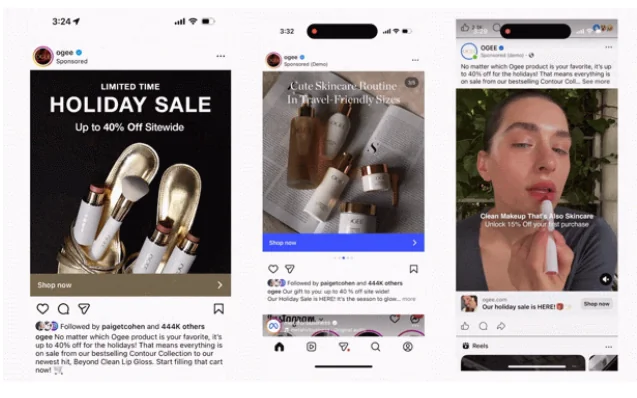
For example, OGEE used static ads, product carousels, and creator-led video during its holiday campaign. Each format supported the same seasonal offer while giving different audience segments another way to respond.
There is no fixed number of variations that suits every campaign. Your budget, audience size, daily spend, and production capacity should guide how many assets you prepare.
Each campaign should also improve the next creative cycle. Ask:
These decisions become easier when creator and campaign data sits in one place. An influencer reporting and analytics dashboard can help you compare creators by views, clicks, referrals, sales, and ROAS, so stronger performers can inform your next creative brief.
Use the answers to improve your creative briefs, scripts, creator selection, messaging priorities, and future A/B tests. Keep a simple record of what worked, what failed, and what deserves another variation.
This creates a repeatable cycle:
Launch → Measure → Learn → Refresh → Test again
Creative fatigue is a normal part of paid advertising. The key is to respond to real performance trends and audience behavior instead of following a fixed refresh schedule.
Strong teams improve winning executions, test fresh concepts, and document what they learn. A repeatable creative system helps you react sooner, waste less budget, and keep campaign performance steady for longer.
If producing a steady stream of high-quality creative is becoming a bottleneck, working with a trusted creative production partner can help you keep testing without overwhelming your internal team.

Schedule a Demo with one of our media experts below.