Turning Influencer Marketing into a Performance Channel

December 10, 2025
|
Published

July 30, 2026
|
Updated

|
Reading

Influencer Performance Marketing Course | VOUCHER: IMC100

Peter Nettesheim
| Author

Drive ROI With Influencers

Global Influencer Database
ALL-IN-ONE platform
CRM, Affiliate, UGC & More
Turning Influencer Marketing into a Performance Channel
Influencer marketing is often seen as a branding exercise - a way to generate awareness and buzz. But in reality, it can be one of the most powerful performance marketing channels when structured correctly.
In this article, you’ll get a deeper understanding of the Influencer Performance Marketing Framework, a system designed to help brands scale influencer campaigns profitably. You’ll learn how to evaluate influencer performance, test at scale, and implement repeatable processes that maximize Return on Influencer Spend (ROIS).
TLDR - Watch the Video
Take the full Influencer Performance Marketing Course and get certified!
What Are the Different Collaboration Formats and Their Roles?
Before building a performance framework, it’s essential to understand the different collaboration formats; each serves a distinct purpose within your strategy.
1. Affiliate + Gifting
The brand provides free products and an affiliate commission in exchange for a confirmed post. Affiliate marketing is the most scalable collaboration type for data-driven campaigns and the foundation of performance-led influencer marketing.
2. Product Seeding (No Obligation)
Brands send products to select macro or mega creators with no posting requirement. The goal is to generate organic exposure and goodwill.
3. Fixed-Fee Deliverables
Creators are paid a flat fee for defined deliverables (e.g., one reel, one static post, three stories).
4. UGC Production
The objective is to collect content assets for paid and organic use, not immediate conversions. Brands compensate creators for high-quality creatives that can later be used across channels.
5. Store Visits & Activations
Used primarily by physical retail brands to drive foot traffic and brand experiences through in-person influencer appearances.
Want to see how this type of campaign works? Read our TCL case study that focused on powering In-store campaigns in the UAE.
Focus for Performance: While many brands experiment across all formats, the most reliable performance outcomes typically come from affiliate + gifting campaigns, which allow consistent ROI tracking and scalability.
The Two-Phase Performance System
At the heart of this framework are two distinct phases:
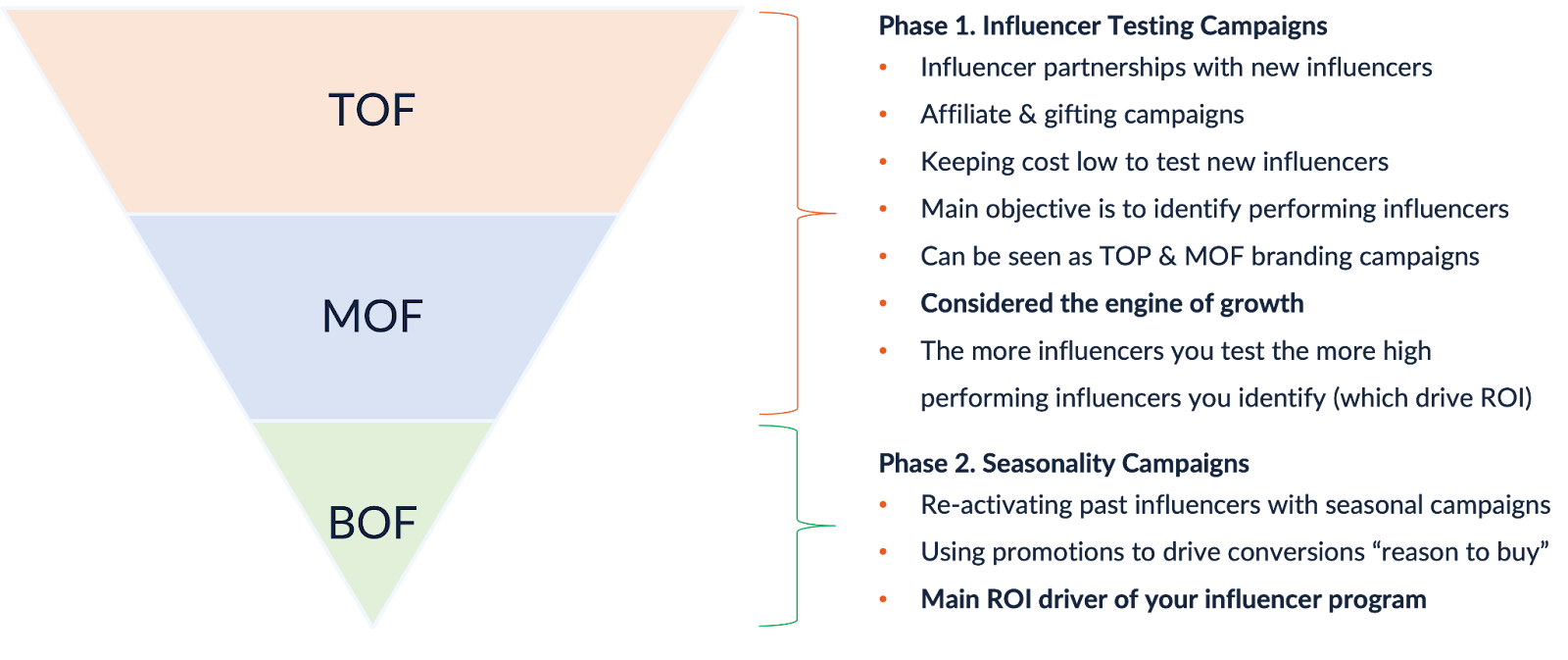
Phase 1 – Influencer Testing Campaigns
Phase 1 focuses on testing first-time collaborations with a large number of creators. The goal is simple - identify which influencers drive measurable conversions through affiliate links or discount codes
Creators are categorized based on their performance after posting:
- High Performers (HPs): ≥ 10 conversions per post
- Medium Performers (MPs): 3–9 conversions per post
- Low Performers (LPs): 0–2 conversions per post
In practice, only a small fraction of creators generate the majority of results — a classic Pareto distribution (80/20 rule). Often, 10% of influencers drive 90% of total revenue.
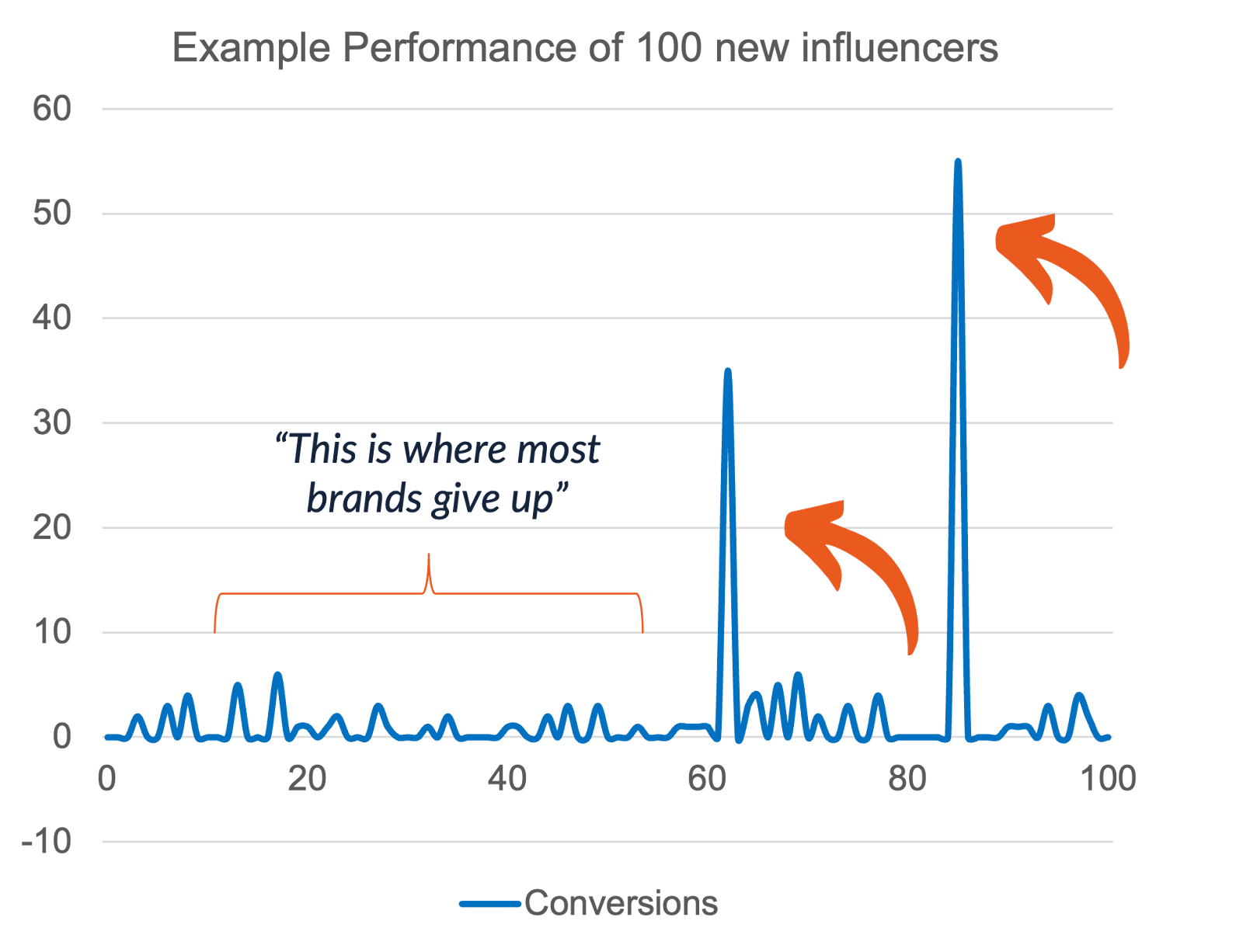
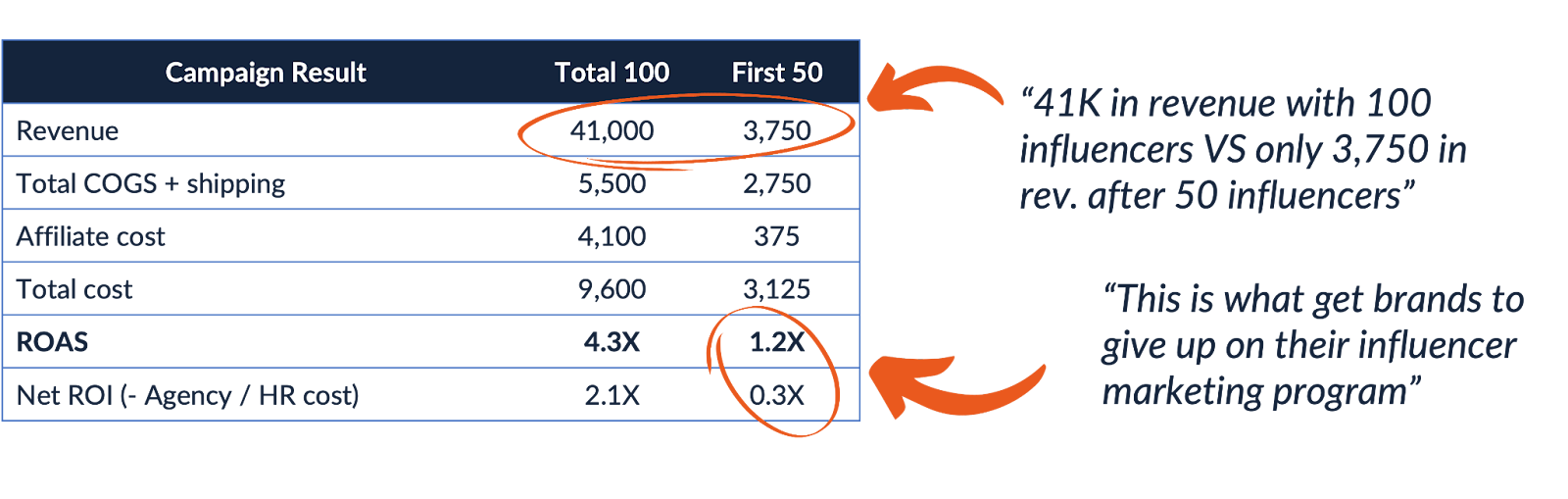
That’s why brands must test in batches of at least 100 influencers instead of relying on small sample sizes. Stopping early — say, after 20 or 30 — often leads to false conclusions that “influencer marketing doesn’t work,” when in fact the high performers simply haven’t been discovered yet.
Pro Tip
Use a pipeline system to manage Phase 1 efficiently:
Sourced → Negotiating → Agreed/Gifted → Awaiting Post → Posted → Results Captured → Tier Assigned (HP/MP/LP).
In this phase, ROI doesn’t need to be high. Even breakeven or slightly negative outcomes are acceptable, as the real value lies in identifying HPs who will later drive exponential returns.
Phase 2 – Seasonality Campaigns
Phase 2 reactivates HPs and MPs during high-intent retail moments such as Valentine’s Day, Mother’s/Father’s Day, Summer Sales, Halloween, and BFCM.
The strategy is to bundle multiple deliverables per creator to reduce cost per post and amplify cumulative conversions.
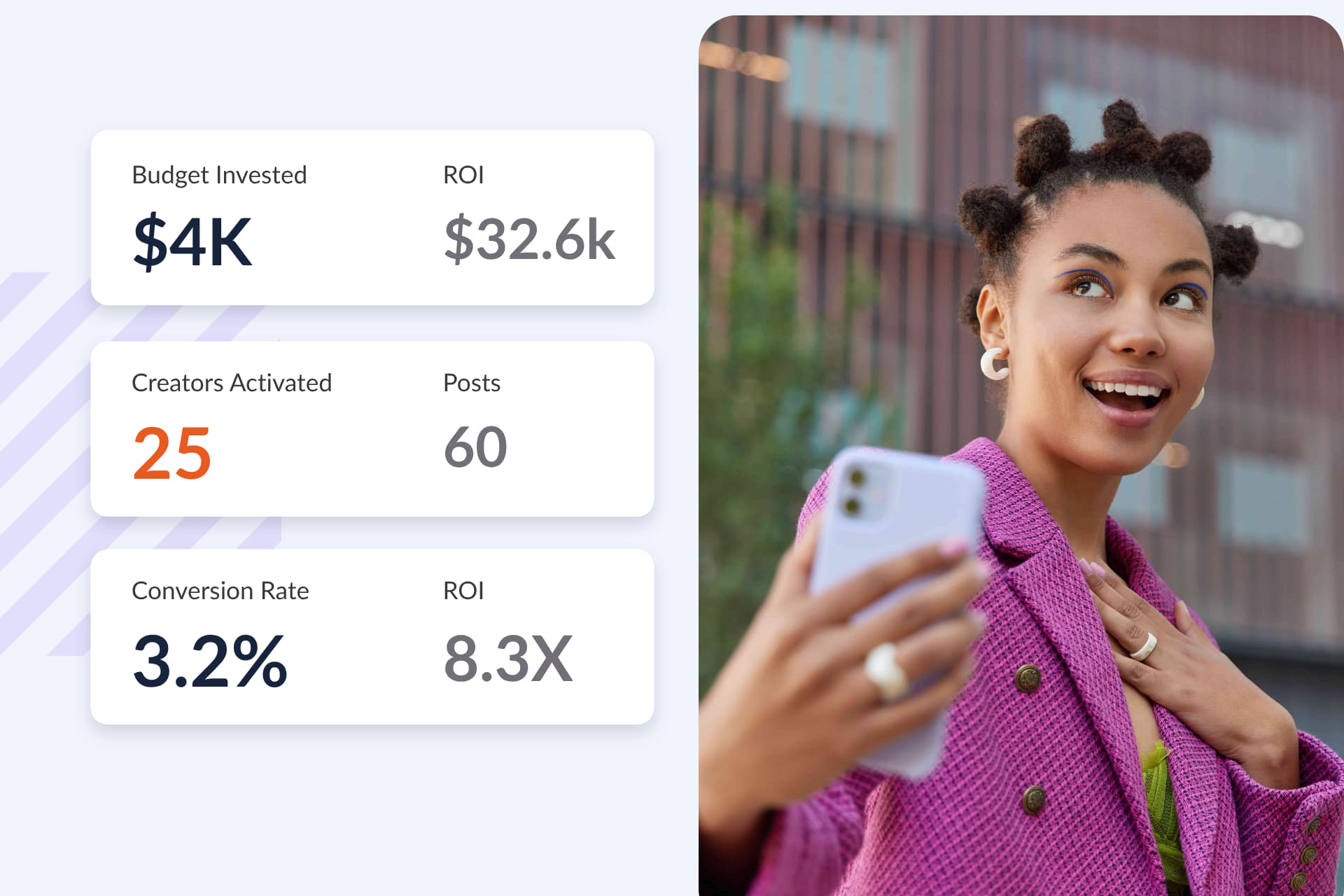
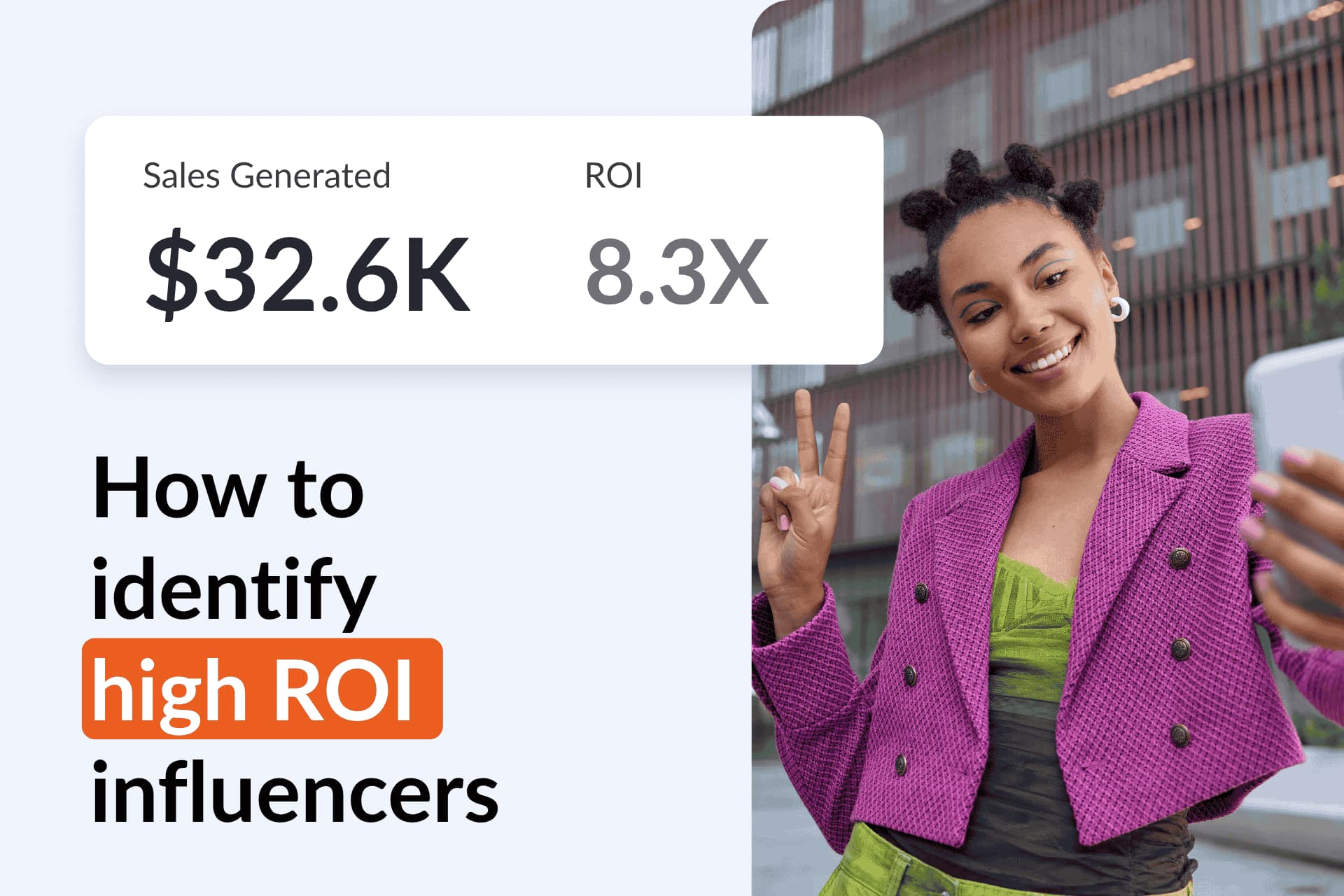
For example, if a creator generated $5,000 in attributable revenue from one post in Phase 1, a five-post campaign during a seasonal sale could reasonably target $25,000 in sales — with a projected 8.3× Return on Influencer Spend (ROIS).
New Metric: ROIS (Return on Influencer Spend): Traditional metrics like ROAS can be misleading since no ad spend occurs on paid platforms. ROIS measures your return purely from influencer compensation, giving a more accurate reflection of campaign profitability.
We’ll cover how to execute a high-performing Phase 2 Seasonality Campaign step by step in Chapter 5.
Utilize and Systemize Your Influencer Program
Once Phases 1 and 2 are active, the goal is to build an always-on influencer system that continuously fuels growth.
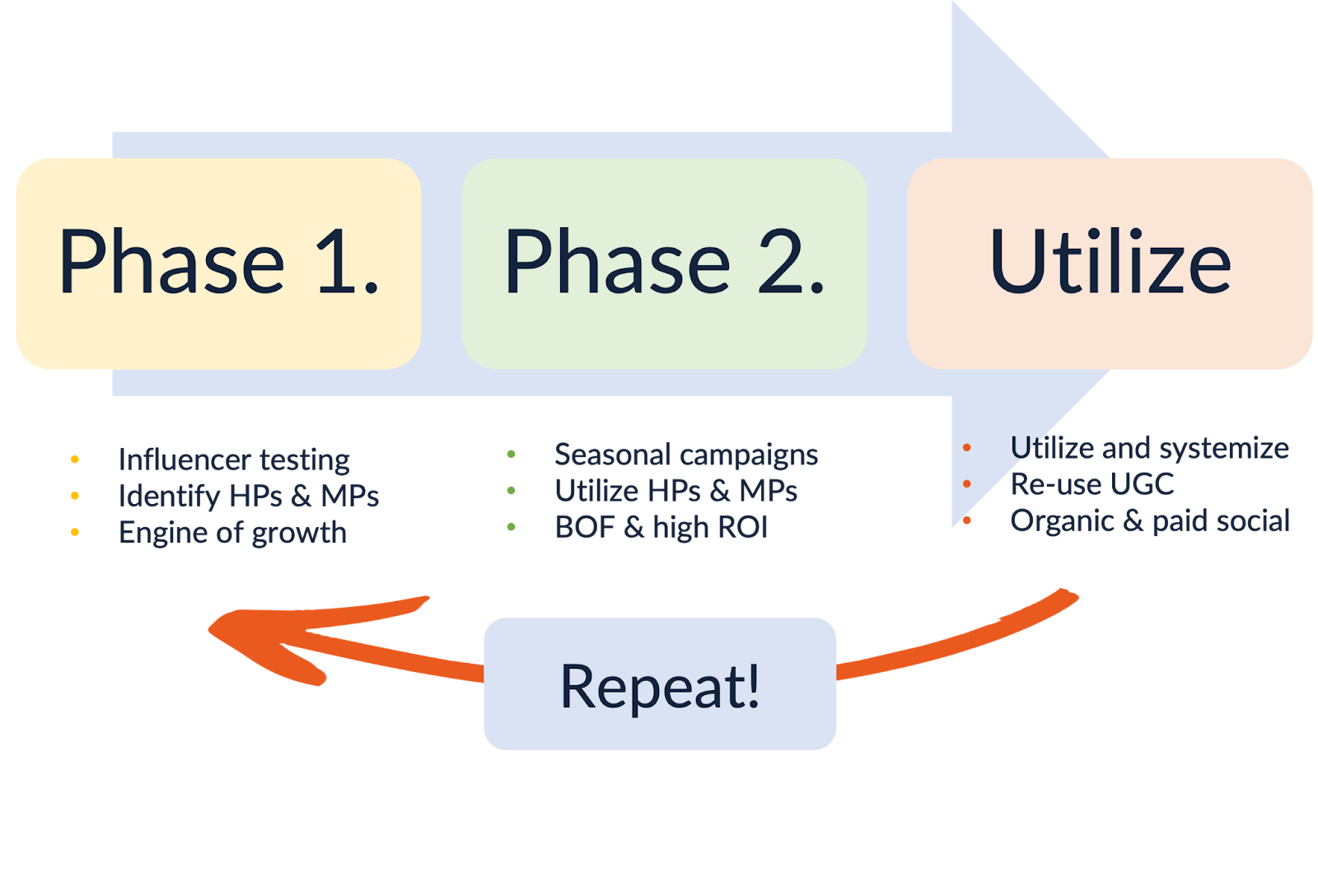
- 1. Utilize Content: Repurpose influencer content across your website, newsletters, paid ads, and organic channels.
- 2. Utilize Traffic: Leverage all traffic generated through influencer campaigns with retargeting ads and automated email flows.
- 3. Systemize Operations: Create SOPs and a dedicated influencer marketing team to ensure both phases run continuously.
Remember: Phase 1 is your growth engine. Without constant testing of new creators, you’ll lose the momentum needed to identify your next top performers.
Final Thoughts
Shifting from one-off influencer collaborations to a performance-driven system is the key to turning influencer marketing into a reliable growth engine. The most successful brands don’t view creators as a marketing experiment - they treat them as part of an ongoing revenue strategy.
By understanding the different collaboration formats, implementing the two-phase system, and analyzing results through ROIS (Return on Influencer Spend), brands can create a structured pipeline that delivers predictable results over time.
This chapter laid the groundwork for how to think about influencer marketing from an operational and financial perspective. In the next chapters, we’ll explore how to put this framework into action, starting with how to find the right influencers for your brand and set your performance engine in motion.
Key Takeaways
- Treat influencer marketing as a performance channel, not a branding activity.
- Use affiliate + gifting campaigns as the most scalable foundation for data-driven testing.
- Implement the two-phase system — Phase 1 for discovery, Phase 2 for scaling.
- Focus on ROIS (Return on Influencer Spend) to measure true campaign efficiency.
- Build an always-on influencer program that continuously tests, activates, and scales creators for long-term growth.
Continue learning: How to Find Influencers That Actually Convert
Summary
This is some text inside of a div block.
This is some text inside of a div block.
Pricing/Month
Shopify Reviews
This is some text inside of a div block.
This is some text inside of a div block.
This is some text inside of a div block.
This is some text inside of a div block.
This is some text inside of a div block.
This is some text inside of a div block.
This is some text inside of a div block.
This is some text inside of a div block.
This is some text inside of a div block.
This is some text inside of a div block.
This is some text inside of a div block.
This is some text inside of a div block.
This is some text inside of a div block.
This is some text inside of a div block.
This is some text inside of a div block.
This is some text inside of a div block.
This is some text inside of a div block.
This is some text inside of a div block.
This is some text inside of a div block.
This is some text inside of a div block.
This is some text inside of a div block.
Read More

FAQs
What is influencer performance marketing?

Influencer performance marketing is a data-driven approach that treats influencer collaborations as measurable, revenue-generating channels rather than brand awareness campaigns. Instead of paying for impressions, brands track concrete results like clicks, conversions, and ROI — often through affiliate links or discount codes.
How is influencer performance marketing different from traditional influencer marketing?
Traditional influencer marketing focuses on reach and engagement, making it difficult to measure direct ROI. Performance-led influencer marketing, on the other hand, ties every collaboration to sales outcomes, allowing brands to identify high-performing creators and scale those partnerships profitably.
What is the two-phase influencer performance system?
The two-phase system consists of:
- Phase 1: Testing Campaigns – Brands test new creators with low-cost gifting and affiliate offers to identify high performers.
- Phase 2: Seasonality Campaigns – High-performing influencers (HPs) are reactivated during key retail moments (like BFCM or Valentine’s Day) to drive scalable revenue.
What does ROIS mean in influencer marketing?
ROIS stands for Return on Influencer Spend. It measures the revenue generated from influencer partnerships relative to the total compensation paid to them. Unlike ROAS, which is tied to paid ad spend, ROIS focuses purely on the profitability of influencer collaborations.
What type of influencer collaborations work best for performance marketing?
Affiliate + gifting collaborations tend to deliver the most measurable results. They allow brands to track conversions, test large batches of influencers efficiently, and scale campaigns based on performance data.

Most Popular Blogs


Drive ROI With Influencer Marketing
Join 1,200+ brands and 150+ agencies scaling creator programs with Influencer Hero.