
Key Metrics to Analyze to Improve Influencer ROI

December 10, 2025
|
Published

July 30, 2026
|
Updated

|
Reading

Influencer Performance Marketing Course | VOUCHER: IMC100

Peter Nettesheim
| Author

Drive ROI With Influencers

Global Influencer Database
ALL-IN-ONE platform
CRM, Affiliate, UGC & More
Key Metrics to Analyze to Improve Influencer ROI
Most brands track influencer performance the wrong way - focusing on likes, comments, and impressions, while completely missing the metrics that actually drive revenue. With media costs rising and every marketing dollar under pressure, knowing what to measure (and how to measure it) is the difference between a scalable influencer program and one that quietly burns budget.
In this article, you’ll learn the core KPIs that matter across the funnel - from awareness to engagement to conversions, ROIS, CAC, and customer value. You’ll learn the exact attribution tools that top-performing teams use, when to rely on affiliate links and discount codes, how to measure earned media value, and how to build performance reports that align influencer marketing with broader business goals.
TLDR - Watch the Video
Take the full Influencer Performance Marketing Course and get certified!
How to Measure Influencer Marketing Results
Measuring influencer performance starts with choosing the right attribution tools. For revenue-focused campaigns, the most accurate way to track results is through affiliate links and unique discount codes - together, they give you a full picture of clicks, conversions, and revenue generated per creator.
Affiliate Links (Clicks + Conversions)
Affiliate links allow you to measure:
- Page visits
- Add-to-carts
- Conversions
- Total revenue attributed to a creator
Because you’re getting data directly from your site or tracking platform, affiliate links provide the cleanest bottom-of-funnel insight.
Discount Codes (Extra Attribution Layer)
Discount codes act as a secondary attribution layer.
They help capture purchases from followers who didn’t click the affiliate link (e.g., they typed the brand name manually or returned later).
In most industries, affiliate links + discount codes combined capture ~70% of total sales - which is why both are essential for accurate reporting.
What About TOF Metrics Like Views or Impressions?
Top-of-funnel metrics still matter, especially for brands investing in broader awareness campaigns. However, accessing these metrics can be challenging:
- Not all creators will connect their social accounts to third-party platforms (due to privacy and security concerns).
- Merged analytics dashboards exist, but participation depends entirely on creator consent.
- If connection isn’t possible, the only way to obtain TOF metrics is to request screenshots of post analytics directly from creators.
This is normal - most brands combine automated tracking (for clicks and conversions) with creator-provided screenshots (for impressions, views, reach, and engagement).
When to Prioritize TOF, MOF, or BOF Metrics
- Smaller D2C brands and performance-led teams tend to focus on bottom-of-funnel KPIs (sales, ROIS, CAC).
- Larger brands or those with multi-channel retail distribution often prioritize top-of-funnel brand metrics, because conversion attribution becomes more complex across online, wholesale, and physical stores.
Ultimately, every program should measure both - but your primary KPI should match your business model and growth stage.
Top & Middle of the Funnel KPIs: The Metrics That Shape Awareness and Consideration
While revenue and conversions sit at the bottom of the funnel, your creators’ ability to drive attention and interest determines whether those conversions happen in the first place. These top- and mid-funnel metrics help brands understand how potential customers are discovering, engaging with, and evaluating your product before they buy.
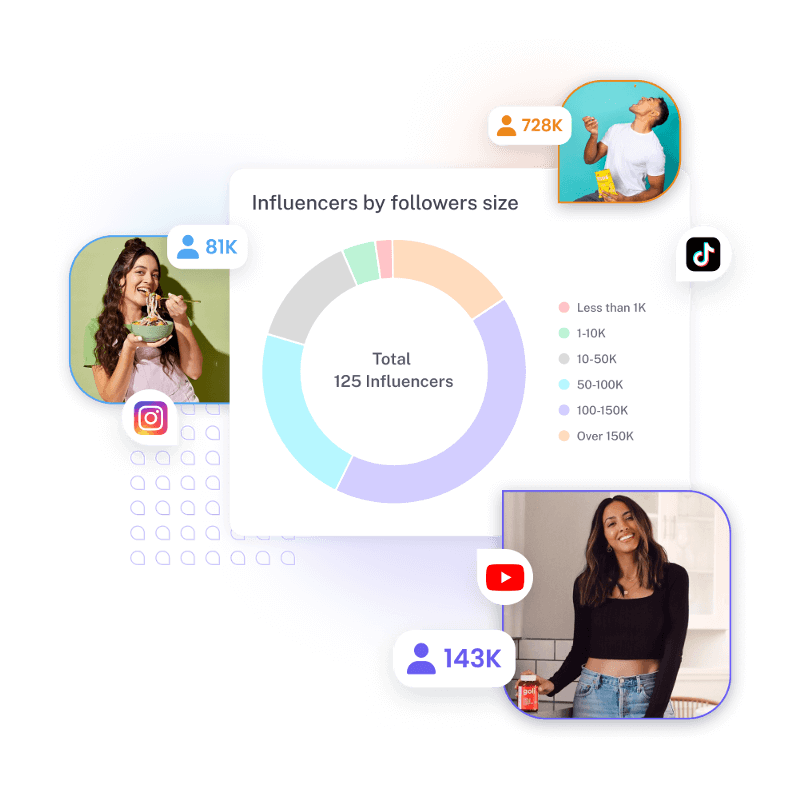
Below are the core KPIs every marketer should monitor in awareness and consideration-focused influencer campaigns.
1. Impressions
The total number of times content is displayed.
- Indicates reach potential
- Helps evaluate creator effectiveness on different platforms (especially TikTok vs Instagram)
- Useful for calculating Earned Media Value (EMV)
2. Reach
The number of unique users who saw the content.
- A stronger indicator of true exposure than impressions
- Helps brands identify creators with broad but real audiences
3. CPM (Cost per Mille)
The cost to reach 1,000 people.
- A benchmarking tool to compare influencer reach vs paid ads
- Helps determine if creators are cost-efficient for awareness campaigns
Interested in learning how to measure CPM? Check our guide with our free CPM calculator.
4. Follower Growth
The increase in the creator’s (or brand’s) audience during a campaign.
- Serves as a proxy for brand momentum
- Indicates whether the content is resonating enough to drive new audience interest
5. Engagement Rate
The formula to calculate engagement rate is:
ER = Interactions (likes + comments) / Followers
- Signals how actively the audience interacts with the creator
- Helps determine if the creator’s reach translates to consumer interest
- Ideal for evaluating creators before investing larger budgets
6. Quality Engagement Signals
Not all engagement is created equal.
Metrics like:
- Shares (amplification)
- Saves (intent)
- Brand mentions (influence beyond the post)
…help you understand deeper consumer behavior and whether the content created real value.
7. Click-Through Rate
The percentage of users who clicked from a creator’s content to your landing page.
- Direct insight into the strength of the content’s call-to-action
- One of the strongest indicators of mid-funnel interest
- Helps filter high-intent creators who can later drive conversions in Phase 2 campaigns
How to Use TOF + MOF Metrics Strategically
- Use impressions + reach to evaluate cost efficiency and brand awareness lift.
- Use engagement rate, shares, and CTR to identify creators whose content actually moves people toward purchase.
- Combine these metrics with conversion data (from affiliate links + discount codes) to build a full-funnel performance model.
Together, TOF and MOF KPIs let you understand not just who saw a creator’s content — but whether the content created meaningful momentum toward the sale.
Bottom-of-Funnel KPIs: The Metrics That Directly Impact Revenue

Bottom-of-funnel (BOF) metrics are where influencer marketing becomes a performance channel rather than a brand awareness activity. These KPIs show which creators truly drive sales, profitability, and long-term customer value - and which ones drain your budget.
If your goal is measurable ROI, these are the metrics that matter most.
1. Sales / Revenue Generated
The total dollar value driven by each creator.
- Captured through affiliate links and discount codes
- Your primary benchmark for evaluating creator performance
- Helps determine which creators to re-activate during seasonality campaigns
Revenue is the foundation of every performance-driven influencer program. Without it, you can’t scale profitably.
2. ROIS (Return on Influencer Spend)
Also referred to as ROAS, but ROIS is more accurate for influencer programs since the costs are not ad platform spend.
ROIS = Revenue Generated / Influencer Spend
Includes:
- Fixed payments
- Affiliate payouts
- COGS + shipping for gifted products
ROIS shows the true financial impact of your influencer activity. Brands aiming for sustainable results typically target 3x–10x ROIS, depending on margin structure.
3. CAC (Customer Acquisition Cost)
CAC = Total Influencer Spend / Number of New Customers Acquired
A critical metric when you need to compare influencer performance against other acquisition channels like Meta Ads or Google.
CAC determines whether influencers are more cost-efficient than other paid channels — and whether scaling is feasible.
4. CLTV (Customer Lifetime Value)
How much a customer is worth to the brand over time. This is especially important for products with strong repeat purchase behavior (skincare, supplements, apparel, etc.).
Some creators may appear “expensive” on first purchase but deliver high-value customers who buy multiple times. CLTV helps you distinguish between high-quality and low-quality acquisition.
5. AOV (Average Order Value)
AOV = Total Revenue / Number of Orders
Higher AOV means influencers are attracting customers who purchase more per transaction — strengthening profitability and ROIS.
6. Conversion Rate (CR)
CR = Conversions / Clicks
Measures how effectively a creator’s content and link drive purchase intent.
A high CR indicates strong product-audience match, persuasive content, and high creator trust.
CR is often more valuable than impressions or engagement when selecting creators for paid partnerships or whitelisting.
When Bottom-of-Funnel Should Be Your Primary Focus
- D2C brands aiming for profitable acquisition
- Startups needing efficient growth
- Brands with proven product-market fit
- Companies scaling influencer marketing with automation
Larger corporations may prioritize TOF branding, but for most consumer brands, BOF metrics are what justify budget increases and enable true performance scaling.
Earned Media Value (EMV): How to Quantify the Monetary Impact of Influencer Content (H2)
Earned Media Value (EMV) is one of the most useful upper-funnel KPIs for brands investing in influencer marketing. It assigns a dollar value to the exposure generated by creators - allowing you to compare influencer reach directly against what you would have paid for similar results through paid advertising.
In other words: EMV tells you how much the same impressions would have cost if you ran them as ads on Meta, TikTok, or YouTube.
Why EMV Matters
- Helps justify influencer spend to leadership
- Allows clear comparisons between creators
- Helps map influencer reach to paid media equivalents
- Useful for brand awareness, virality, and long-term brand equity tracking
For brands running hybrid strategies (influencer + paid ads), EMV is one of the cleanest ways to quantify the “brand lift” side of the program.
How EMV Is Calculated
The formula is simple:
EMV = (Impressions / 1000) x CPM
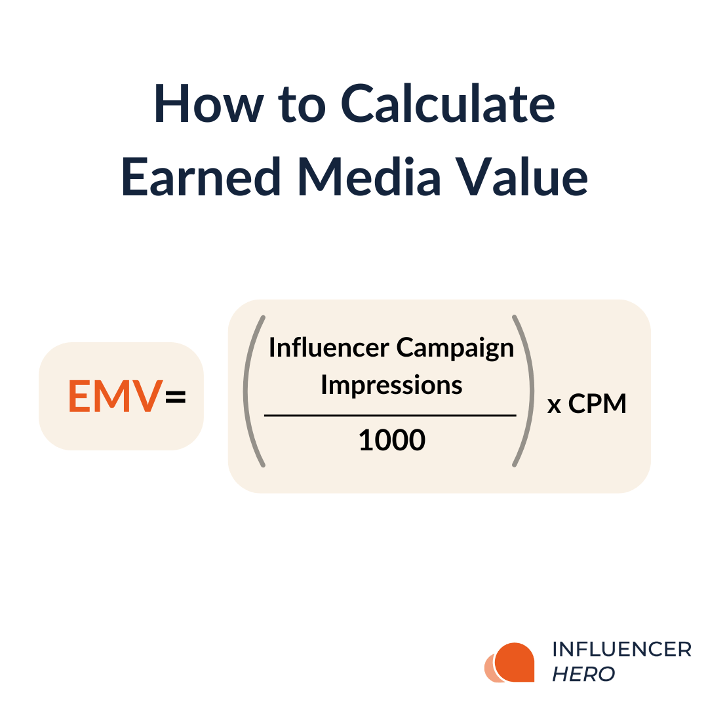
Where:
- Impressions = total views on the influencer’s content
- CPM = cost per thousand impressions on a comparable paid channel
To avoid underestimating value, brands use a premium CPM (usually 50–100% higher) because influencer content often delivers stronger engagement, watch time, and social proof than standard ads.
CPM varies widely by platform, audience, country, and season. A simple rule of thumb:
- Instagram paid ads: ~$10 average CPM
- For EMV: Use $15–$20 to reflect the premium value of influencer content
Other examples:
- TikTok ads: ~$8–$12 CPM (use $12–$18 for EMV)
- YouTube ads: ~$12–$18 CPM (use $18–$25 for EMV)
These premiums account for the higher trust and authenticity of UGC compared to traditional ads.
Earned Media Value Example
Let’s look at a real example of an influencer post that went viral with 54.7 million views.
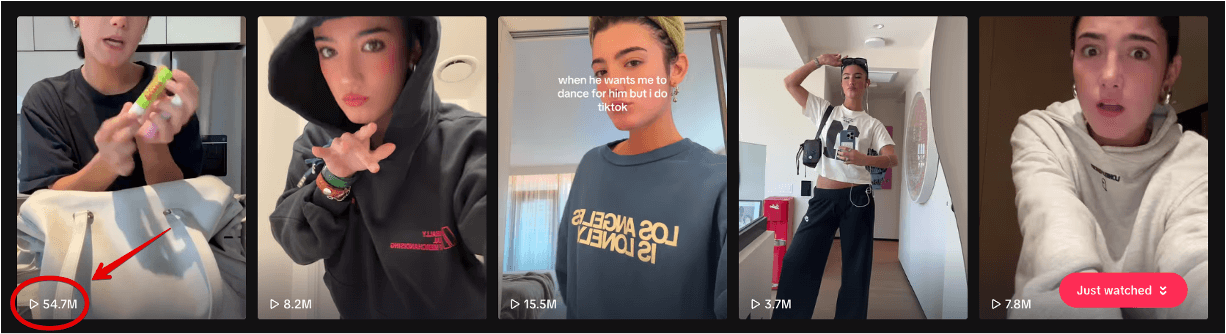
Step-by-step calculation:
- Determine impressions: 54,700,000 views
- Assign CPM: $15 (premium Instagram CPM for EMV purposes)
- Apply formula:
EMV = 54,700,000 / 1,000) x 15 = $820,500
When EMV Is Most Useful
EMV shines in campaigns where brand lift is as important as immediate conversions, such as:
- Product launches
- Brand repositioning
- Fashion, beauty, luxury, lifestyle
- Viral or trend-based campaigns
- Macro and celebrity influencer partnerships
For performance-led D2C brands, EMV complements revenue metrics by highlighting the full scope of value beyond just tracked conversions.
How to Create Influencer Marketing Reports (That CMOs Actually Care About)
A well-built report does more than show numbers - it tells a clear, strategic story. Whether you're presenting results to a CMO, a founder, or a client, your report should show what worked, what didn’t, and what should happen next.
Start with summing up the most important KPIs including TOF, MOF & BOF KPIs. To make it easier simply create a copy of our reporting template which you can access here.
This section breaks down exactly what to include, how to structure it, and how to make your insights actionable.
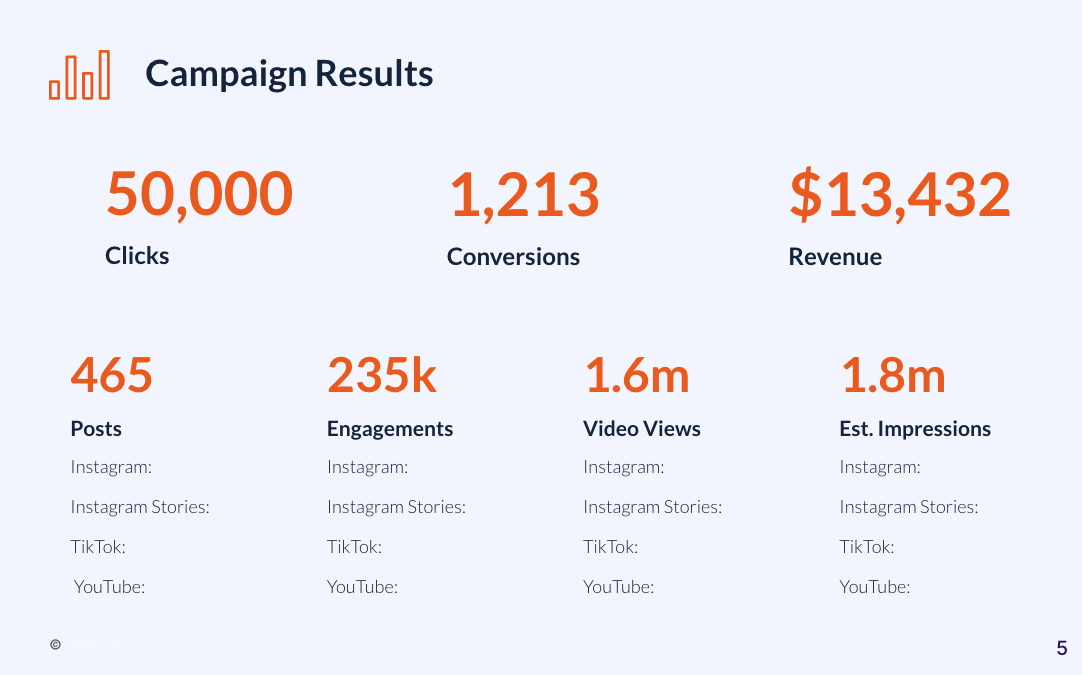
1. Start With a High-Level Summary of Core KPIs
Open your report with a snapshot of performance across the funnel. Include a simple, clean section summarizing:
Top-of-Funnel (Awareness) KPIs
- Impressions
- Reach
- Engagement rate
- Follower growth
- CPM equivalent
- Brand mentions
- CTR
Middle-of-Funnel (Consideration) KPIs
- Shares
- Saves
- Website visits
- Bounce rate (if tracked indirectly via affiliate links)
- Click-to-purchase delay insights
Bottom-of-Funnel (Conversion) KPIs
- Total revenue
- ROIS (Return on Influencer Spend)
- CAC (Cost per Acquisition)
- AOV (Average Order Value)
- CR (Conversion Rate)
- Number of new customers vs returning customers
This gives stakeholders a complete picture at a glance.
Break Down All Influencer-Related Costs
After showing results, show what you spent to achieve them. This includes costs such as:
- Fixed influencer payments
- Affiliate commission payouts
- Product COGS for gifting
- Shipping costs
- Usage-rights fees (if any)
- Paid media budget for whitelisted ads
- Internal team hours (optional but recommended for agencies)
This section is essential for validating ROI and budgeting future campaigns.
Showcase Your Best-Performing Creators
This is one of the most important parts of an influencer report - especially for leadership teams trying to understand what’s driving growth.
Accompany this with a visual table showing at minimum:
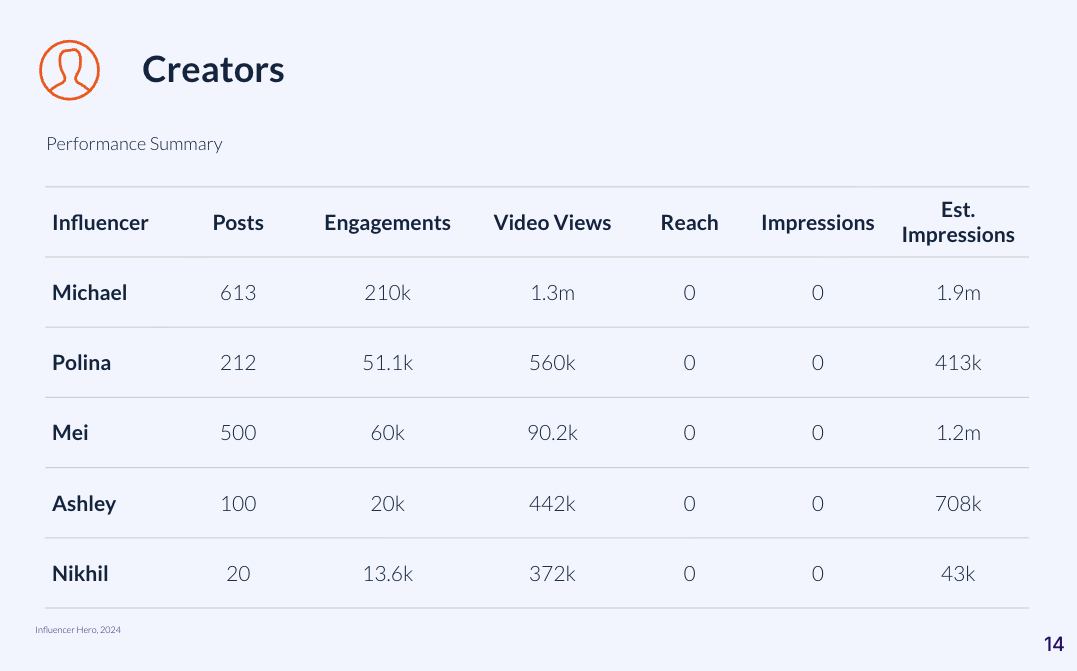
This table makes it immediately clear who should be reactivated, upgraded, or moved into fixed-fee partnerships for future campaigns.
Visualize Top-Performing Creatives
Instead of listing metrics only, show the actual photos, Reels, or TikToks that performed best.
Include:
- 3–6 top creatives
- Why they performed well (hook, CTA, relatability, etc.)
- How each will be repurposed for paid ads, whitelisting, or organic
- Creators to re-engage for future UGC production

This turns raw data into actionable creative strategy.
Identify Patterns and Insights
Data is useless without interpretation. Include a concise insights section, such as:
- “Creators with 30–80k followers consistently drove the highest ROIS.”
- “Reels outperformed static posts by 4× in CTR.”
- “Creators using discount codes in Stories converted 22% better than those using only feed posts.”
- “High-performing creators had significantly higher audience credibility scores.”
This shows leadership that you’re not just tracking results - you’re learning from them.
Make Clear Recommendations for Future Campaigns
End with a section that tells the team exactly what to do next. Examples:
- Expand testing to 150 new creators next month
- Move top 10 HPs into fixed-fee seasonal campaigns
- Increase whitelisting budget for 3 best-performing UGC videos
- Reallocate budget away from LPs with low conversion rates
- Run a BOF seasonality push with HPs for Mother’s Day
This is the section CMOs care about the most - what the data means for growth.
Use a Reporting Template to Standardize Everything
If you’re an agency, standard reporting ensures consistency across clients. If you’re a brand, it ensures clean internal communication.
Tools like Influencer Hero allow you to automatically generate reporting dashboards that combine:
- TOF metrics
- Affiliate link data
- Creator-level conversion reports
- Cost tracking
- Creative libraries
- Custom ROIS calculations
This reduces manual reporting time and eliminates errors.
Final Thoughts
Influencer marketing becomes truly scalable only when brands treat it like a performance channel, not a gamble. Tracking the right metrics gives you visibility into the full funnel: how people discover your brand, how they interact with creators, and ultimately, how many convert into paying customers.
With accurate attribution (affiliate links + discount codes), clear KPIs across the funnel, and structured reporting, you can identify your top-performing creators, optimize budget allocation, and build campaigns that compound over time.
If you're ready to build a performance-driven influencer program with accurate attribution, automated reporting, and a full creator CRM, book a demo and see how top brands track and scale their influencer ROI with ease.
Key Takeaways
- Affiliate links and discount codes are the most reliable way to track bottom-funnel influencer performance.
- TOF metrics like impressions, reach, and engagement rate reveal creator reach and content resonance.
- BOF KPIs - revenue, ROIS, CAC, AOV, CR - determine true profitability.
- Earned Media Value (EMV) helps quantify brand awareness in monetary terms.
- Great reports include: KPIs across the funnel, costs, top creators, top creatives, insights, and recommendations.
- Use reporting to reallocate budget, re-activate top performers, and refine your influencer program over time.
- The brands that win long-term are those who treat influencer marketing as a data-driven growth engine.
Continue learning: How to Budget, Forecast, and Finance a Performance-Driven Influencer Campaign
Summary
This is some text inside of a div block.
This is some text inside of a div block.
Pricing/Month
Shopify Reviews
This is some text inside of a div block.
This is some text inside of a div block.
This is some text inside of a div block.
This is some text inside of a div block.
This is some text inside of a div block.
This is some text inside of a div block.
This is some text inside of a div block.
This is some text inside of a div block.
This is some text inside of a div block.
This is some text inside of a div block.
This is some text inside of a div block.
This is some text inside of a div block.
This is some text inside of a div block.
This is some text inside of a div block.
This is some text inside of a div block.
This is some text inside of a div block.
This is some text inside of a div block.
This is some text inside of a div block.
This is some text inside of a div block.
This is some text inside of a div block.
This is some text inside of a div block.
Read More

FAQs
What is the most accurate way to track influencer sales?

The highest accuracy comes from using affiliate links + unique discount codes together. Links track clicks and conversions, while discount codes capture sales from users who purchased later or via a different device. Combined, they typically capture about 70% of total attributable sales.
Which influencer KPIs should brands focus on first?
For performance-driven brands: Revenue, ROIS (Return on Influencer Spend), CAC (Customer Acquisition Cost) For awareness-focused campaigns: Impressions, Engagement rate, CTR
The right KPI depends on whether your campaign objective is branding or conversions.
How do I know which creators to re-activate?
Look for creators with: High ROIS, Consistent sales per post, Strong CTR, High audience credibility (low fake follower %). These creators become your “High Performers” and should be prioritized for seasonal campaigns and paid partnerships.
What is a good ROIS for influencer marketing?
Most high-performing D2C brands target 3×–10× ROIS depending on margins. For high-LTV products (skincare, supplements), ROIS can be lower because repeat purchases increase long-term value.
How often should I report on influencer performance?
- Weekly for always-on programs
- Daily during high-intent campaigns (BFCM, Valentine’s, Mother’s Day)
- Monthly for executive reports
- Consistent reporting allows you to quickly spot conversion trends, optimize budget allocation, and reactivate top creators at the right moments.




Most Popular Blogs


Drive ROI With Influencer Marketing
Join 1,200+ brands and 150+ agencies scaling creator programs with Influencer Hero.