
Cision Pricing & Review In 2026

March 6, 2026
|
Published

August 19, 2026
|
Updated

10 minutes
|
Reading

Influencer Performance Marketing Course | VOUCHER: IMC100

María Vincenzini
I Author

Drive ROI With Influencers

Global Influencer Database
ALL-IN-ONE platform
CRM, Affiliate, UGC & More
Cision Pricing & Review in 2026
Cision pricing is not published anywhere — no tiers, no starting price, just a contact form that routes you to a sales call and a custom quote.
Based on real procurement data, the median Cision buyer pays around $12,677/year, with most deals landing between roughly $3,400 and $33,700 depending on products, seats, and how hard you negotiate. Enterprise suites that bundle PR Newswire can run well into six figures.
Here's the honest breakdown of what Cision actually costs by product, what you get, how brands rate it, and where it fits if influencer marketing — not PR — is what you're really after.
Cision Pricing in 2026
These figures are estimates pulled from procurement databases and user reports, not official rates — Cision publishes none. Annual contracts are mandatory, and there are no monthly plans.
CisionOne (Communications Cloud)
- AI-powered media monitoring, outreach, analytics, and social listening
- Includes media and influencer targeting from Cision's contact database
- Estimated ~$7,000 to start, scaling to $25,000+ with seats and modules
CisionOne is the flagship platform and where most buyers begin. Base configurations reportedly start near $7,000/year, climbing as you add users, global coverage, social listening, or broadcast monitoring. It's best for in-house comms teams and agencies that live in media monitoring day to day.
Media Database (standalone)
- Access to journalist, editor, expert, and media-influencer contacts
- Priced per user, tiered by seats and geographic coverage
- Estimated ~$5,700–$6,000/year for the database alone
The media database can be bought on its own and is one of Cision's best-known assets. Cost scales with the number of seats and whether you need North America only or global coverage. For small teams it often falls in the $10,000–$25,000 range once seats and research depth are added.
PR Newswire
- Press release distribution across regional, national, and global networks
- Priced per release, with annual packages for frequent senders
- A 400-word national release reportedly starts around $1,070
PR Newswire is Cision-owned and priced separately from the platform. A single release climbs quickly once you add word count and multimedia — real-world examples push past $2,000 for one announcement. Teams distributing regularly often buy annual packages that bundle a set number of releases.
Enterprise (full suite)
- Bundles CisionOne, the media database, social listening, and PR Newswire
- Custom-negotiated, multi-year terms common
- Estimated $50,000–$150,000+/year
Enterprise is for large, multi-market comms operations with compliance or investor-relations needs. Pricing is entirely bespoke, and buyers frequently negotiate 15–25% below the first quote on multi-year or bundled deals.
API access
Cision offers integrations and API access as part of enterprise arrangements rather than a published pricing line, so it's quoted with your contract. For reference, Influencer Hero also offers API access for brands that want campaign and creator data in their own systems.
Cision Overview
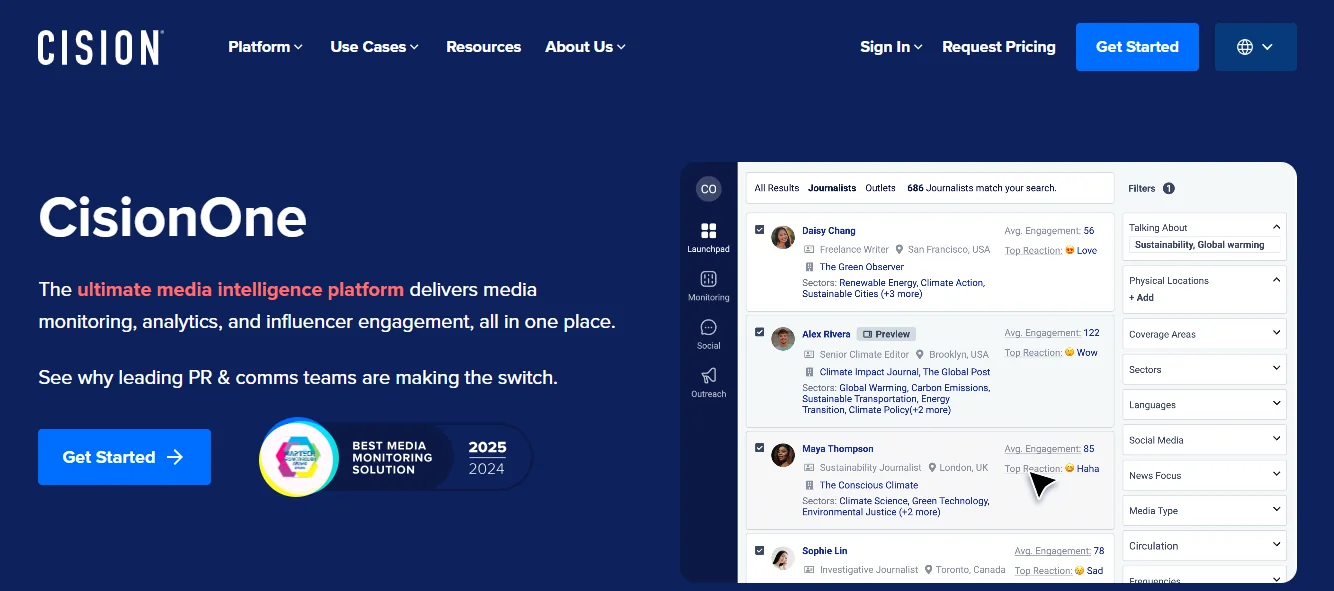
Cision is an enterprise PR and media-intelligence suite built for communications teams, not a dedicated influencer marketing platform. Its core jobs are monitoring media coverage, maintaining a vast journalist and media-contact database, distributing press releases through PR Newswire, and tracking sentiment with social listening.
It does include media and influencer targeting, but that capability sits inside an earned-media workflow — identifying journalists and media personalities to pitch, rather than running paid creator campaigns end to end.
Cision Best Features
- Media monitoring and coverage tracking: Cision's centralized monitoring is its standout, letting teams track brand mentions across online, print, broadcast, and social in one dashboard. Reviewers consistently cite this and the real-time alerts as the main reason they stay on the platform.
- Global media database: The database houses journalist, editor, expert, and media-influencer contacts validated by AI and human researchers, marketed as a network of over a billion profiles. For PR teams pitching stories, it's a serious time-saver for finding and reaching the right reporters.
- PR Newswire distribution: Through its owned distribution network, Cision can push press releases to regional, national, or global outlets with multimedia support. It's an industry standard for regulated disclosure and high-volume press distribution, which is why large brands keep it.
- Social listening and sentiment analysis: Via its social intelligence tools, Cision surfaces emerging conversations and applies AI sentiment scoring to flag potentially harmful coverage. This helps comms teams manage reputation risk proactively rather than reacting after a story spreads.
- PR analytics and reporting: Cision ties coverage back to reporting dashboards so teams can demonstrate PR impact and trends over time. The reporting depth is frequently praised by reviewers who need to justify PR spend to leadership.
Cision Reviews
CisionOne holds roughly a 3.9 out of 5 on G2 across more than 1,200 reviews, with PR Newswire similar at 3.9 across around 750. Users praise the centralized monitoring, ease of use, the breadth of the media database, and the reporting — it's a genuinely capable PR tool.
The criticism clusters around cost and contracts. Reviewers flag opaque pricing, unexpected billing, and contract terms that need careful review before signing. On the influencer side specifically, the platform is not the standout — one peer reviewer notes there are other, better platforms for influencer engagement, which lines up with Cision's PR-first design.
Across Reddit and procurement forums, the recurring theme is pricing opacity and wide quote variance for similar configurations, which pushes smaller teams toward cheaper PR alternatives like Prowly, Prezly, or Muck Rack.
Cision vs Influencer Hero Pricing
The honest comparison here isn't price — it's purpose. Cision is an earned-media platform; you pay $10,000+/year primarily to monitor coverage, pitch journalists, and distribute press releases. Influencer Hero is built for the opposite motion: actively running influencer campaigns that drive sales, with transparent published pricing you can see before any call.
That difference shows up in the toolset. Cision identifies media contacts and tracks mentions; it doesn't run creator outreach at scale, manage gifting and seeding, handle affiliate links, or connect to your store. Influencer Hero covers that full pipeline — global creator discovery, outreach automation and follow-ups, an influencer CRM, gifting, affiliate and commission management, ROI tracking, and native Shopify integration. So if "influencer marketing" is the actual goal, Cision's influencer features are a secondary layer on a PR tool, while Influencer Hero is purpose-built for it.
Final Thoughts
Cision earns its reputation as a comprehensive PR suite: the monitoring, media database, and PR Newswire distribution are strong, and large comms teams running multi-regional, compliance-heavy programs get real value. The drawbacks are the opaque, high pricing, mandatory annual contracts, and the fact that its influencer capabilities are built around earned media rather than paid creator campaigns.
For brands whose actual goal is influencer marketing — finding creators, running campaigns, and tying them to sales — Influencer Hero is the more fitting platform, with transparent pricing and an end-to-end stack from discovery to Shopify conversion. If PR and media monitoring are what you need but Cision's cost is the sticking point, Prowly, Prezly, and Muck Rack are worth comparing. To see how purpose-built influencer marketing works, book a demo with Influencer Hero!
Summary
This is some text inside of a div block.
This is some text inside of a div block.
Pricing/Month
Shopify Reviews
This is some text inside of a div block.
This is some text inside of a div block.
This is some text inside of a div block.
This is some text inside of a div block.
This is some text inside of a div block.
This is some text inside of a div block.
This is some text inside of a div block.
This is some text inside of a div block.
This is some text inside of a div block.
This is some text inside of a div block.
This is some text inside of a div block.
This is some text inside of a div block.
This is some text inside of a div block.
This is some text inside of a div block.
This is some text inside of a div block.
This is some text inside of a div block.
This is some text inside of a div block.
This is some text inside of a div block.
This is some text inside of a div block.
This is some text inside of a div block.
This is some text inside of a div block.
Read More

FAQs







Most Popular Blogs


Drive ROI With Influencer Marketing
Join 1,200+ brands and 150+ agencies scaling creator programs with Influencer Hero.