Top 13 Influencer CRM Software for Managing Creator Relationships
Influencer marketing has become one of the most effective growth channels for brands in 2025, but managing creator relationships at scale is increasingly complex. From discovery and outreach to campaign tracking and payments, the right influencer CRM software can make the difference between chaotic workflows and scalable, performance-driven influencer programs.
Influencer CRM platforms like Influencer Hero, CreatorIQ, Upfluence, and others give brands the tools to streamline influencer discovery, manage communication, automate outreach, and track campaign performance in real time. These platforms centralize every stage of the influencer lifecycle, helping teams build stronger relationships and maximize ROI from creator collaborations.
Whether you’re a fast-growing DTC brand or an enterprise marketing team, choosing the right influencer CRM will allow you to scale partnerships efficiently, reduce manual work, and improve campaign performance visibility. In this guide, we’ll walk you through the best influencer CRM software to help you take your influencer marketing strategy to the next level.
Why You Should Use Influencer Search & Discovery Tools in 2026
Influencer marketing is more competitive than ever. With millions of creators across TikTok, Instagram, YouTube, and emerging platforms, manually finding the right partners is time-consuming, inconsistent, and often inaccurate. In 2026, brands can’t rely on vanity metrics alone. You need to analyze audience demographics, engagement authenticity, niche relevance, growth trends, and historical campaign performance before investing your budget.
The best tools go beyond simple discovery — combining AI-powered search with built-in CRM, automated outreach, affiliate tracking, and analytics. That means you don’t just find creators; you activate, manage, and scale partnerships within one centralized system.
What to Look For in an Influencer CRM Software for Managing Campaigns
Influencer CRM platforms have become essential for brands that want to build, scale, and optimize creator relationships. Especially for teams running high-volume influencer campaigns, the right CRM can be the difference between disorganized outreach and a fully streamlined, revenue-driving system. Here are the key factors to consider:
Influencer Discovery & Database Quality: Look for platforms with strong creator databases, AI-powered search, and advanced filters that help you identify relevant influencers based on niche, audience quality, engagement, and performance signals.
Outreach & Communication Tools: The best CRMs allow you to manage outreach directly within the platform, including email sequences, messaging templates, and conversation tracking to maintain structured communication with creators.
Campaign Management & Workflow Automation: Prioritize tools that help you manage the entire campaign lifecycle—from onboarding and contracts to deliverables, approvals, and reporting—ideally with automated workflows and visual pipelines.
Affiliate Tracking & Monetization Tools: For performance-driven campaigns, CRM platforms should support affiliate links, discount codes, and sales tracking to connect influencer activity directly to revenue outcomes.
Analytics & Performance Reporting: Strong reporting dashboards are essential for tracking ROI, engagement, conversions, and top-performing creators, helping teams make data-driven decisions for future campaigns.
Ease of Use & Collaboration: A user-friendly interface with team collaboration features (notes, tags, campaign boards, shared dashboards) is critical for managing multiple stakeholders and large influencer lists.
Integrations & Scalability: The platform should integrate smoothly with eCommerce systems (like Shopify), analytics tools, and marketing stacks while scaling with your influencer program as it grows.
Pricing & Flexibility: Consider whether the platform offers transparent pricing, scalable plans, and flexibility for startups, mid-market brands, or enterprise-level organizations.
Criteria of Selection: How We Evaluated the Best Influencer CRM Software
When selecting the top influencer CRM platforms, we focused on features that directly impact a brand’s ability to manage influencer relationships efficiently and scale campaigns effectively. Each platform was evaluated using the following criteria:
1. CRM & Campaign Management Capabilities
We prioritized platforms with strong CRM functionality, including influencer databases, tagging systems, campaign pipelines, and end-to-end workflow management for influencer collaborations.
2. User Reviews & Market Reputation
We analyzed feedback from verified users and industry sources such as G2, Capterra, Reddit discussions, and agency reviews to assess reliability, usability, and real-world performance.
3. Pricing & Value for Money
We evaluated whether each platform offers strong ROI relative to its pricing structure, including entry-level accessibility, enterprise pricing transparency, and feature depth at each tier.
4. Ease of Use & Workflow Efficiency
We assessed how intuitive each platform is for managing influencer relationships at scale, including onboarding complexity, interface design, and campaign setup speed.
5. Integrations & Scalability
We examined how well each CRM integrates with eCommerce platforms, affiliate systems, analytics tools, and broader marketing stacks, as well as how effectively it supports scaling influencer programs over time.
Top 13 Influencer CRM Software
1. Influencer Hero
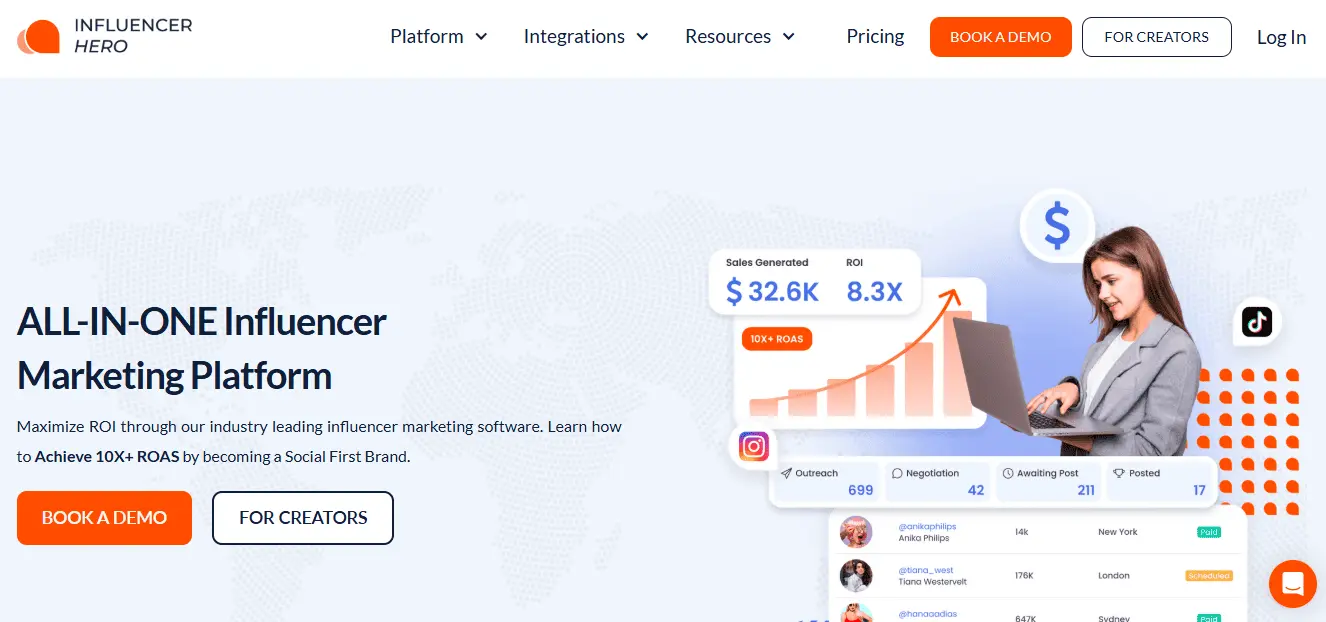
Influencer Hero is the best influencer marketing software for growing D2C and eCommerce brands that manage high-volume influencer campaigns and need a strong CRM-centered workflow. It combines discovery, outreach, gifting, affiliate tracking, UGC collection, and payments in one centralized platform, making it one of the most complete influencer CRM systems for scaling creator programs.
Pricing:
Standard Plan: $649/month
Pro Plan: $1,049/month
Business Plan: $2,490/month
Custom & Agency Plan: Custom pricing
Best For: Growing DTC and eCommerce brands running high-volume influencer campaigns
Influencer Hero Influencer CRM Features
Campaign-Centric CRM Automation: Influencer Hero uses structured CRM pipelines (similar to Kanban boards) to manage every stage of influencer relationships—from outreach to payments. Bulk actions and filtering make it easy to manage thousands of creators efficiently.
AI Workflow Optimization: The platform recommends creators, predicts campaign performance, and automates outreach messaging to reduce manual workload and improve efficiency.
Multi-Platform Coverage: Supports influencer campaigns across 8 platforms including Instagram, TikTok, YouTube, Facebook, Pinterest, Snapchat, X, and Twitch.
Affiliate & Payments Hub: Tracks commissions, affiliate links, and payouts directly in-platform, integrated with eCommerce systems like Shopify and WooCommerce.
UGC Collection System: Automatically collects influencer content and organizes it for repurposing in ads or organic campaigns.
Centralized Influencer Relationship Management: All influencer data—profiles, conversations, campaign history, contracts, and performance metrics—is stored in a single unified system, giving teams a complete view of each creator and enabling more organized, scalable relationship management.
AI Predictive ROI Analytics: Provides real-time insights into clicks, conversions, and ROI while using predictive models to forecast campaign performance.
Other Standout Features
Influencer Hero also offers bulk outreach email sequences, campaign automation workflows, and centralized influencer relationship tracking. It is designed as a full end-to-end influencer marketing system rather than a simple CRM tool.
Pros and Cons
Pros
Cons
Powerful CRM system with visual campaign boards and automation
Requires paid plan for full access (no extensive free tier)
All-in-one workflow: discovery, outreach, gifting, UGC, and payments
Learning curve due to advanced automation features
Strong AI automation and predictive analytics
Excellent for scaling high-volume influencer campaigns
Our Insights:
Influencer Hero is the most complete influencer CRM for growing brands that need automation, scalability, and full campaign control. While it requires onboarding time, its all-in-one workflow and AI-driven features make it the strongest option for managing influencer campaigns at scale.
2. GRIN
GRIN is best for DTC and eCommerce brands that want to manage end-to-end influencer programs in a single unified platform. It is designed for teams running large-scale influencer operations that require product seeding, affiliate tracking, UGC management, and ROI measurement all within one centralized CRM system.
Pricing:
Starts around $2,500/month
Can reach $10,000+/month depending on usage
Annual contracts only (12-month minimum commitment)
Entry-level pricing starts around $25,000/year
Best For: Established DTC and eCommerce brands managing large-scale influencer programs
GRIN Influencer CRM Features
Unlimited Creator Management: GRIN allows brands to manage unlimited influencer partnerships without per-creator fees, making it highly scalable for high-volume programs.
AI-Powered Discovery (Gia Assistant): Uses AI to recommend creators, qualify influencers, and automate outreach suggestions to streamline discovery workflows.
End-to-End Influencer CRM: Centralizes all influencer data, communication history, campaign progress, and collaboration tracking within one dashboard.
UGC Content Library: Automatically collects influencer-generated content, including Instagram Stories, and organizes it for easy repurposing across marketing channels.
Payments via PayPal Integration: Enables direct influencer payments within the platform, simplifying financial workflows and reconciliation.
Media Rights Management: Automatically includes usage rights in influencer collaborations for easier content repurposing in ads and campaigns.
Other Standout Features
GRIN integrates deeply with Shopify for eCommerce workflows, provides creator landing pages for inbound applications, and offers detailed performance analytics for tracking ROI across campaigns.
Pros
Cons
Unlimited influencer partnerships with no per-creator limits
High entry cost compared to mid-market tools
Strong eCommerce integrations (Shopify, PayPal)
No native paid ad boosting or whitelisting features
Complete influencer lifecycle CRM system
Primarily designed for enterprise-level brands
AI-powered discovery and automation tools
Our Insights:
GRIN is a powerful influencer CRM built for scaling DTC brands that need full lifecycle management and deep eCommerce integration. While it offers excellent automation and scalability, its pricing makes it most suitable for established brands rather than startups.
3. Aspire
Aspire is best for mid-sized and large brands that want to manage influencer marketing through a fully connected workflow, from discovery and outreach to gifting, approvals, and performance tracking. It is especially strong for eCommerce teams that rely on first-party social data and structured campaign execution.
Pricing:
Starts around $2,300/month
Typically ranges between $2,000–$5,000/month
Annual contracts only
Best For: Mid-market and enterprise DTC brands running ongoing influencer campaigns
Aspire Influencer CRM Features
First-Party Data Integrations: Uses verified data from platforms like Instagram, TikTok, and Pinterest for more accurate influencer insights and audience analysis.
Inbound Creator Marketplace: Provides access to 1M+ creators who can apply directly to brand campaigns, reducing manual outreach efforts.
Workflow Automation: Automates key campaign processes such as approvals, contracts, and collaboration management.
Shopify Gifting Integration: Allows influencers to select products directly from brand catalogs for seamless gifting campaigns.
Affiliate & Sales Tracking: Generates discount codes and affiliate links tied to influencer performance for direct revenue attribution.
Other Standout Features
Aspire also includes UGC content libraries, AI-powered creator recommendations, and campaign reporting dashboards that help teams measure performance across multiple channels.
Pros and Cons
Pros
Cons
Large inbound creator marketplace
Higher pricing compared to SMB tools
Strong automation and workflow tools
No built-in payment processing system
Reliable first-party social data
Limited support for niche influencer platforms
Dedicated onboarding and support
Our Insights:
Aspire is a strong influencer CRM for brands that want a balance between automation and creator marketplace access. It is particularly effective for structured eCommerce influencer programs that require scale and organization.
4. Influencity
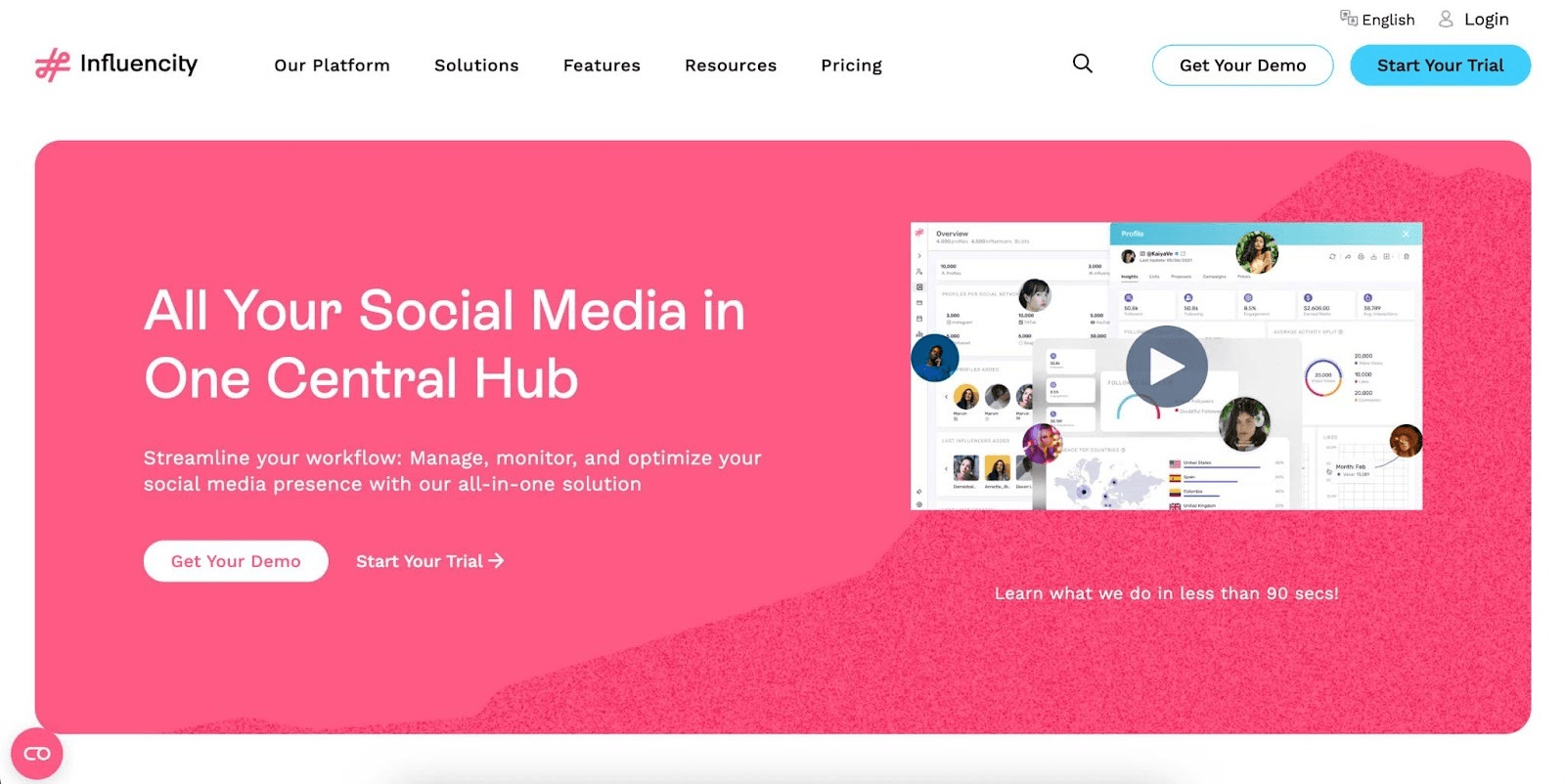
Influencity is best for brands and agencies that need a data-driven influencer CRM to manage large creator databases efficiently. It combines discovery, outreach, campaign management, and reporting in a structured visual workflow, making it ideal for teams that prioritize organization and analytics.
Pricing:
Professional Plan: $3,816/year
Business Plan: Custom pricing
Tracker Add-On: $660/year
Best For: Mid-sized brands and agencies managing multiple influencer campaigns
Influencity Influencer CRM Features
Visual CRM System: Organizes influencers in a Trello-style interface with lists, tags, and segmentation for campaign tracking and workflow management.
Smart Influencer Discovery: Uses AI filters, hashtags, engagement metrics, and audience data to identify relevant creators for campaigns.
Automated Outreach System: Enables email outreach campaigns with tracking for open rates, clicks, and responses directly in-platform.
Shopify Integration: Supports product seeding, discount codes, and affiliate tracking through Shopify synchronization.
Advanced Campaign Management: Allows teams to run multiple campaigns simultaneously with task-based boards and structured workflows.
Other Standout Features
Influencity includes AI forecasting tools for predicting campaign performance, as well as exportable reporting in multiple formats for stakeholder reporting.
Pros and Cons
Pros
Cons
Strong visual CRM organization system
No in-platform messaging for negotiations
All-in-one campaign management workflow
Limited integrations beyond Shopify
AI-powered discovery and forecasting tools
Additional costs for auto-tracking features
Exportable reporting and analytics
Our Insights:
Influencity is a highly structured influencer CRM that works well for teams managing multiple campaigns at once. Its visual workflow system makes it especially effective for agencies and data-driven marketing teams.
5. Meltwater
Meltwater is best for enterprise brands and agencies that need a full influencer CRM combined with analytics, discovery, payments, and reporting in a single enterprise-grade platform. As part of the Meltwater ecosystem, it is particularly strong for teams that want influencer marketing integrated with broader PR and social intelligence workflows.
Pricing:
Starts around $50,000/year
Can reach $73,000/year+ depending on scale
Annual contracts only
Best For: Large enterprise teams requiring integrated influencer analytics and CRM tools
Meltwater Influencer CRM Features
Integrated Influencer CRM: Centralizes influencer relationships, communication history, campaign notes, and collaboration tracking in one system.
True Reach™ Analytics: Uses AI to measure actual audience exposure and filter out fake followers or inflated engagement metrics.
Advanced Discovery Filters: Allows brands to search millions of influencers using demographic, behavioral, and niche-based filters.
Campaign Management Dashboard: Tracks deliverables, gifting workflows, coupon codes, and campaign performance in real time.
Built-In Payments (MeltwaterPay): Enables secure global influencer payments with full compliance support.
Other Standout Features
Meltwater provides comprehensive reporting dashboards with ROI, engagement, and sentiment tracking, plus integrations across Meltwater’s broader marketing intelligence tools.
Pros and Cons
Pros
Cons
Strong enterprise-level CRM functionality
Very high enterprise pricing
Accurate audience and reach analytics
No flexible or monthly plans
All-in-one influencer management system
Requires onboarding and training for full use
Integrated payments and compliance tools
Our Insights:
Meltwater is a powerful enterprise influencer CRM designed for large organizations that want deep analytics and cross-functional marketing integration. It is best suited for global brands with significant influencer budgets.
6. Traackr
Traackr is best for enterprise and performance-focused brands that prioritize influencer relationship management, ROI optimization, and budget control across global campaigns. It is designed for long-term influencer strategy and data-driven decision-making.
Pricing:
Starts around $32,500/year
Additional modules available (affiliate tracking, analytics, extra users)
Annual contracts only
Best For: Global enterprise brands focused on ROI-driven influencer marketing
Traackr Influencer CRM Features
Dedicated Influencer CRM: Centralizes influencer profiles, communication history, campaign notes, and collaboration stages in one structured system.
Influencer Discovery & Benchmarking: Searches millions of creators and compares performance against historical benchmarks.
Outreach & Relationship Management: Uses templates, branded recruitment pages, and follow-up automation for structured influencer communication.
ROI & Budget Analytics: Tracks CPC, CPE, CPV, and overall campaign ROI for financial performance analysis.
Traackr also includes product seeding workflows and UGC libraries that help brands manage influencer-generated content for repurposing.
Pros and Cons
Pros
Cons
Strong relationship-focused CRM system
High entry pricing
Advanced ROI and budget analytics
No AI-powered discovery engine
Global scalability for enterprise teams
Complex setup and onboarding process
Strong campaign performance tracking
Our Insights:
Traackr is a highly analytical influencer CRM built for enterprise brands that want full control over influencer budgets and long-term performance tracking. It is best suited for structured, ROI-focused marketing teams.
7. Upfluence
Upfluence is best for eCommerce and retail brands that want an all-in-one influencer CRM combining discovery, outreach automation, affiliate tracking, and sales attribution. It is especially powerful for Shopify and Amazon sellers looking to connect influencer activity directly to revenue.
Pricing:
Starts around $1,276/month
Approx. $16,000/year or $14,406 upfront
Annual contracts only
Best For: eCommerce brands focused on influencer-driven sales conversion
Upfluence Influencer CRM Features
Unified Influencer CRM: Centralizes influencer data, email communication, campaign stages, and collaboration history in one dashboard.
AI Campaign Assistant (Jace AI): Automates outreach messaging, follow-ups, and campaign communication workflows.
Shopify & Amazon Integration: Tracks influencer-driven purchases and identifies creators already engaging with your brand.
Affiliate & Discount Tracking: Generates and monitors affiliate links and discount codes tied to influencer performance.
Social Listening Tools: Identifies trending content and competitor influencer activity for campaign optimization.
Other Standout Features
Upfluence includes bulk outreach automation via Gmail and Outlook, as well as real-time performance dashboards for tracking engagement and conversions.
Pros and Cons
Pros
Cons
Strong CRM and influencer tracking system
Requires annual commitment
Deep eCommerce integrations (Shopify, Amazon)
Learning curve for new users
AI-powered outreach automation
Some data inconsistencies reported in filtering
Full influencer marketing suite
Our Insights:
Upfluence is a strong influencer CRM for eCommerce brands that want to directly connect influencer activity with sales performance. It is especially effective for conversion-driven marketing strategies.
8. HypeAuditor
HypeAuditor is best for data-driven brands and agencies that prioritize influencer authenticity, fraud detection, and performance analytics. It combines influencer CRM functionality with advanced AI-powered audience analysis for global campaigns.
Pricing:
HypeAuditor offers customizable pricing based on campaigns, reports and seats needed. A typical “Business” plan can start at $10.000/yearly, while its “Enterprise” option at $60.000/yearly
Best For: Brands focused on influencer authenticity and data transparency
HypeAuditor Influencer CRM Features
Built-In Influencer CRM: Stores influencer profiles, communication history, campaign data, and performance tracking in a centralized database.
AI Influencer Discovery: Filters creators by audience quality, demographics, language, brand affinity, and authenticity scores.
Lookalike Search: Identifies similar creators based on top-performing influencers for scalable campaign growth.
Integrated Messaging System: Supports influencer outreach via email, DM, or internal messaging tools.
Campaign Content Management: Tracks influencer deliverables, approvals, and engagement metrics per campaign.
Other Standout Features
HypeAuditor also includes social listening tools for detecting brand mentions and comprehensive reporting dashboards for performance tracking.
Pros and Cons
Pros
Cons
Strong influencer authenticity detection
No transparent pricing structure
AI-powered discovery and filtering tools
Limited affiliate and eCommerce integrations
Multi-platform coverage
Manual data inputs required in some cases
Strong reporting and analytics
Our Insights:
HypeAuditor is a highly analytical influencer CRM designed for brands that prioritize data accuracy and influencer authenticity over operational simplicity. It is ideal for global, data-driven marketing teams.
9. Modash
Modash is best for DTC brands, startups, and agencies that need a scalable and easy-to-use influencer CRM with strong discovery, outreach, and affiliate tracking capabilities. It is designed for teams that want efficiency and automation without enterprise complexity.
Pricing:
Essentials: $199/month
Performance: $499/month
Enterprise: Custom pricing
Best For: Growing DTC brands and agencies needing scalable influencer workflows
Modash Influencer CRM Features
Integrated Influencer CRM: Organizes influencer outreach, collaboration stages, and communication history in customizable pipelines.
AI Discovery Engine: Accesses over 350M creator profiles using filters like niche, engagement, audience demographics, and keywords.
Outreach Hub: Integrates with Gmail and Outlook for bulk outreach and email sequencing.
Shopify Integration: Automates product seeding, discount codes, and UTM tracking for influencer campaigns.
Other Standout Features
Modash includes lookalike tools to find similar influencers and “find your fans” features to identify creators already connected to your brand.
Pros and Cons
Pros
Cons
Easy-to-use influencer CRM system
Limited integrations beyond Shopify
Massive creator database (350M+ profiles)
No built-in content licensing tools
Strong automation for affiliate tracking
No paid ads management features
Affordable compared to enterprise tools
Our Insights:
Modash is a highly efficient influencer CRM designed for fast-growing brands that want scalability without enterprise complexity. It offers strong discovery and automation tools at an accessible price point.
10. Humanz
Humanz is best for brands that want a hybrid influencer CRM platform combined with managed service support. It is designed for performance-driven influencer campaigns where brands need both advanced software tools and hands-on execution support, especially in U.S. and European markets. The platform combines influencer discovery, bidding, campaign execution, and real-time analytics in a single system supported by dedicated customer success managers.
Pricing:
Custom pricing based on campaign scope
Typical minimum budget starts around $15,000–$20,000/month
Includes platform access + managed service fees + influencer payments
Best For: Mid-to-large brands running performance-driven influencer campaigns with hybrid support needs
Humanz Influencer CRM Features
Advanced Influencer Discovery & Filtering: Humanz provides over 50 filtering parameters, including demographics, engagement rates, audience quality, location, and AI-powered profile analysis. This allows brands to identify highly specific influencer segments aligned with campaign objectives.
Influencer Bidding System: One of Humanz’s standout features is its bidding model, where influencers submit pricing proposals for campaign participation. Brands can then review, negotiate, and approve creators directly within the platform.
Hybrid Compensation Models: Supports flexible payment structures combining flat fees, gifting, and affiliate commissions, allowing brands to optimize campaign budgets based on performance goals.
Managed Campaign Execution Support: Dedicated Customer Success Managers assist with influencer onboarding, contract management, content approvals, and ensuring compliance with brand guidelines throughout the campaign lifecycle.
Integrated Contracts & Usage Rights: Usage rights and content licensing are embedded directly into influencer agreements, which can be customized depending on campaign scope and budget.
Other Standout Features
Humanz includes automated content collection for posts and stories, influencer performance scoring, and campaign optimization dashboards that help brands identify top-performing creators for scaling future collaborations.
Pros and Cons
Pros
Cons
Hybrid platform combining software + managed service support
High minimum monthly budget requirement ($15K–$20K+)
Strong real-time campaign tracking and reporting
Requires onboarding and coordination due to hybrid model
Limited scalability for low-budget influencer programs
Strong partnerships with major social platforms for data accuracy
Our Insights:
Humanz is a powerful influencer CRM for brands that want both technology and hands-on campaign execution support. It is particularly strong for performance-driven campaigns where real-time optimization, structured bidding, and managed services are essential. However, its pricing and operational model make it best suited for mid-to-large brands rather than startups.
11. Captiv8
Captiv8 is best for enterprise brands that need a highly advanced influencer CRM combined with competitive intelligence, deep analytics, and large-scale campaign management capabilities. It is designed for organizations running complex influencer programs where data tracking, collaboration, and performance measurement are critical across multiple teams and markets.
Pricing:
$25,000 annual base contract
$3,000 one-time onboarding fee
Additional $20,000–$30,000/month for affiliate + storefront features
Annual-only contracts
Best For: Enterprise brands managing large-scale influencer marketing operations
Captiv8 Influencer CRM Features
Massive Influencer Discovery Engine: Provides access to over 15M+ creators with advanced filtering options including demographics, interests, location, engagement rates, posting behavior, and even sensitive topic safety scoring.
Competitor Intelligence Search: Allows brands to identify influencers already working with competitors or mentioning brands across captions, hashtags, and visual content.
Campaign Collaboration Hub: Teams can manage multiple campaigns simultaneously, approve or reject creators collaboratively, and communicate directly with influencers inside the platform.
Integrated Messaging System: Enables direct communication with creators via email and Instagram DMs, as well as internal collaboration chat between team members.
Advanced Performance Tracking: Tracks ROAS, EMV, impressions, clicks, engagement, saves, shares, comments, and even sentiment analysis using customizable dashboards.
Other Standout Features
Captiv8 includes storefront and affiliate commerce capabilities, allowing creators to curate product selections and drive direct sales. It also supports posting requirement templates, filter locking for saved searches, and shareable public reporting links.
Pros and Cons
Pros
Cons
Strong competitive intelligence and brand monitoring tools
Very high pricing structure with multiple add-on costs
Highly advanced campaign tracking and analytics suite
Enterprise-only focus with no SMB accessibility
Collaborative CRM built for large marketing teams
Reported customer support and payment issues from users
Deep performance measurement (ROAS, EMV, sentiment analysis)
Limited flexibility and integration options beyond core tools
Custom reporting and data visualization flexibility
Complex platform requiring onboarding and training
Our Insights:
Captiv8 is a high-end influencer CRM built for enterprise organizations that need deep data visibility and competitive intelligence at scale. Its strength lies in analytics, collaboration, and reporting depth, making it ideal for large marketing teams. However, its cost and complexity make it unsuitable for smaller brands or teams seeking a lightweight solution.
12. Favikon
Favikon is best for data-driven brands and marketing teams that want an AI-powered influencer CRM focused on discovery, scoring, and relationship management. It is designed to help brands scale influencer campaigns with precision using AI rankings, multi-platform creator insights, and a lightweight CRM system that centralizes outreach and campaign tracking.
Pricing:
Starter: $69/year
Standard: $139/year
Pro: $299/year
Annual-only pricing structure
Best For: Brands and teams seeking AI-driven influencer discovery and CRM organization
Favikon Influencer CRM Features
AI-Powered Influencer Discovery & Scoring: Favikon uses proprietary AI systems to evaluate and rank millions of creators based on engagement quality, audience authenticity, niche relevance, and overall influence score. This allows brands to quickly identify high-quality influencers without manual filtering.
Multi-Platform Creator Database: Supports influencer discovery across Instagram, TikTok, YouTube, and LinkedIn, making it particularly useful for both B2C and B2B influencer strategies.
Integrated CRM System: Enables brands to manage influencer pipelines, track outreach, monitor communication history, and organize campaigns through tagging and structured workflows.
Chrome Extension for On-the-Go Discovery: Allows users to evaluate influencers directly from social platforms and add them to CRM lists instantly, streamlining prospecting workflows.
Advanced Analytics Dashboard: Provides insights into influencer performance, audience behavior, and campaign effectiveness, helping brands refine targeting and optimize ROI.
Other Standout Features
Favikon includes list-building tools, performance benchmarking, and campaign tracking capabilities that allow teams to monitor influencer performance across multiple campaigns in a centralized workspace.
Pros and Cons
Pros
Cons
AI-powered influencer ranking and discovery system
No built-in UGC rights management system
Strong multi-platform coverage including LinkedIn influencers
Limited eCommerce and affiliate tracking tools
Lightweight yet structured CRM for relationship management
No automated logistics or product seeding features
Chrome extension for fast creator sourcing
Requires manual handling for contracts and payments
Affordable entry pricing compared to enterprise tools
Less suitable for enterprise-level campaign complexity
Our Insights:
Favikon is a strong AI-first influencer CRM built for brands that prioritize discovery quality and data-driven decision-making. It is particularly useful for teams that want structured influencer management without the complexity or cost of enterprise platforms. While it lacks advanced eCommerce automation, its AI scoring system and CRM capabilities make it a powerful tool for scaling influencer discovery and outreach efficiently.
13. CreatorIQ
CreatorIQ is best for enterprise brands and global organizations managing complex, multi-market influencer programs at scale. It is designed for large marketing teams and agencies that require deep data infrastructure, compliance-ready influencer payments, and advanced performance reporting across multiple social platforms.
Pricing:
CreatorIQ operates on annual contracts only, with pricing tailored to organization size, usage, and campaign volume.
Basic Plan: $35,000/year
Standard Plan: $50,000/year
Professional Plan: $90,000/year
Enterprise Plan: $200,000/year
Add-on: Creator Connect, additional $15,000/year
All plans include core features such as CRM, influencer discovery, campaign management, analytics, and reporting. Creator payouts exceeding $100,000 annually are subject to a 2% service fee.
Best For: Enterprise brands and global marketing teams running large-scale, data-heavy influencer programs with strict compliance and reporting needs
Creator IQ Influencer CRM Features
Enterprise-Grade CRM: Centralizes all influencer relationships, communication history, campaign notes, tagging systems, and audience insights in one structured workspace designed for large teams managing thousands of creators.
AI-Powered Discovery & Advanced Filters: Enables highly precise creator search using semantic and contextual queries such as “home chefs under 100K followers” or “tennis dads,” combining audience demographics, content themes, and engagement signals.
Campaign Approval Workflows: Supports internal collaboration through shareable campaign briefs and approval pages, allowing stakeholders to review and approve influencers without requiring platform access.
Shopify Integration & Affiliate Tracking: Their Shopify integration connects influencer campaigns with eCommerce performance, enabling gifting workflows, discount code tracking, and attribution of sales activity directly within the platform.
Built-In Payments with Compliance Controls: Facilitates secure influencer payouts directly within the platform, including full tax documentation and compliance handling, functioning similarly to a business-grade payment system.
Other Standout Features
CreatorIQ also includes API integrations for enterprise data syncing, automated campaign reporting, advanced segmentation tools, and multi-market campaign coordination features designed for global teams managing complex influencer ecosystems.
Pros and Cons
Pros
Cons
Built to handle global, multi-market influencer operations
Entry-level plan starts at $35,000/year with no monthly options
Powerful keyword and semantic search capabilities for precision targeting
Requires onboarding time and training to fully leverage enterprise features
Real-time dashboards, API-level reporting, and ROI metrics impress data-driven teams
Pricing and complexity make it less suitable for smaller or early-stage brands
Streamlined, compliant payouts with tax documentation
Features like Creator Connect or extended data access require additional investment
Our Insights
CreatorIQ is one of the most powerful enterprise influencer marketing platforms available, built specifically for large organizations that need deep data intelligence, compliance infrastructure, and global campaign management. While its pricing and complexity place it firmly in the enterprise category, its combination of AI-driven discovery, advanced analytics, and integrated payments makes it a top-tier solution for brands running large-scale, multi-market influencer programs with high operational demands.
Final Thoughts
Choosing the right influencer CRM is key for brands looking to scale creator partnerships and drive consistent results. The best platforms combine discovery, outreach, automation, and analytics to streamline workflows and improve campaign performance.
While many tools focus on specific features, the most effective solutions bring everything into one centralized system. This is especially important for high-volume campaigns, where managing creators, content, and performance across multiple tools can slow teams down.
For brands that want a complete solution, Influencer Hero stands out by combining CRM automation, influencer marketing, and performance tracking in one place. It’s built for teams that need scalability without complexity. Book a demo with Influencer Hero to see how you can streamline and grow your influencer programs.
What is an influencer CRM platform and how does it work?
An influencer CRM platform is a software solution that helps brands manage influencer relationships, campaigns, and performance in one centralized system. It typically includes tools for discovery, outreach, communication tracking, campaign management, payments, and analytics, allowing teams to streamline influencer marketing workflows from start to finish.
What features should brands look for in an influencer CRM?
Key features to look for include influencer discovery, automated outreach, CRM pipeline management, campaign tracking, affiliate and discount code tracking, UGC collection, and performance analytics. Advanced platforms also offer AI-powered recommendations, eCommerce integrations, and automation tools to improve efficiency and ROI.
How much do influencer CRM platforms typically cost?
Pricing varies widely depending on the platform and level of functionality. Entry-level tools can start under $100/month, while mid-market platforms typically range from $1,000 to $5,000/month. Enterprise solutions can exceed $20,000 per year, often requiring annual contracts and onboarding fees.
What is the difference between influencer marketing platforms and influencer CRMs?
Influencer marketing platforms often focus on discovery and campaign execution, while influencer CRMs are designed to manage long-term relationships and workflows. A true influencer CRM centralizes communication, tracks influencer history, and supports ongoing collaboration, making it more suitable for scaling programs.
Which influencer CRM is best for eCommerce brands?
The best influencer CRM for eCommerce brands is one that integrates with platforms like Shopify, supports product seeding, tracks affiliate sales, and automates outreach. Influencer Hero stands out as a strong option because it combines all of these features into one system, helping brands manage high-volume campaigns and directly tie influencer activity to revenue.