Phyllo Pricing And Review in 2026

April 30, 2026
|
Published

August 19, 2026
|
Updated

10 minutes
|
Reading

Influencer Performance Marketing Course | VOUCHER: IMC100

Lucía Zabala
I Author

Drive ROI With Influencers

Global Influencer Database
ALL-IN-ONE platform
CRM, Affiliate, UGC & More
Phyllo Pricing And Review in 2026
If you're researching Phyllo pricing, the short answer is: Phyllo doesn't publish public plans. All pricing is custom and quote-based, with reported entry points starting around $199/month and scaling based on API call volume.
That's because Phyllo isn't a typical influencer marketing platform you log into. It's a data infrastructure layer, APIs that pull creator data from social platforms into your own product.
Below, we'll break down what's known about Phyllo's pricing structure, what each plan typically includes, and how it stacks up against Influencer Hero if you're looking for something more turnkey.
Phyllo Pricing in 2026
Phyllo operates on a fully custom pricing model. There are no tiered "Basic / Pro / Business" plans on its website, instead, you book a consultation, share your use case (number of creators, platforms, API call volume), and get a tailored quote.
Here's what each tier typically looks like based on user reports and public references:
Sandbox / Free Sign-Up
- Limited access to the developer dashboard
- Test API endpoints in a sandbox environment
- No production-ready data pulls
This is the entry point for developers exploring the API. You can sign up directly, poke around the docs, and run basic test calls, but it's not built for live workloads. Use it to validate the integration before committing to a paid plan. Check the Phyllo signup page for current sandbox terms.
Starter / Standard Tier (Custom)
- Reported entry around $199/month
- Access to core social data APIs across major platforms
- Webhook support and normalized data outputs
- SOC 2 Type 1 compliance
This is where most early-stage SaaS teams and smaller agencies land. It typically covers Instagram, TikTok, YouTube, and a handful of other networks with capped API calls. If you're building a creator discovery tool or a creator-facing product, this is the realistic starting line.
Growth / Mid-Tier (Custom)
- Higher API call volume
- Access to additional endpoints (social listening, social screening, brand-fit modeling)
- Dedicated technical support
Brands and platforms scaling past initial validation usually move here. Pricing scales primarily with volume — more creators connected, more API calls, more data points pulled per request. There's no published number, but expect a meaningful jump from the entry tier.
Enterprise (Custom)
- Full platform access across 20+ social networks
- Custom SLAs and dedicated account management
- Advanced features like Video Intelligence and Measurement APIs
Built for large platforms, financial services companies, or agencies pulling creator data at scale. This is where Phyllo's enterprise customers sit. Pricing is fully bespoke and tied to volume, complexity, and the specific endpoints you need.
API Pricing
Phyllo's entire business is API pricing — that's the product. Costs scale with API call volume, number of connected creator accounts, and which endpoints you're using (basic profile data is cheaper than video intelligence or social listening). Hidden costs to watch for include data refresh frequency, webhook events, and per-platform pricing variation.
Worth noting: Influencer Hero also offers APIs for influencer marketing, including Discovery, Raw, and Brand Collaborations endpoints — so if you're choosing between the two for an API-only use case, it's worth comparing both quotes directly.
Phyllo Overview
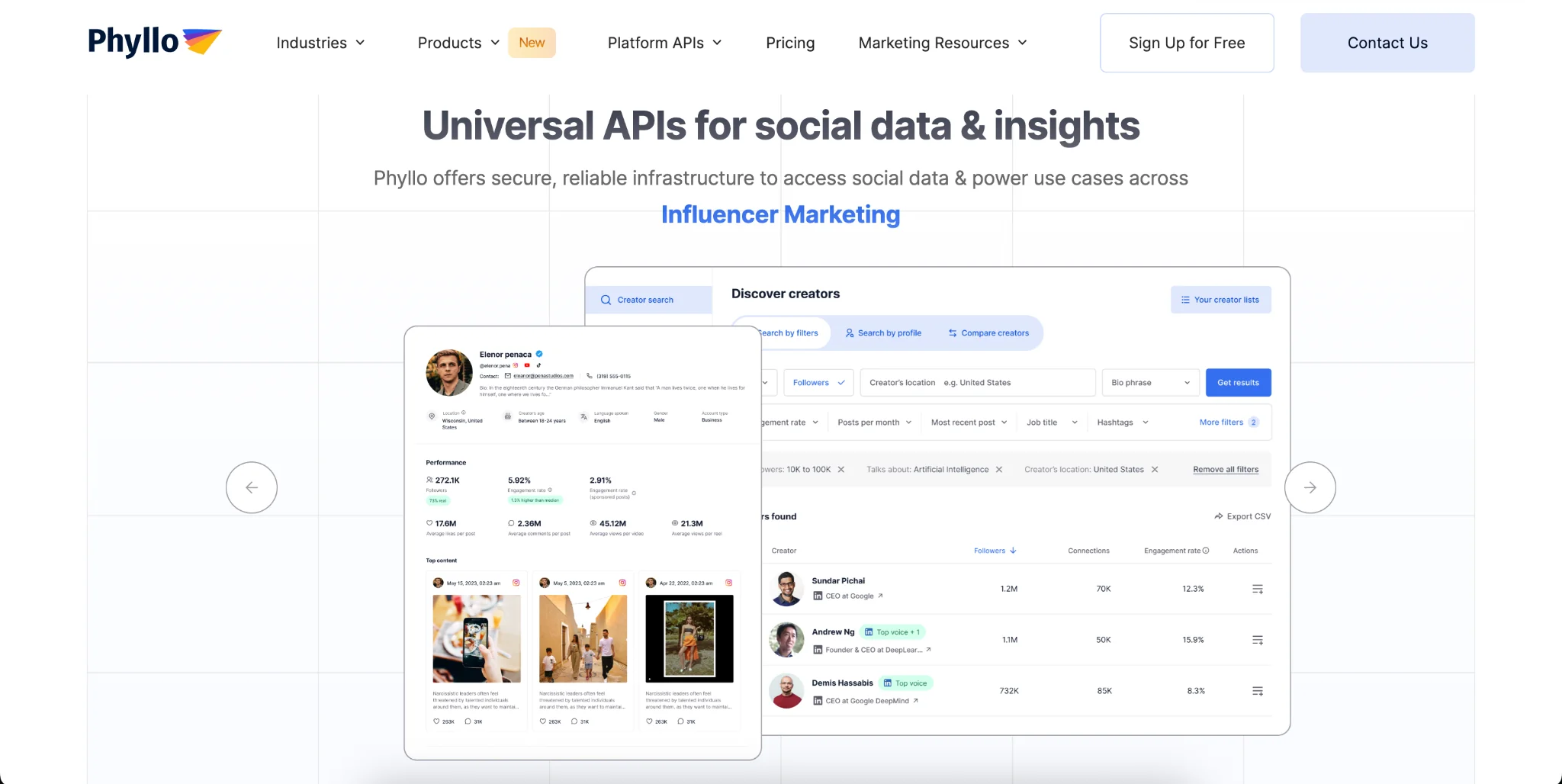
Phyllo is an API-first infrastructure platform for creator and social data. It's built for developers and product teams who want to integrate live, normalized creator data into their own applications, whether that's an influencer marketing tool, a fintech app verifying creator income, or a hiring platform screening social profiles.
Phyllo Best Features
- Creator-Permissioned Data via OAuth Unlike most influencer data providers that scrape public data, Phyllo uses authenticated OAuth flows where creators directly grant access to their accounts. This unlocks deeper, more accurate data — including private metrics — but means creators have to opt in.
- 20+ Platform Integrations Phyllo connects to Instagram, YouTube, TikTok, Twitter, Twitch, Snapchat, Facebook, and a growing list of long-tail platforms. The platform also handles oAuth flows, webhooks, and approvals on the backend so your team doesn't have to.
- Normalized Data Outputs Each social platform has its own quirks, fields, and data formats. Phyllo standardizes everything into a unified schema, so your engineers can work with one consistent data structure across platforms instead of writing custom parsers for each.
- Social Listening & Brand Fit APIs Beyond raw profile data, Phyllo offers specialized endpoints for tracking online conversations, monitoring competitor campaigns, and scoring influencer-brand alignment. These tend to land in higher pricing tiers but are useful for agencies and platforms building advanced analytics.
- SDKs for Fast Integration Phyllo ships SDKs for iOS, Android, React Native, Flutter, and web, with claimed integration times under 7 days. For dev teams building creator-facing products, this is one of the biggest selling points — most of the platform integration plumbing is already handled.
Phyllo Reviews
Phyllo holds strong ratings on G2 with users praising its ease of integration and responsive support team. The Ease of Use score sits at 9.2, with reviewers consistently flagging the speed of getting up and running as a key strength.
The most common criticism centers on dependencies that aren't really Phyllo's fault — when Meta or another platform changes its API, Phyllo's data flow can hiccup. "Most of the negative experiences we've had with Phyllo have ultimately been out of their control," notes one G2 reviewer. Some users also want better error handling and feedback during OAuth flows.
Across Reddit and developer forums, sentiment skews positive among technical buyers but cautious — most users emphasize that Phyllo is infrastructure, not a marketing tool, so non-technical teams often realize too late that they still need to build (or buy) the campaign management layer on top.
Phyllo vs Influencer Hero Pricing
Phyllo's entry point is lower on paper — $199/month versus $649/month for Influencer Hero's Standard plan. But this comparison only makes sense if you're solving the same problem, and most of the time you aren't. Phyllo gives you raw API access. Influencer Hero gives you a working influencer marketing platform with the data already wrapped in a UI.
Influencer Hero covers the operational side that Phyllo doesn't touch — automated influencer outreach, CRM workflows, gifting, affiliate tracking, Shopify integrations, UGC libraries, and ROI reporting. If you want a team to actually run campaigns tomorrow without writing a single line of code, Phyllo on its own won't get you there. If you want both — a managed platform AND raw API access — Influencer Hero offers them together.
For a deeper feature-by-feature breakdown, check the full Phyllo vs Influencer Hero comparison guide.
Final Thoughts
Phyllo pricing reflects what Phyllo actually is: a developer infrastructure tool. The custom-quote model makes sense for API-based products where usage varies wildly between customers, but it also means you can't comparison-shop on a pricing page — you have to talk to sales to know what you'll pay.
If you're a developer building a creator-economy product from scratch, Phyllo is one of the strongest options for authenticated social data. If you're a brand or agency that needs discovery, outreach, CRM, and reporting working out of the box, Phyllo alone won't cover it — you'll need to layer software on top. Tools like Influencer Hero, Modash, or GRIN handle the full marketing workflow without requiring engineering work upfront.
Want to see the full platform in action? Book a demo with Influencer Hero.
Summary
This is some text inside of a div block.
This is some text inside of a div block.
Pricing/Month
Shopify Reviews
This is some text inside of a div block.
This is some text inside of a div block.
This is some text inside of a div block.
This is some text inside of a div block.
This is some text inside of a div block.
This is some text inside of a div block.
This is some text inside of a div block.
This is some text inside of a div block.
This is some text inside of a div block.
This is some text inside of a div block.
This is some text inside of a div block.
This is some text inside of a div block.
This is some text inside of a div block.
This is some text inside of a div block.
This is some text inside of a div block.
This is some text inside of a div block.
This is some text inside of a div block.
This is some text inside of a div block.
This is some text inside of a div block.
This is some text inside of a div block.
This is some text inside of a div block.
Read More

FAQs




Most Popular Blogs


Drive ROI With Influencer Marketing
Join 1,200+ brands and 150+ agencies scaling creator programs with Influencer Hero.