Deep Research: The AI Influencer Research Tool That Vets Every Creator for You

October 20, 2026
|
Published

October 20, 2026
|
Updated

11 minutes
|
Reading

Influencer Performance Marketing Course | VOUCHER: IMC100

Gabriela Molina
I Author

Drive ROI With Influencers

Global Influencer Database
ALL-IN-ONE platform
CRM, Affiliate, UGC & More
Deep Research: The AI Influencer Research Tool That Vets Every Creator for You
Building a good creator long list takes time. You run one search, then another with different keywords, then a lookalike, then a translated keyword for a second market. Then you open hundreds of profiles one by one to check if each creator actually fits the brief.
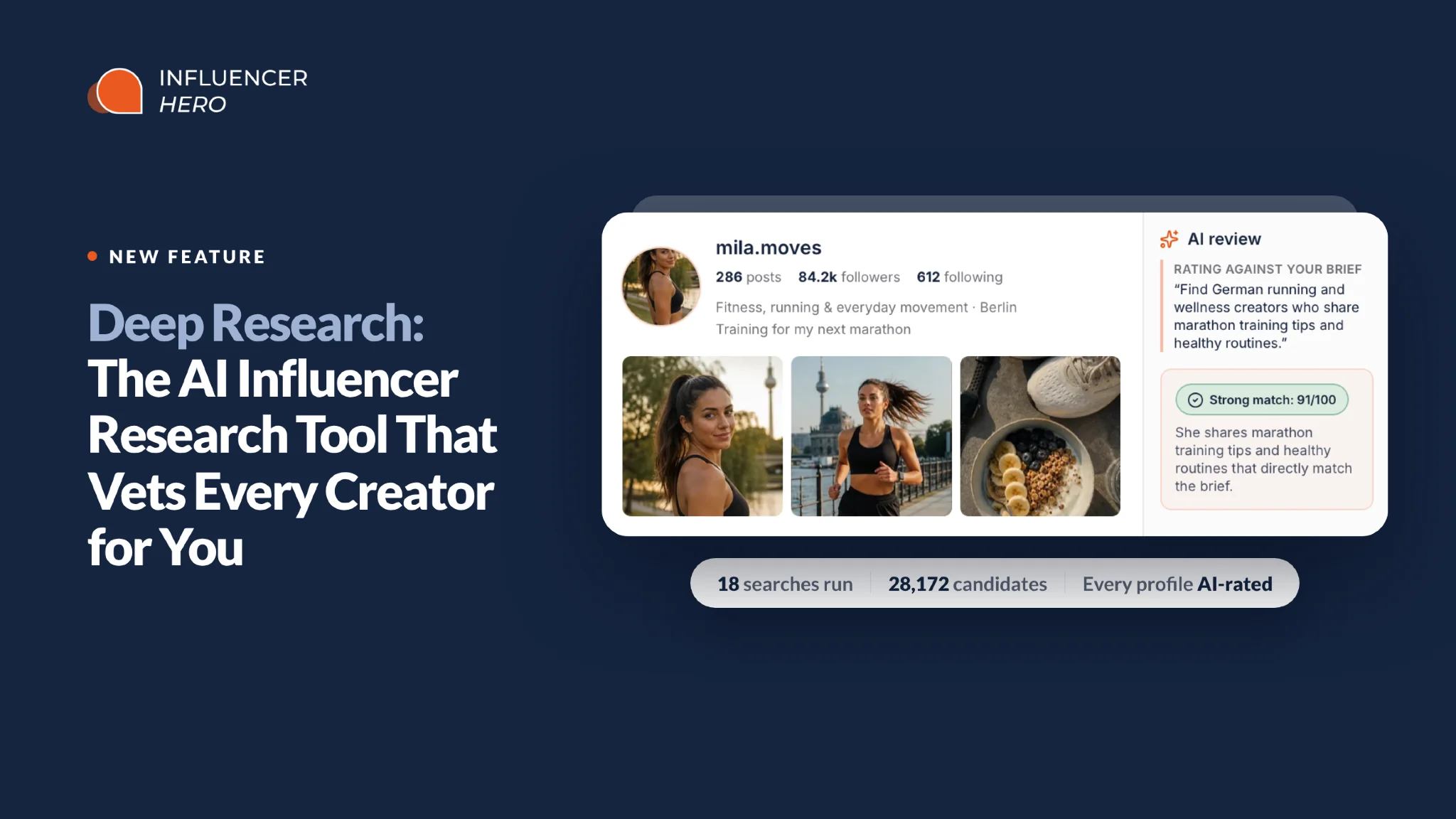
Deep Research does that whole process for you. It's part of the new Influencer Finder in Influencer Hero, and it works a lot like Deep Research in ChatGPT: you hand it a brief, it goes away and does the research, and it comes back with a detailed answer. In this case, the answer is a vetted list of creators, each with a fit score from 1 to 100 and a short match assessment.
Here's how it works and how to get the most out of it.
What Is Deep Research?
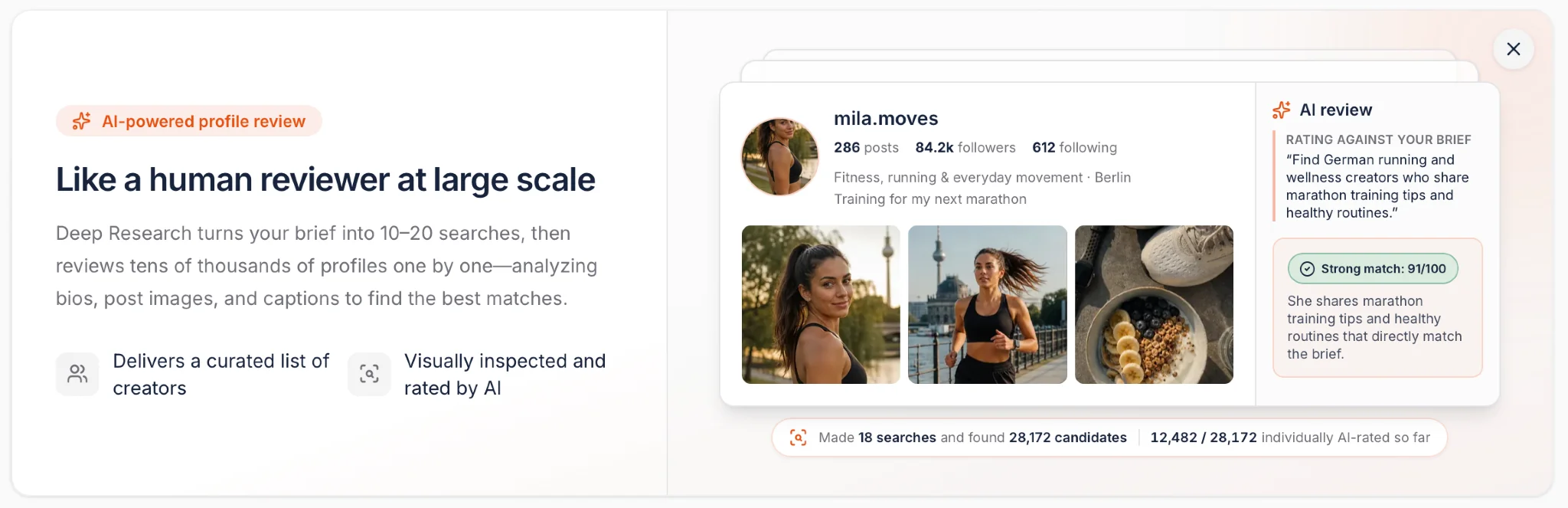
Deep Research is an AI influencer research tool that turns a written brief into a vetted creator list. It runs in three stages:
- It searches from every angle. The AI turns your brief into 10 to 20 different searches in the Influencer Finder.
- It learns from your feedback. It shows you a handful of sample creators and asks which ones fit. If you don’t approve a creator it will ask you for feedback so it can run a better and more specific search.
- It vets every creator one by one. The AI reviews every profile it found against your brief and your feedback, then scores each one from 1 to 100 and writes a match assessment.
It's the work a careful human researcher would do, at a scale no human team has time for.
How Deep Research Works, Step by Step
Step 1: Write Your Brief
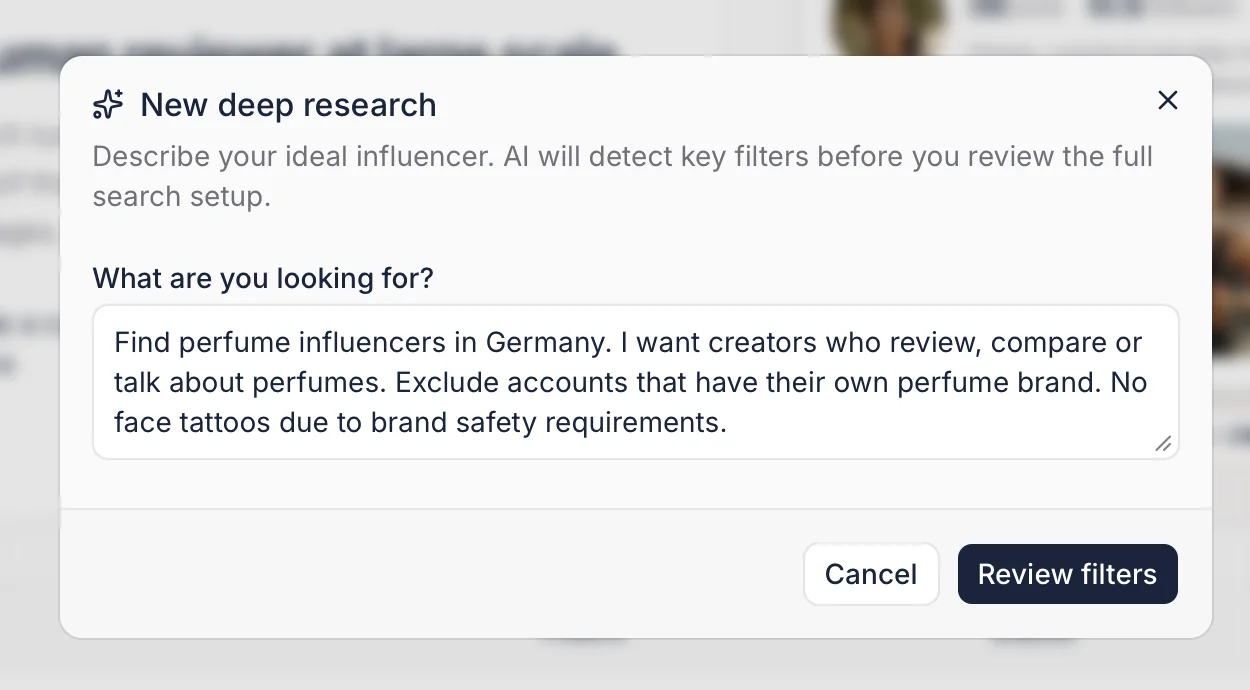
Start a new Deep Research and describe who you're looking for. The brief can be as long and detailed as you like, and the more specific it is, the better the results.
A good brief covers the niche, the market, the content you want and anything you want to exclude. For example:
Find perfume influencers in Germany. I want creators who review, compare or talk about perfumes. Exclude accounts that have their own perfume brand. No face tattoos due to brand safety requirements.
That last line matters. Because the AI looks at every creator's images, you can include or exclude anything you'd spot as a human reviewer: a certain look, a setting, a type of content.
Step 2: Set Your Filters and Strictness
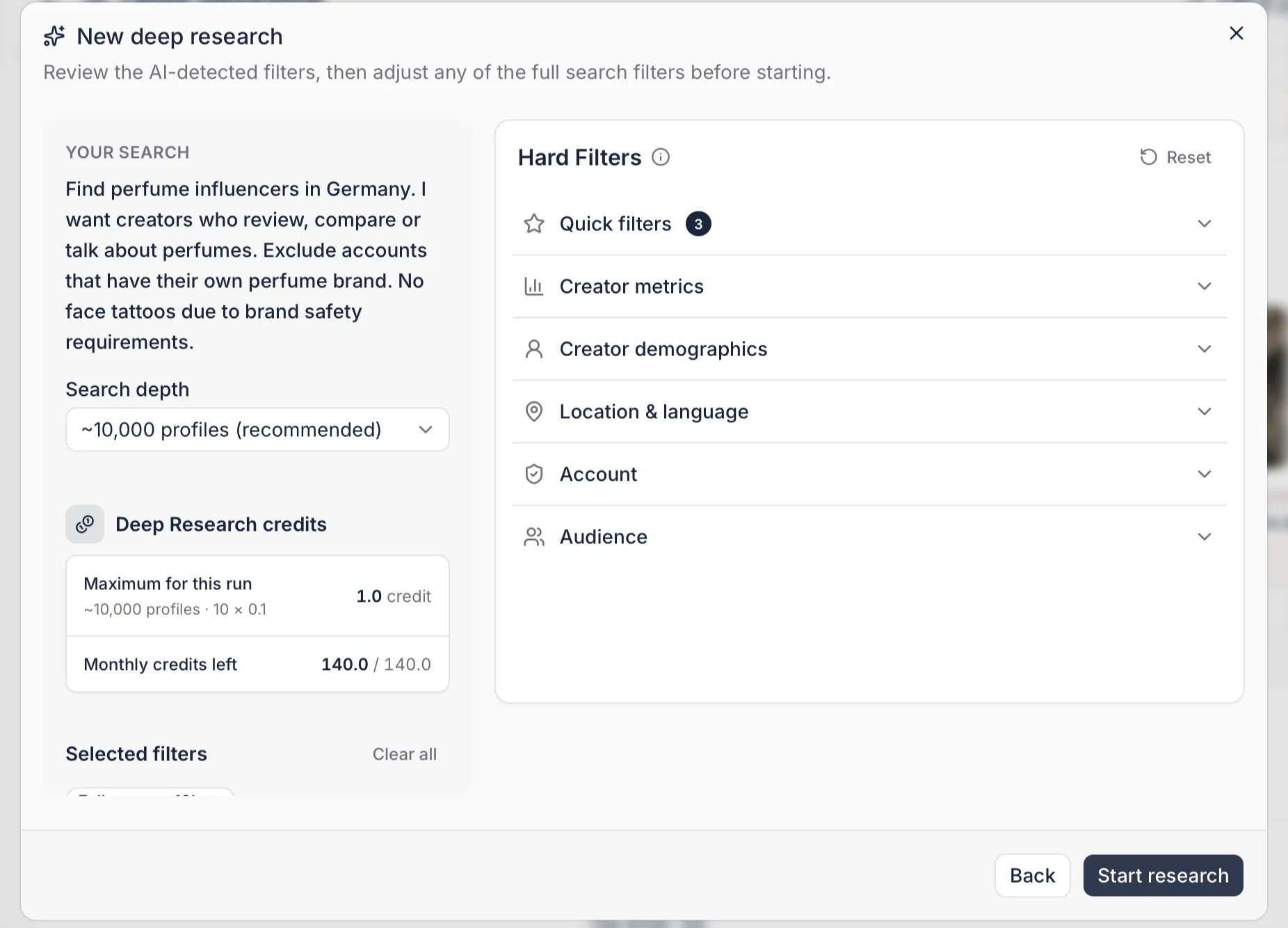
Before the search starts, you get a quick check of the hard filters. The AI sets some automatically from your brief, like the country, plus defaults like follower range and has email. You can remove them or add more, like language. These act as guardrails for everything that follows.
You also decide how strict the AI should be when it judges each creator:
- Very broad: includes creators who are only loosely related to your brief. Useful when the niche is tiny.
- Broad: includes adjacent creators, like a beauty creator who posts perfume content now and then.
- Medium (default): keeps only creators who are clearly a good fit.
- Strict: keeps only near-perfect matches.
Pick strict when you need a tight, high-quality shortlist. Pick broad or very broad when you'd rather see every possible option and filter yourself.
In the filters, you can also set your search depth. Choose a quick search of 2,000 profiles (this uses 0.5 credits) for faster results, or go deeper with a full search of 10,000 profiles (this uses 1 credit). From there, refine your results with any hard filters you need: creator metrics, demographics, location and language, account type, and audience.
Step 3: Let It Scout
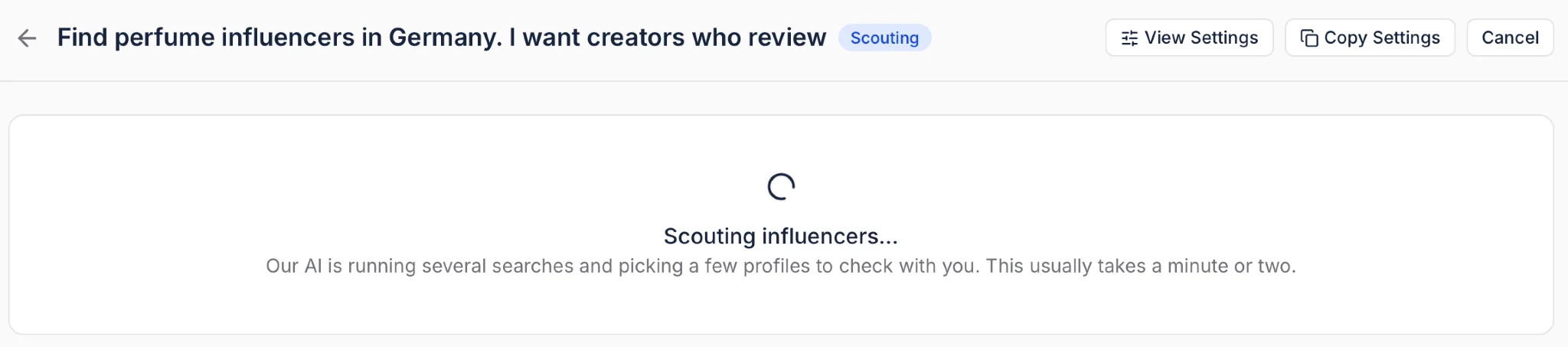
The AI now runs its searches. It applies the relevant filters and search criteria automatically, so you can find the right creators without manually setting up each search in the Finder.
- AI profile searches with different phrasings of your brief
- Keyword searches, including translations for the market (like German fragrance terms for a German brief)
- Lookalike searches, both Expand (more creators) and Refine (the common thread between examples)
- Visual searches for the content you described
It then picks a few example creators to show you. This first round usually takes between 2-3 minutes.
Step 4: Give Feedback on the Sample Creators
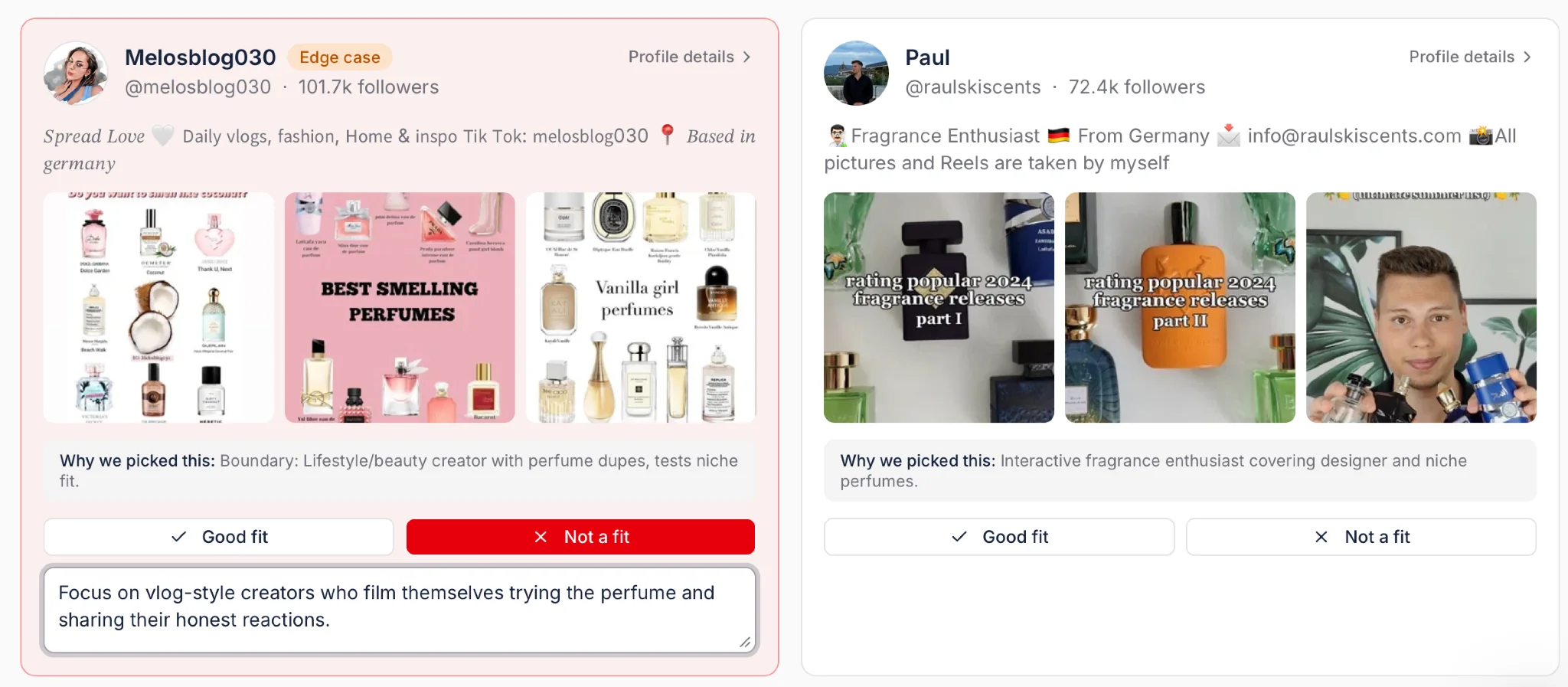
You'll see a handful of sample creators, each with a short note on why the AI picked them. Some are clear matches. Others are boundary cases, picked on purpose so the AI can learn where your line is.
For each one, mark it as a good fit or not. If it's not a fit, say why. It’s important to explain why they are not a fit as it helps the AI to better understand the type of creators you’re trying to find. For example: "She posts screenshot-style reviews, not in-person reviews. We want creators who show the product on camera."
If you decline most of them, the AI may come back with a second round of samples to get a clearer picture.
Step 5: Get Your Vetted List
After you submit feedback, the AI goes through every creator it found, one by one. It looks at their profile picture, bio and recent posts, and checks each creator against your brief and your feedback.

This is the deep part, and it takes time: usually under an hour, and up to one or two hours for big markets. You don't need to wait around. The research runs in the background and you'll find it in your list of researches when it's done.
What You Get at the End
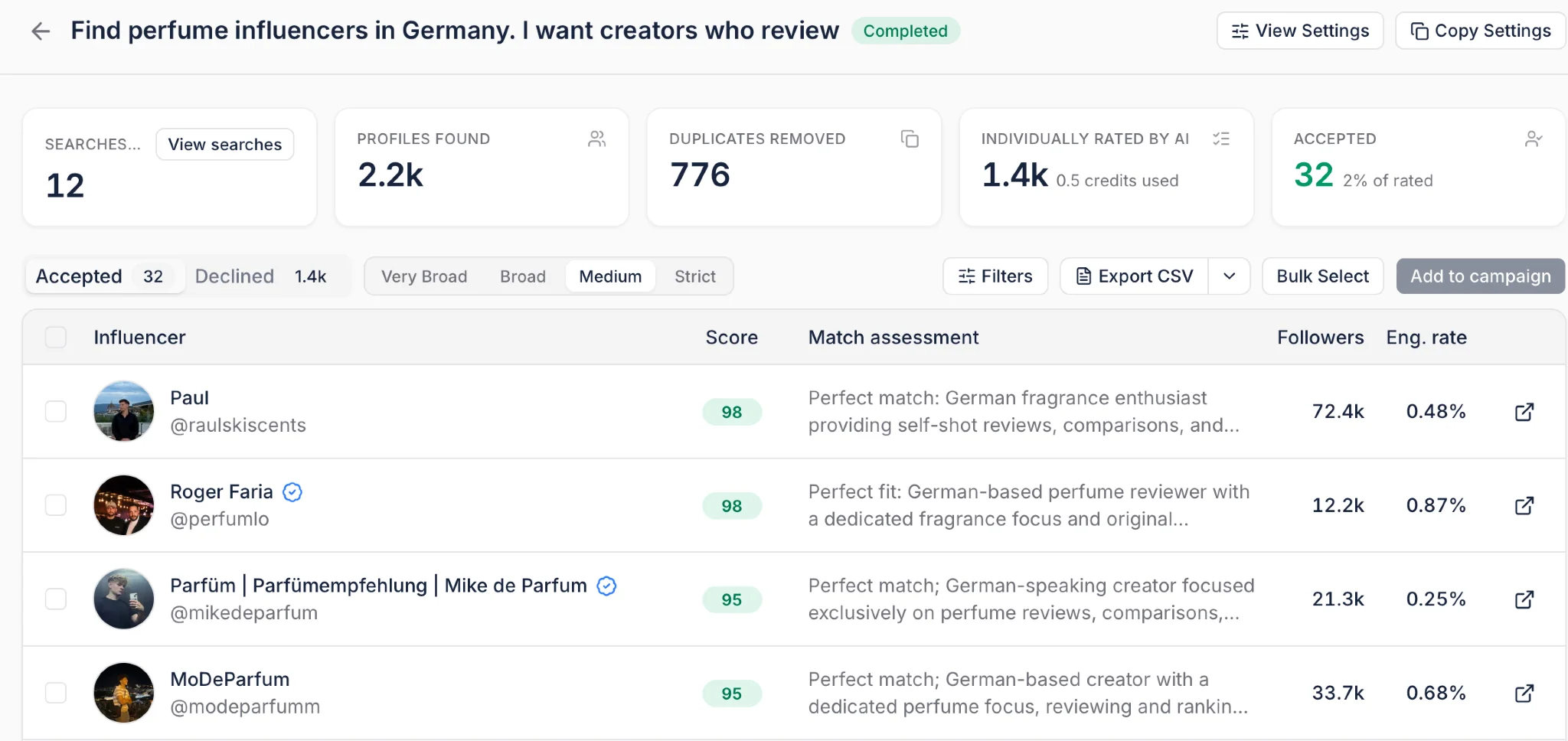
When the research is complete, every creator comes back with a score, a match assessment and a full profile you can open. Here is what that looks like.
A Fit Score From 1 to 100
Each creator gets a score from 1 to 100 based on how well they match your brief and your feedback. A creator who reviews niche perfumes every week in German scores in the 90s. A beauty creator with one perfume post in the last month scores much lower.
The score makes the list easy to sort. Start at the top, work down, and stop when the fit drops below what you need.
A Match Assessment for Every Creator
Next to the score, the AI writes a short assessment of why each creator is or isn't a match. For example:
- "Strong match. German-based fragrance enthusiast posting in-depth reviews and comparisons, with no own perfume brand."
- "Declined. Mostly beauty and lifestyle content, with only occasional perfume posts."
You get this for accepted and declined creators, so you can see exactly what was left out and why. No more guessing why a creator made the list, and no more re-checking every profile yourself.
Strictness You Can Change After the Fact
The strictness you picked at the start isn't final. Once the results are in, switch between very broad, broad, medium and strict and the list updates instantly.
This is especially useful for small niches. Run at medium, look at the near-misses in the declined list, and if they work for you, switch to broad to bring them in. You can also add more filters on top and export the list.
The Full Profile, One Click Away
Click any creator in the results and you get the full picture without leaving Influencer Hero: their recent posts and visuals, bio, key metrics and the AI's assessment. You can check the content with your own eyes and decide in seconds, instead of opening a new tab for every Instagram profile.
Every Search the AI Ran
You can also see the full list of searches the AI ran (the AI queries, keywords, translations and lookalikes), so you know exactly how it built your list.
[SCREENSHOT — add: completed Deep Research with scores and reasons]
[ALT: Influencer Hero Deep Research Vetted Creator List]
Quick Comparison: Manual Research vs Deep Research
When to Use Deep Research
Deep Research is built for briefs where getting the list right matters more than getting it in five seconds.
Niche Markets
If you're looking for perfume reviewers in Germany or plan-based diets influencers in the US, there aren't thousands of them. Deep Research searches from enough angles to find close to all of them, including the ones a single keyword search would miss.
One honest note: it won't invent creators who don't exist. If a niche is small in a market, the list will be small too. But you'll know you've covered it.
Detailed Briefs With Must-Haves and Deal-Breakers
Client wants women in the US who post hair care content focused on volume, with no competitor partnerships and no own brand? Put it all in the brief. The AI checks every creator against every point.
Brand Safety Requirements
Anything you can see on a profile, Deep Research can screen for. Write your exclusions in the brief and every creator is checked against them, instead of relying on someone to catch it while scrolling.
Agency Long Lists
For agencies, Deep Research turns a client brief into a documented long list. Every creator comes with a score and an assessment, so presenting the list (and defending it) is a lot easier.
Tips for Better Results
- Write the brief like you'd brief a junior researcher. Niche, market, content style, must-haves and deal-breakers.
- Be honest in your feedback. Explaining why a creator isn't a fit teaches the AI far more than a plain "no".
- Use the boundary cases. The borderline samples are where you set your line. Think about how far you're willing to go.
- Keep hard filters loose. Let the AI do the judging. Only set hard filters for true requirements, like country.
- Check the declined list. If your niche is small, look at what was declined and switch to broad if the near-misses work for you.
- Mind your credits. Deep Research uses credits for the profiles it analyzes. The settings show the cost, and you can set how many profiles it should review.
How It Fits With the Rest of the New Influencer Finder
Deep Research builds on every other search in the new Influencer Finder, which runs on Influencer Hero's proprietary search engine indexing around 450 million Instagram profiles.
The Finder also includes:
- AI Profile Search, which reads a creator's profile and posts, not just bio keywords
- AI Content Search, which finds creators by describing a post or uploading an image
- Multi-creator and campaign lookalikes, with Expand and Refine
- Multiple keywords and Tagged-In search to find creators who worked with a specific brand
You can also run creator searches from Claude, ChatGPT or Gemini with the Influencer Hero MCP.
And when you want a person, not a prompt, brands on managed plans still get 24/7 support from a human account manager.
Final Thoughts
The hardest part of influencer research isn't finding creators. It's checking that each one actually fits. Deep Research does both: it searches from every angle, learns what you mean from a few examples, and vets every creator against your brief with a score and an assessment you can read.
Write a brief for your next campaign, give feedback on the samples, and let it run while you do something else.
Already an Influencer Hero customer? Open the Influencer Finder and start a new Deep Research. New here? We can show you how Influencer Hero can take your influencer marketing campaigns to the next level.
Summary
This is some text inside of a div block.
This is some text inside of a div block.
Pricing/Month
Shopify Reviews
This is some text inside of a div block.
This is some text inside of a div block.
This is some text inside of a div block.
This is some text inside of a div block.
This is some text inside of a div block.
This is some text inside of a div block.
This is some text inside of a div block.
This is some text inside of a div block.
This is some text inside of a div block.
This is some text inside of a div block.
This is some text inside of a div block.
This is some text inside of a div block.
This is some text inside of a div block.
This is some text inside of a div block.
This is some text inside of a div block.
This is some text inside of a div block.
This is some text inside of a div block.
This is some text inside of a div block.
This is some text inside of a div block.
This is some text inside of a div block.
This is some text inside of a div block.
Read More

FAQs


Most Popular Blogs


Drive ROI With Influencer Marketing
Join 1,200+ brands and 150+ agencies scaling creator programs with Influencer Hero.