Wowzi Pricing & Review in 2026

February 6, 2026
|
Published

August 19, 2026
|
Updated

10 minutes
|
Reading

Influencer Performance Marketing Course | VOUCHER: IMC100

María Vincenzini
I Author

Drive ROI With Influencers

Global Influencer Database
ALL-IN-ONE platform
CRM, Affiliate, UGC & More
Wowzi Pricing & Review in 2026
Wowzi pricing works differently from most influencer platforms: there are no subscription tiers. Signing up is free, and you only pay when you run a campaign — at which point Wowzi adds a commission fee on top.
The catch is that the commission percentage isn't published anywhere, and it's not clear whether it's calculated on total campaign spend or on creator earnings. That makes upfront budgeting harder than with a flat monthly plan.
Here's how Wowzi's model actually works, what you get for the money, where it shines, and how it stacks up against a platform with transparent pricing.
Wowzi Pricing in 2026
Wowzi doesn't sell plans — it sells access to a creator network you activate campaign by campaign. There's no monthly fee to maintain; cost is driven entirely by the campaigns you run.
Free sign-up
- No cost to create a brand account and browse the platform
- Access to creator discovery and campaign-building tools before spending
- You commit budget only when you launch
Getting onto Wowzi costs nothing, which lowers the barrier to testing it. You can explore the creator library and set up a campaign before any money changes hands. The actual spend starts when you push a campaign live.
Pay-per-campaign + commission
- You fund the campaign (creator payments) plus Wowzi's commission
- The commission rate is not disclosed publicly
- Whether the fee applies to total spend or creator earnings isn't specified
This is the core of Wowzi's pricing, and also its biggest question mark. Because the commission isn't published and the base it applies to is unclear, two campaigns with the same creator budget could cost different amounts to you depending on how the fee is structured. For brands that need predictable, line-item budgeting, that ambiguity is worth raising on your first call.
No subscription tiers
- No Standard/Pro/Enterprise-style monthly plans
- Cost scales with campaign volume, not feature access
- Enterprise and agency arrangements are handled directly
Unlike most SaaS influencer tools, there's nothing to subscribe to. That's an advantage if you run campaigns infrequently and don't want a recurring bill, but it also means you can't lock in a known monthly cost or compare tiers side by side.
API pricing
Wowzi does not advertise a public API or separate API pricing. If you need to pipe creator and campaign data into your own systems, note that Influencer Hero offers API access.
Wowzi Overview
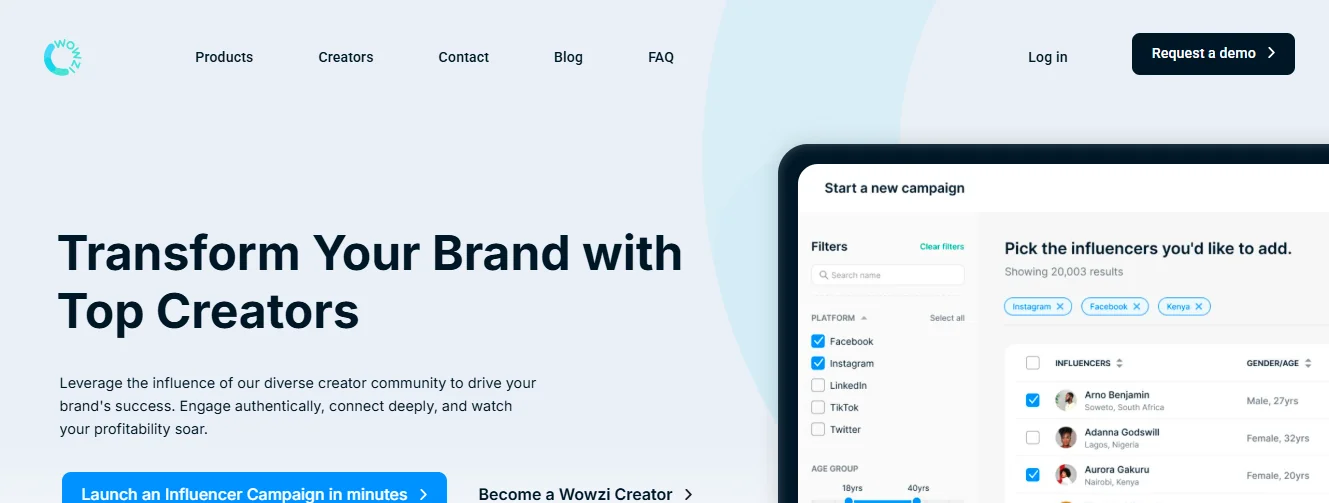
Wowzi is an Africa-focused creator marketing platform headquartered in Nairobi, Kenya, with teams across Ghana, Nigeria, South Africa, Tanzania, Uganda, and Europe. Its model is built around mobilizing large numbers of nano and micro creators — everyday social media users — to push brand messages and pull consumer insights across African markets. It serves a broad client base, from SMEs and multinationals to agencies, research firms, and NGOs.
Wowzi Best Features
- Africa's nano/micro creator network at scale: Wowzi's defining strength is mobilizing thousands of nano and micro creators in a single campaign across multiple channels at once. For brands chasing authentic, high-volume reach in African markets, that scale and local relevance is hard to replicate with a traditional shortlist of macro influencers.
- Hyperlocal targeting: You can target creators down to the village level, filtering by age, gender, location, income bracket, and follower count. That granularity is genuinely useful for campaigns that need to reach specific regional or demographic pockets rather than a broad national audience.
- Pre-vetted, verified creators: Wowzi confirms creator identity and account authenticity, monitors for bots, and enforces community standards before creators join campaigns. That vetting layer reduces fraud risk, which is a real concern at the nano/micro scale where bad actors are harder to spot manually.
- In-app content approval and brand safety: Creators submit draft content for review, and managers can request changes before anything goes live. This moderation workflow keeps high-volume campaigns on-brief and on-brand without you chasing individual posts.
- Cross-border creator payments: Wowzi handles payouts in local currencies with local tax withholding, paying creators on time via mobile money (like M-PESA) or bank transfer. Managing thousands of small payments across countries is exactly the kind of operational burden brands want off their plate.
Wowzi Reviews
Wowzi has very little independent product-review presence — its G2 profile is managed but carries minimal review volume, and it's largely absent from Capterra, so there's no reliable aggregate star rating to cite. Most validation comes from Wowzi's own case studies rather than third-party platforms.
Where reported user feedback does surface, the recurring concerns are pricing transparency, onboarding, and support. Users note the undisclosed commission makes campaign costs hard to predict, and that first-time users can face a steep learning curve with limited onboarding guidance. Support response times for more complex campaigns have also been flagged.
On the positive side, brands consistently credit Wowzi with scaling programs to thousands of creators — one client describes engaging over 5,000 influencers through the platform, a volume that would be unmanageable manually. The takeaway: strong for scale in Africa, lighter on the transparency and hand-holding some teams expect.
Wowzi vs Influencer Hero Pricing
The pricing models are fundamentally different. Wowzi charges nothing upfront and takes an undisclosed commission per campaign, so your cost floats with each activation and isn't easy to forecast. Influencer Hero uses transparent flat-rate subscriptions — $649, $1,049, and $2,490/month — so you know the platform cost before you commit and can plan budgets without waiting on a quote.
Geography and use case are the other dividing lines. Wowzi is purpose-built for African markets and excels at nano/micro creator volume and consumer insights, which is a specific job. Influencer Hero is global and built to run influencer programs end to end — creator discovery worldwide, outreach automation and follow-ups, an influencer CRM, gifting and seeding, affiliate and commission management, ROI tracking, and native Shopify integration. For a DTC or e-commerce brand focused on converting campaigns into sales outside Africa, that's a different toolkit.
The decision comes down to where and how you sell: if your audience is in African markets and you want mass nano/micro reach, Wowzi is built for that.
Final Thoughts
Wowzi is a strong choice for a clear scenario: brands and agencies running campaigns in African markets that want to activate large volumes of vetted nano and micro creators, with payments and brand-safety moderation handled for them. The free sign-up and pay-as-you-go model also suit teams that run campaigns occasionally rather than continuously. The trade-offs are the undisclosed commission, the resulting lack of budget predictability, and a network concentrated in Africa.
For brands that want transparent, fixed pricing, global creator reach, and an end-to-end stack spanning outreach, CRM, gifting, affiliate, and Shopify, Influencer Hero is the more complete platform for scaling beyond a single region. If your focus is specifically African or emerging-market reach, platforms like Pulse or regional networks are also worth weighing. To see how full-funnel, transparently priced influencer marketing works, book a demo with Influencer Hero!
Summary
This is some text inside of a div block.
This is some text inside of a div block.
Pricing/Month
Shopify Reviews
This is some text inside of a div block.
This is some text inside of a div block.
This is some text inside of a div block.
This is some text inside of a div block.
This is some text inside of a div block.
This is some text inside of a div block.
This is some text inside of a div block.
This is some text inside of a div block.
This is some text inside of a div block.
This is some text inside of a div block.
This is some text inside of a div block.
This is some text inside of a div block.
This is some text inside of a div block.
This is some text inside of a div block.
This is some text inside of a div block.
This is some text inside of a div block.
This is some text inside of a div block.
This is some text inside of a div block.
This is some text inside of a div block.
This is some text inside of a div block.
This is some text inside of a div block.
Read More

FAQs


Most Popular Blogs


Drive ROI With Influencer Marketing
Join 1,200+ brands and 150+ agencies scaling creator programs with Influencer Hero.