
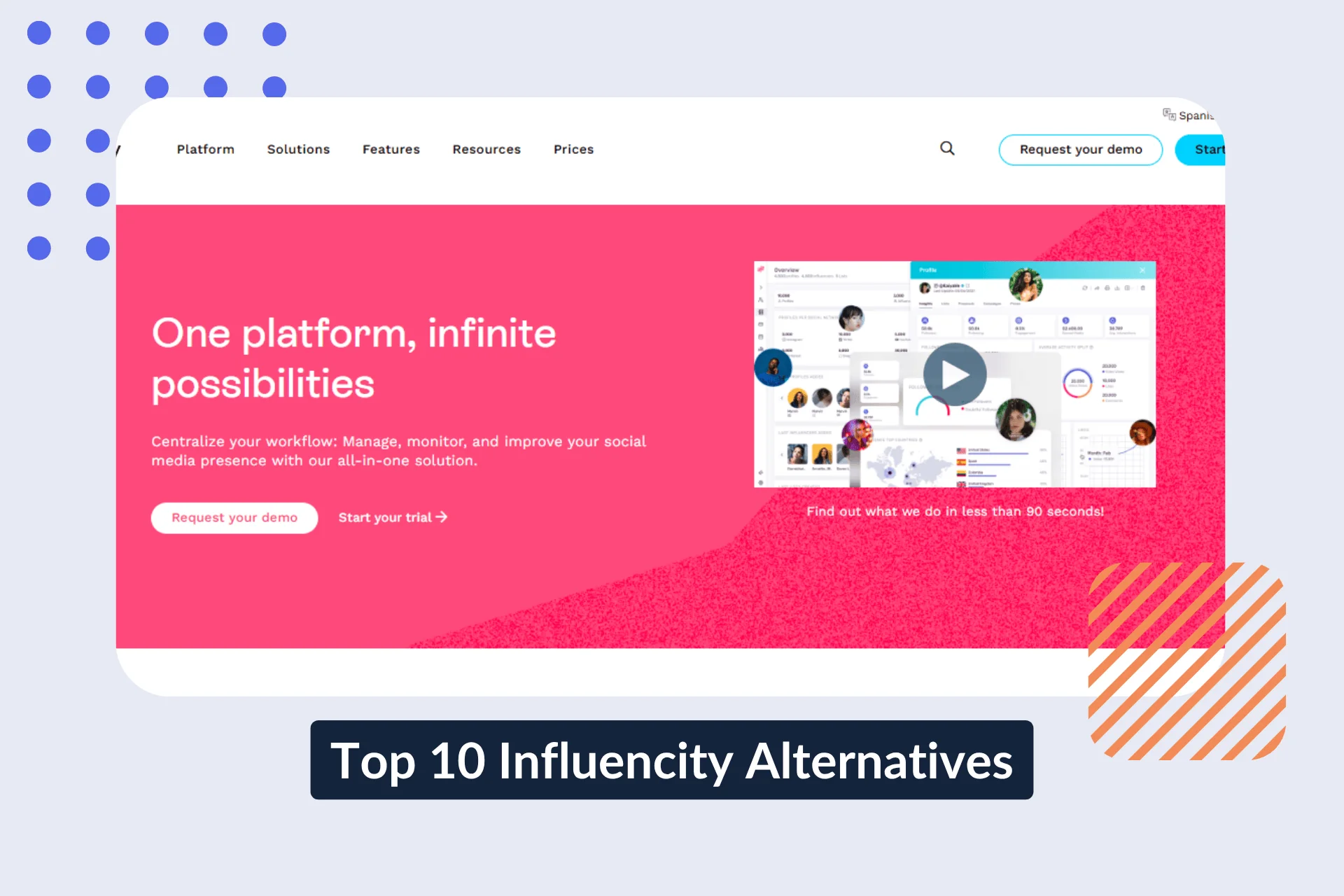
Top 10 Influencity Alternatives in 2026: Features, Pricing and Review

March 1, 2024
|
Published

September 18, 2026
|
Updated

18 minutes
|
Reading

Influencer Performance Marketing Course | VOUCHER: IMC100

María Vincenzini
Author
.jpg)
María Vincenzini

Drive ROI With Influencers

Global Influencer Database
ALL-IN-ONE platform
CRM, Affiliate, UGC & More
Top 10 Influencity Alternatives in 2026: Features, Pricing and Review
Influencer marketing is now a core channel rather than an experiment, and the platforms supporting it have consolidated fast. Influencity is one of the more accessible options in the category: it indexes over 200 million public profiles across Instagram, TikTok, YouTube and Twitch, integrates with Shopify for gifting and affiliate tracking, and organises campaigns through a visual, Trello-style CRM.
It also bills month to month with self-serve cancellation, which puts it well below most of this list on commitment. The friction sits elsewhere. There is no in-platform messaging, so every negotiation happens in your inbox. eCommerce integration stops at Shopify. Auto-tracking is a paid add-on rather than a core feature. And there are no native tools for UGC licensing or ad whitelisting.
Whether you need better integrations, deeper campaign workflows, or tools that keep outreach and reporting in one place, choosing the right platform is what decides your ROI. A strong alternative that covers all of it is Influencer Hero, which pairs AI-powered discovery with a full influencer CRM and transparent monthly pricing.
Here are the top 10 Influencity alternatives in 2026:
1. Influencer Hero
2. Captiv8
3. Upfluence
4. Brandbassador
5. HypeAuditor
6. Sprout Social
7. CreatorIQ
8. Aspire
9. Traackr
10. Later
We'll explore each one carefully so you can choose wisely before launching your next campaign. Let's dive in.
Why Look For Influencity Alternatives in 2026?
Influencity covers discovery, CRM and campaign management at a genuinely accessible price. Even so, four things push brands to look elsewhere.
No Built-In Messaging for Negotiation or Follow-Up
Influencity does not offer direct in-platform messaging. It sends automated outreach emails, but replies land in your inbox and every negotiation happens outside the platform. That fragments the process: you cannot manage conversations, track what was agreed, or keep contracts in one dashboard. For a team running dozens of collaborations at once, reconstructing who agreed to what from an email thread becomes its own job.
eCommerce Integration Stops at Shopify
Influencity integrates only with Shopify for gifting and affiliate campaigns. There is no WooCommerce, Magento, BigCommerce or Amazon support, which rules it out for brands running on anything else. If your store is not on Shopify, the affiliate and gifting half of the platform is simply unavailable to you.
Extra Cost for Essential Features
The auto-tracking tool costs an additional $660 per year for 50 influencers, on top of your plan. That feature is what makes automated reporting and UGC tracking work at scale, and users regularly flag frustration that something this central sits behind a separate fee. The plan structure is credit-based too, capping monthly profile analyses, post analyses, outreach emails and active campaigns, so heavy use pushes you into an upgrade.
No UGC Licensing or Whitelisting
Influencity has no native support for UGC licensing or ad whitelisting, and does not cover UGC capture, Stories detection or shoppable UGC feeds. If you want to repurpose creator content for paid ads, your website or long-term brand assets, every licensing term has to be negotiated separately with each creator and tracked outside the platform.
Criteria for Selecting Influencity Alternatives in 2026
Our comparison focuses on several key aspects:
- Social Media Platform Coverage: The extent to which each platform supports major social networks such as Instagram, YouTube, TikTok, Facebook and Pinterest.
- Reviews: Verified ratings from G2, Capterra and Shopify.
- Pricing and Commitments: Understanding cost and commitment levels helps brands choose based on budget and flexibility needs.
- Ease of Use (UX/UI): Dashboard design, navigation and onboarding, especially important for teams with limited time or tech support.
- Customer Support: Availability and responsiveness across live chat, email and onboarding, plus resolution speed for technical or billing issues.
- Key Features: Influencer discovery, outreach, CRM, reporting, gifting, UGC and content collection, affiliate and payments, storefronts, application pages and AI capabilities.
- Standout Features: The unique or innovative capabilities that differentiate each platform.
Influencity Brand Overview in 2026
[image][ALT: Influencity overview - Influencity alternatives]
Influencity is an influencer marketing platform covering discovery, outreach, CRM, campaign execution, analytics and reporting, built around one of the largest public profile databases in the category.
Best For: Brands wanting access to a very large influencer database and a campaign management system integrated with Shopify for gifting and affiliate tracking, without an annual contract.
Platform Coverage: Instagram, TikTok, YouTube and Twitch, with X (Twitter) supported for analytics only.
Pricing & Commitment: Influencity uses a credit-based model, with each tier capping monthly profile analyses, post analyses, outreach emails and active campaigns. Month-to-month billing is available with self-serve cancellation, and annual billing carries a discount.
- Basic Plan: From around $168/month, aimed at small teams doing discovery only.
- Professional Plan: $318/month billed annually, or $398/month billed monthly. Includes 10,000 monthly search results, 150 profile unlocks, 1,200 outreach emails per month and 10 campaign boards.
- Business Plan: $798/month billed annually. Includes 25,000 monthly search results, 500 profile analyses, 4,000 outreach emails per month, 50 campaign boards, unlimited proposals, social listening and the Shopify integration.
- Enterprise Plan: Custom pricing, with annual renewal caps and built-in price increases worth negotiating before signing.
- Tracked Add-On: Tracking up to 50 influencers for $660/year.
Reviews: 4.3 / 5.0 (G2)
Ease of Use (UX/UI): A clean interface that can be hard to follow for first-time users, largely because of the credit system. Onboarding takes four to six weeks, slower than average for a self-serve platform.
Customer Support: Available via email with dedicated onboarding. Responsiveness is limited on lower-tier plans.
Influencity's Key Features
- Public Data Discovery: Broad access to over 200 million public profiles with no opt-ins required, which makes it unusually strong for uncovering niche creators and non-English markets.
- AI-Powered Search and Lookalikes: Advanced filters and smart suggestions surface relevant creators based on behaviour and audience insights.
- Branded Application Pages: Collect inbound influencer applications through customised landing pages styled to match your brand.
- Shopify Integration and Affiliate Gifting: Track gifting campaigns and influencer-linked sales through Shopify with discount code monitoring.
- Visual Campaign Boards: Trello-style campaign tracking with deadlines, deliverables and influencer assignments laid out visually.
- Audience Affinity and Follower Quality Metrics: Deep audience demographics, engagement and affinity data to verify a creator's follower base is real and relevant.
- Automated Email Performance Tracking: Monitor open rates, click-throughs and replies on outreach emails to optimise messaging and follow-ups.
Influencity Pros and Cons
Quick Comparison: Top 10 Influencity Alternatives in 2026
Top 10 Influencity Alternatives in 2026
1. Influencer Hero
[image][ALT: Influencer Hero overview - Influencity alternatives]
Best For: Brands that want discovery, negotiation, gifting, affiliate and payouts running from a single dashboard, without an annual contract.
Platform Coverage: Instagram, TikTok, YouTube, Facebook, Pinterest, Snapchat, X (Twitter) and Twitch.
Pricing & Commitment: Published openly and billed monthly, with no annual lock-in.
- Standard Plan: $649/month. Contact up to 1,000 creators a month.
- Pro Plan: $1,049/month. Contact up to 5,000 creators a month.
- Business Plan: $2,490/month. Contact up to 10,000 creators a month.
- Custom & Agency: Tailored pricing based on your brand needs.
Reviews: 5.0 / 5.0 (Capterra)
Ease of Use (UX/UI): An intuitive dashboard with automated workflows and built-in email templates that streamline discovery and outreach. Most teams run a first campaign within days rather than weeks.
Customer Support: Guided onboarding, a dedicated account manager on every plan from day one, a detailed Help Center, and 24/7 live chat with real agents plus a private Slack channel on Pro.
Influencer Hero's Key Features
- Full CRM with Centralised Conversations: Negotiation, contracts, deliverables and content schedules all live in the platform, so nothing gets lost in an inbox thread.
- AI Assistant for Outreach and Follow-Ups: Rewrite any email before it sends, set AI instructions at account or campaign level, and generate follow-ups built from the content of the original thread rather than a static sequence.
- Content Reviews with Unlimited Rounds: Request content from the deal page, approve or reject with a reason, and let creators resubmit until it is right, with a central queue of everything pending approval.
- Invoicing Workflows: Request invoices from creators, approve or reject them with a comment, and block payouts until an invoice clears.
- Lowest Payout Fees on the Market: Creator payouts run at 0.1% to 0.5%, against the 5% to 7% most platforms charge.
- Flexible eCommerce and Affiliate Integrations: Shopify, WooCommerce, Magento, BigCommerce and custom scripts, with affiliate links, gifting, commission tracking and shipping managed from one dashboard.
- Cross-Platform Discovery and Chrome Extension: Search eight networks with 20+ filters and AI keyword search, or pull creator insights while browsing social media and add them to a campaign in one click.
Influencer Hero Pros and Cons
Influencity vs Influencer Hero
Influencity gives you an enormous public database and a tidy visual CRM at a low entry price, and its month-to-month billing genuinely lowers the risk of trying it. Where it stops is execution. Every negotiation leaves the platform the moment a creator replies, gifting and affiliate only work on Shopify, and automated tracking costs extra.
Influencer Hero keeps the whole workflow inside one system: discovery across eight networks, AI-assisted outreach, centralised conversations, content review with unlimited revision rounds, invoicing, affiliate attribution and payouts. eCommerce support extends past Shopify to WooCommerce, Magento, BigCommerce and custom scripts.
The trade is entry cost. Influencity starts at $168 per month for discovery, while Influencer Hero starts at $649 per month for the full stack, with no annual commitment either way. Want to see how the two compare on your own catalog? Book a demo with the Influencer Hero team.
2. Captiv8
[image][ALT: Captiv8 overview - Influencity alternatives]
Best For: Enterprise and large mid-market brands running high-budget, multi-channel influencer programs that need deep analytics and multi-team workflows.
Platform Coverage: Instagram, TikTok, YouTube, Facebook, Pinterest, Snapchat, X and Twitch.
Pricing & Commitment: Quote-based, with no published tiers.
- Starting price of roughly $25,000/year on an annual contract, plus a $3,000 onboarding fee.
- Full bundles with higher usage and more seats can run well over $250,000/year.
- No self-serve signup and no free trial at any price point.
Reviews: 4.7 / 5.0 (G2)
Ease of Use (UX/UI): Users praise the automated payment system and the depth of the creator database, though the platform requires a real onboarding investment, and reviewers commonly describe needing a dedicated 3-5+ person team to run it well.
Customer Support: Email, help desk and phone support, plus multi-team collaboration with role-based permissions built for agencies and large organizations rather than lean teams.
Explore the top Captiv8 alternatives if you want to compare enterprise-scale discovery tools side by side.
Captiv8's Key Features
- AI-Powered Creator Discovery: Search a database of 15 million-plus creator profiles using natural language queries, built in partnership with Perplexity.
- Instagram Priority DMs: One of the first platforms integrated with Instagram's creator marketplace, letting brands message creators directly through a priority inbox instead of relying on email.
- Media Safety Layer: Scans captions and comments against 300M+ external media sources to flag brand-risk content before you commit budget.
- Multi-Team Collaboration: Role-based permissions let large organizations review, comment and approve creators together.
- Automated Payment System: Handles creator payouts across large-scale campaigns, a feature reviewers consistently call out as a time-saver.
- eCommerce and Affiliate Integrations: Connects to Shopify, Amazon and TikTok Shop for commerce-driven campaigns.
Captiv8 Pros and Cons
Influencity vs Captiv8
Both platforms lead with a large public database, but the gap between them is scale and commitment rather than approach. Influencity indexes 200 million profiles for around $168 a month; Captiv8 indexes 15 million-plus vetted profiles behind a quote starting near $25,000 a year, plus a $3,000 onboarding fee.
Messaging is where Captiv8 actually closes an Influencity gap. Its Instagram priority DM integration keeps outreach inside the platform, something Influencity cannot do at any tier. What Captiv8 does not offer is Influencity's self-serve, month-to-month flexibility, or its price.
For most brands reading this article, Captiv8 is the enterprise ceiling rather than a realistic swap. It belongs here for teams running Fortune 500-scale programs with a dedicated team to operate it, not for a lean brand replacing Influencity on a budget.
3. Upfluence
[image][ALT: Upfluence overview - Influencity alternatives]
Best For: Brands looking to turn existing customers into creators, especially Shopify and Amazon sellers.
Platform Coverage: Instagram, TikTok, YouTube, X (Twitter), Pinterest, Twitch and WordPress.
Pricing & Commitment: Modular rather than tiered. The Search and Contact module starts at $478/month, and a full setup covering search, campaign management and Upfluence Pay comes to roughly $1,276/month for one seat, about $16,007/year. Extra seats scale linearly, a required onboarding fee applies, and the minimum contract is 12 months.
Reviews: 4.3 / 5.0 (Capterra)
Ease of Use (UX/UI): A clean all-in-one dashboard that is easy to navigate, though the breadth of features carries a real learning curve.
Customer Support: Onboarding sessions, weekly Q&A sessions and dedicated account managers.
Compare the leading Upfluence alternatives to see how modular pricing stacks up against flat-rate platforms.
Upfluence's Key Features
- Built for Amazon and Shopify Sellers: Native integrations allow sales tracking and affiliate campaign management across both storefronts.
- Jaice AI Assistant: Automates outreach at scale once a campaign brief is set, including creator selection and follow-ups.
- Influential Customer Identification: Discovers which of your existing customers are also creators, opening the door to warmer collaborations.
- Flexible Gifting: Creators browse and choose products directly from your store, making gifting more personalised.
- Social Listening: Monitor trends, competitor content and brand mentions for market insight.
Upfluence Pros and Cons
Influencity vs Upfluence
Influencity is the flexible, low-commitment option: month-to-month billing, self-serve cancellation and an entry point around $168 per month. Upfluence is the opposite, requiring a 12-month contract with an onboarding fee and a full setup running roughly $16,007 per year.
What that buys is commercial infrastructure Influencity does not have. Amazon integration, customer-to-creator matching, multi-currency payouts and tax compliance all sit inside Upfluence, and its AI assistant Jaice automates outreach at a scale Influencity's email tool cannot reach.
For brands judging influencer marketing on tracked revenue, Upfluence does more of that work. For brands that want to test the channel without signing anything, Influencity remains far easier to justify.
4. Brandbassador
[image][ALT: Brandbassador overview - Influencity alternatives]
Best For: DTC and eCommerce brands with an existing customer base of 20,000+ followers that want to turn fans into an ongoing ambassador community rather than search an external database.
Platform Coverage: Instagram, TikTok, YouTube, Facebook, X (Twitter) and Snapchat.
Pricing & Commitment: No public pricing; every plan is quoted after a demo, on an annual contract with monthly payment options available.
- Growth Plan: From roughly $2,000/month. Core platform features, unlimited ambassadors and unlimited missions.
- Pro Plan: From roughly $3,000/month. Adds premium onboarding, a bespoke success plan and limited managed-service hours.
- Co-Pilot and Auto-Pilot Plans: Custom pricing with 15 to 30 managed-service hours, for brands that want the Brandbassador team running day-to-day execution.
Note: Brandbassador rebranded to Club in 2026; the two names are used interchangeably in reviews and on its own site.
Reviews: 4.0 / 5.0 (G2)
Ease of Use (UX/UI): An intuitive interface built around gamified "Missions," though reviewers note the search and filtering tools for finding specific ambassadors are less robust than a dedicated discovery platform.
Customer Support: Live chat, a dedicated success team, and managed-service hours on Pro and above, with users consistently praising the responsiveness of the customer success team.
Browse the leading Brandbassador alternatives to compare ambassador-marketing platforms against open-database discovery tools.
Brandbassador's Key Features
- Gamified Missions System: Assign tasks such as an Instagram post, a TikTok video or a referral share, with rewards paid in cash, points, gift cards or free product.
- In-App Mission Messaging: Ambassadors and brands communicate through the mission workflow inside the app, rather than over open email.
- Community-Based Recruitment: Builds your ambassador pool from your own customers and followers rather than searching an open, unaffiliated database.
- Reward Wallet and Automated Payouts: Ambassadors track earnings, discount codes and vouchers in one place, with cash-to-gift-card conversion bonuses.
- Deep eCommerce Integrations: Native connections to Shopify, Shopify Plus, WooCommerce, BigCommerce, Adobe Commerce, Centra and Wix.
- Managed-Service Hours on Higher Tiers: Co-Pilot and Auto-Pilot plans add a Brandbassador strategist for day-to-day program execution.
Brandbassador Pros and Cons
Influencity vs Brandbassador
These two source creators from opposite directions. Influencity opens a public database of 200 million profiles you search and cold-outreach yourself. Brandbassador starts from your own customers and followers, turning an existing audience into an ambassador community rather than sourcing strangers.
Messaging is Brandbassador's clear win. Its mission-based, in-app communication keeps everything off email, which is one of Influencity's most-cited gaps. What Brandbassador does not do is give you a searchable database at all, so if your existing audience is too small to build a program from, it is the wrong tool entirely.
Price and commitment favour Influencity for most brands. Its month-to-month plans start around $168, against Brandbassador's roughly $2,000/month quoted after a demo. Brandbassador only makes sense once you already have the community to activate.
5. HypeAuditor
[image][ALT: HypeAuditor overview - Influencity alternatives]
Best For: Brands prioritising audience quality verification and fraud detection before committing budget.
Platform Coverage: Instagram, TikTok, YouTube, X (Twitter), Twitch and Snapchat.
Pricing & Commitment: A free tier covers media plans, campaign management and demo versions of the wider toolset. The Basic plan starts at $299/month billed annually, with higher tiers quoted based on data volume, seats and feature access.
Reviews: 4.8 / 5.0 (Capterra)
Ease of Use (UX/UI): A user-friendly layout, though some features feel overwhelming to first-time users.
Customer Support: Live chat, dedicated onboarding and a resource-rich help center with tutorials and guides.
Browse the leading HypeAuditor alternatives to compare verification-first tools against full-workflow platforms.
HypeAuditor's Key Features
- Fraud Detection: AI flags fake followers and suspicious engagement, the capability that built the brand and still the category benchmark.
- AI-Powered Discovery: Scans bios, captions and images across 227 million profiles with 35+ filters to match brands with the right creators.
- Social Listening and Competitor Tracking: Identify creators already engaging with your brand, or with your competitors, for more strategic outreach.
- All-in-One Campaign Management: Outreach, payments and performance tracking in one place, with eCommerce tools for sales and promo codes.
- Shareable Reporting: Export reports as PDFs or share live links so teammates can review conversions, clicks and revenue by creator.
HypeAuditor Pros and Cons
Influencity vs HypeAuditor
These two overlap heavily. Both sell large public databases, AI discovery and campaign analytics, and neither offers native UGC licensing or ad whitelisting.
HypeAuditor pulls ahead on two things that matter. Its fraud detection is the category standard, and it offers omnichannel outreach through email, DMs and a built-in CRM, so negotiation stays in the platform instead of moving to your inbox the way it does on Influencity. It also indexes 227 million profiles against Influencity's 200 million, and has a genuine free tier.
Influencity wins on flexibility and price. Month-to-month billing from around $168 versus annual-only billing from $299 makes it the easier commitment for a brand running campaigns seasonally rather than continuously.
6. Sprout Social
[image][ALT: Sprout Social overview - Influencity alternatives]
Best For: Brands managing social media, content control and brand safety alongside influencer campaigns.
Platform Coverage: Instagram, TikTok, YouTube, Facebook, X, LinkedIn, Pinterest and Threads across the wider suite.
Pricing & Commitment: The influencer marketing module, formerly Tagger, starts at $1,599/month per user with each additional seat at $600/month, and a full-year commitment is mandatory. That works out to over $19,000 a year for one person or roughly $26,000 for a team of two. The core Sprout Social platform is priced separately, from $199 per seat per month.
Reviews: 4.5 / 5.0 (Capterra)
Ease of Use (UX/UI): An intuitive interface with clear dashboards and simple campaign management.
Customer Support: Strong support via live chat, phone and email, plus helpful resources and a real-time system status page.
Our full Sprout Social pricing breakdown covers what a multi-seat setup actually costs.
Sprout Social's Key Features
- Brand Fit Scoring: Affinity scores match brands with creators who align in tone, values and audience.
- Shopify and Affiliate Integration: Manage seeding, track discount codes and automate affiliate payouts through Shopify and PayPal, tied to specific creators.
- Content Approval: Review and approve content directly within the platform before it is published.
- UGC Collection: Download approved content from creators or users with over 1,000 followers who mention your brand or use campaign hashtags.
- Competitive Benchmarking: Custom dashboards monitor real-time performance, track competitors and surface audience insights.
Sprout Social Pros and Cons
Influencity vs Sprout Social
Influencity is a focused influencer platform. Sprout Social is a full social media suite with an influencer module attached, so the question is whether you need the surrounding system.
If your team already publishes and listens inside Sprout, adding influencer workflows keeps everything in one environment and brings brand safety scoring, content approval and EMV reporting that Influencity does not offer. Sprout also collects UGC from brand mentions, which Influencity cannot do at all.
The cost gap is severe. A single Sprout seat runs over $19,000 a year on a mandatory 12-month contract, roughly five times Influencity's Professional plan, with no month-to-month escape hatch. For most brands reading this article, Influencity remains the more proportionate choice.
7. CreatorIQ
[image][ALT: CreatorIQ overview - Influencity alternatives]
Best For: Brands running complex, enterprise-level campaigns with data governance requirements.
Platform Coverage: Instagram, TikTok, YouTube, X (Twitter), Twitch and Snapchat.
Pricing & Commitment: CreatorIQ does not publish pricing. Based on procurement data, annual contracts start around $30,000/year, with a median closer to $39,250 and higher-end deals reaching $59,500 and above. Every contract is annual, there are no monthly plans, and a sales conversation is required before you see a number.
Reviews: 4.4 / 5.0 (Capterra)
Ease of Use (UX/UI): A well-organised dashboard that simplifies campaign management, though initial setup typically runs six to eight weeks.
Customer Support: A dedicated implementation manager, responsive customer team, guided onboarding and quarterly strategic planning sessions.
Our CreatorIQ alternatives guide breaks down where mid-market brands hit a wall on enterprise pricing.
CreatorIQ's Key Features
- AI-Powered Influencer Discovery: Advanced filters for niche, audience data, platform, brand mentions and specific keyword combinations.
- Real-Time Data Integrations: Live, API-connected insights from major platforms for accurate, compliant and up-to-date reporting.
- Branded One-Sheets: Review creator profiles, preview content and collect stakeholder feedback in a centralised workspace without requiring logins.
- Affiliate and Gifting Tools: Shopify integration for gifting logistics and affiliate campaigns, though conversion tracking is manual.
- Payments and Tax Compliance: One-click payouts with built-in tax documentation.
CreatorIQ Pros and Cons
Influencity vs CreatorIQ
This is the widest budget gap on the list. Influencity starts around $168 per month with month-to-month billing. CreatorIQ starts near $30,000 per year on an annual contract quoted after a demo, roughly fifteen times the cost.
What that buys is data reliability and governance: direct API connections to Meta, TikTok and YouTube, compliant global payouts, and reporting built to survive procurement and legal review. Influencity's public-data model cannot match that level of verification.
For the overwhelming majority of brands comparing Influencity alternatives, CreatorIQ is the wrong shortlist. It belongs here as the enterprise ceiling rather than a realistic swap.
8. Aspire
[image][ALT: Aspire overview - Influencity alternatives]
Best For: Brands looking for inbound creator applications and storefronts.
Platform Coverage: Instagram, TikTok, YouTube, Facebook and Pinterest.
Pricing & Commitment: Quote-based, typically starting around $2,300 per month on a 12-month agreement, plus a one-time onboarding fee. Reported annual minimums land near $29,588. Pricing is per user, so costs rise as the team grows.
Reviews: 4.0 / 5.0 (Capterra)
Ease of Use (UX/UI): A clean interface that simplifies every step from discovery to tracking and reporting.
Customer Support: An implementation manager during onboarding and a dedicated client success manager for ongoing support.
Browse the leading Aspire alternatives to compare marketplace-driven platforms against outbound-first tools.
Aspire's Key Features
- Dual Discovery Mode: Combine creator search with a marketplace of over a million influencers actively applying to your campaigns.
- Shopify Gifting and Affiliate Tools: Generate promo codes, manage gifting carts, track affiliate sales and automate payouts in one place.
- End-to-End Workflow: Contracts, briefs, follow-ups, approvals and performance tracking all handled inside the platform.
- CreatorStores: Creators build personalised storefronts featuring your products, driving authentic promotion and conversions.
- UGC Licensing with Digital Term Sheets: Secure ad rights automatically, closing the exact gap Influencity leaves open.
Aspire Pros and Cons
Influencity vs Aspire
Aspire solves two of Influencity's biggest gaps outright. Its digital term sheets secure UGC and ad rights automatically, and its marketplace of over a million creators means talent applies to you rather than waiting on cold email.
It also adds CreatorStores, giving each creator a reason to keep promoting past a single post, which nothing in Influencity's feature set replicates.
The barrier is cost and commitment. Aspire runs roughly $2,300 per month on a 12-month agreement with an onboarding fee, against Influencity's month-to-month plans starting around $168. For a brand that wants inbound sourcing and licensing badly enough to sign for a year, Aspire is the upgrade. For everyone else, the price is the answer.
9. Traackr
[image][ALT: Traackr overview - Influencity alternatives]
Best For: ROI tracking and performance benchmarking across global markets.
Platform Coverage: Instagram, TikTok, YouTube, Facebook, Pinterest, X (Twitter), Snapchat, Twitch and LinkedIn.
Pricing & Commitment: Three annual tiers plus enterprise, all with hard seat minimums. Growth starts at $25,000/year with a minimum of 3 users, Standard at $32,500/year with a minimum of 5, and Plus at $55,000/year with a minimum of 10. Industry benchmarking is an add-on at roughly $8,000/year. There is no monthly billing and no self-serve trial.
Reviews: 4.3 / 5.0 (G2)
Ease of Use (UX/UI): A user-friendly experience with streamlined workflows, though implementation takes around two months and the analytics require training.
Customer Support: Known for strong support, with onboarding sessions, ongoing technical assistance and the well-regarded Traackr Academy.
Traackr's Key Features
- Brand Vitality Score (BVS): A proprietary metric blending visibility, impact and trust to benchmark your brand against competitors.
- Influencer CRM: Shared notes, custom data fields and email integration keep teams aligned throughout the process.
- Budget Calculator: Forecasts creator investment by analysing historical performance rather than guesswork.
- Cost-Per Metrics: Monitors cost per click, engagement and view for clear ROI comparison across campaigns.
- Gifting Management: Tracks product gifting from shipment to post, measuring the real impact of each sendout.
Traackr Pros and Cons
Influencity vs Traackr
Influencity is a discovery and campaign tool. Traackr is a measurement tool that happens to include discovery, built to prove influencer ROI to a finance team rather than to source creators cheaply.
Traackr covers nine networks against Influencity's four and adds spend efficiency metrics, budget forecasting and competitor benchmarking that Influencity has no equivalent for. If your problem is justifying influencer spend internally, that difference is the whole argument.
Everything else favours Influencity. Traackr's entry tier costs $25,000 a year and requires three seats minimum, so a small team cannot buy in at all, and its discovery underperforms on niche creators where Influencity's 200 million public profiles do well.
10. Later
[image][ALT: Later overview - Influencity alternatives]
Best For: Brands wanting influencer discovery and social media management together, with self-serve, hybrid or fully managed options.
Platform Coverage: Instagram, TikTok, YouTube, Facebook, Pinterest, X (Twitter), Snapchat and LinkedIn.
Pricing & Commitment: All plans carry an additional one-time onboarding fee of $5,000 for new customers.
- Essentials Plan: Starts at $28,500/year. Best for brands starting in influencer marketing.
- Pro Plan: Starts at $42,000/year. Adds data and automation for faster campaigns and better ROI.
- Premier Plan: Starts at $60,000/year. Everything needed for a scaled influencer program.
Reviews: 4.4 / 5.0 (Capterra)
Ease of Use (UX/UI): An intuitive interface, with onboarding that usually takes four to six weeks.
Customer Support: Solid support including onboarding sessions and a dedicated account manager.
Explore the top Later alternatives to find platforms matching your needs across varied features and pricing tiers.
Later's Key Features
- AI-Assisted Discovery: Identifies top creators by analysing keywords, audience data and content, useful for surfacing niche opportunities.
- Advanced Sourcing: Hand the discovery process to Later's team with a clear brief if your own team lacks bandwidth.
- Flexible Campaign Management: Manage everything in-house, or move to hybrid or full-service support as needs change.
- Custom Application Pages: Branded landing pages where creators apply directly to your campaigns.
- Mavely Commission Network: Later's acquisition of Mavely added 120,000+ creators plus product-level sales attribution, tracking campaigns down to the specific products they sold.
Later Pros and Cons
Influencity vs Later
Both platforms offer similar core tooling: creator discovery, campaign tracking and branded application pages, with onboarding that takes four to six weeks either way.
Later adds two things Influencity cannot match. Its Mavely commission network brings 120,000+ creators with product-level sales attribution, and its service tiers let you hand execution to Later's team when your own is stretched.
The price difference is hard to ignore. Later starts at $28,500 a year plus a $5,000 onboarding fee, while Influencity delivers comparable discovery and campaign tools for a fraction of that on month-to-month billing. Unless you specifically need managed service or Mavely attribution, Influencity is the better value.
Final Thoughts on the Top 10 Influencity Alternatives in 2026
Influencity is a genuinely good option if you want a budget-friendly platform with access to over 200 million public profiles, Shopify integration, a visual campaign CRM and the freedom to cancel any month. For discovery and structured campaign tracking at a low entry price, few tools compete with it.
The limits show up once campaigns get real. Negotiation leaves the platform the moment a creator replies. Gifting and affiliate work on Shopify and nothing else. Automated tracking costs $660 a year extra. And there are no tools at all for licensing creator content or running it as paid ads.
Each alternative closes a different gap. Captiv8 brings in-platform Instagram messaging at enterprise scale. Brandbassador turns your existing customers into a managed ambassador community. Aspire brings inbound sourcing and digital term sheets. Traackr and CreatorIQ go deeper on enterprise measurement.
If you want to manage your whole campaign from one place, Influencer Hero is the strongest all-round alternative in 2026. It combines AI-powered discovery across eight platforms, centralised negotiation inside a full CRM, content review, invoicing, gifting, affiliate attribution and creator payouts at 0.1% to 0.5% fees, with pricing published from $649 per month and no annual commitment.
Ready to see it running on your own catalog? Book a demo and explore the AI-powered CRM, clean dashboards and advanced search filters with our team.
Summary
This is some text inside of a div block.
This is some text inside of a div block.
Pricing/Month
Shopify Reviews
This is some text inside of a div block.
This is some text inside of a div block.
This is some text inside of a div block.
This is some text inside of a div block.
This is some text inside of a div block.
This is some text inside of a div block.
This is some text inside of a div block.
This is some text inside of a div block.
This is some text inside of a div block.
This is some text inside of a div block.
This is some text inside of a div block.
This is some text inside of a div block.
This is some text inside of a div block.
This is some text inside of a div block.
This is some text inside of a div block.
This is some text inside of a div block.
This is some text inside of a div block.
This is some text inside of a div block.
This is some text inside of a div block.
This is some text inside of a div block.
This is some text inside of a div block.
Read More

FAQs
Plataformas de influencer marketing podem ajudar a gerenciar comissões de afiliados e pagamentos?

Sim, muitas plataformas de influencers agora oferecem ferramentas de rastreamento de afiliados e pagamentos para automatizar a gestão de comissões. Influencity oferece isso apenas através da Shopify, e cobra extra pelo rastreamento. Em comparação, Influencer Hero permite que marcas gerenciem links de afiliados, códigos de desconto, envios e pagamentos em um único painel—com compatibilidade para Shopify, WooCommerce e lojas personalizadas.
Qual alternativa do Influencity tem o melhor suporte ao cliente e experiência de integração?
Com base em avaliações de usuários e recursos da plataforma, Influencer Hero é amplamente reconhecido por ter um dos melhores sistemas de suporte da indústria. Oferece onboarding dedicado, chat ao vivo, suporte 24/7 no Slack e acesso a um Help Center detalhado. Esta é uma grande vantagem em relação a plataformas como Influencity, onde o onboarding pode levar 4–6 semanas e o suporte é limitado em planos de nível inferior.
Quais são os recursos principais que devo procurar em uma alternativa ao Influencity?
Ao escolher uma alternativa ao Influencity, considere o seguinte:
- Cobertura de plataforma (Instagram, TikTok, YouTube, etc.)
- Ferramentas de CRM e prospecção
- Rastreamento de afiliados e gerenciamento de gifting
- Coleta e licenciamento de UGC
- Relatórios de campanha e automação
- Qualidade do suporte ao cliente e velocidade de integração
Qual é a importância do licenciamento e whitelisting de UGC em plataformas de marketing de influenciadores?
Licenciamento e whitelisting de UGC são cruciais se você planeja reutilizar conteúdo de influenciadores para anúncios, uso em site ou ativos de marca de longo prazo. Plataformas como Influencity não oferecem ferramentas nativas para gerenciamento de direitos de conteúdo no momento, o que pode retardar a ativação de anúncios. Alternativas como Influencer Hero fornecem rastreamento e organização de conteúdo, embora o licenciamento ainda exija aprovação manual—tornando-o mais simplificado, mas não totalmente automatizado.
Quais plataformas são suportadas pela maioria das principais ferramentas de marketing de influenciadores em 2025?
Em 2025, as principais plataformas de influencer normalmente suportam Instagram, TikTok e YouTube como os canais principais. Algumas, como Influencer Hero, vão além ao incluir Pinterest, Facebook, Twitch, Snapchat e X (Twitter). Se sua marca trabalha em múltiplos canais, escolher uma plataforma com cobertura ampla e profunda é essencial para consistência de campanha e relatórios precisos.





Most Popular Blogs


Ready to achieve 10X+ ROI?
Schedule a Demo with one of our media experts below.