Influencity Pricing & Review: Is It Worth the Cost?

May 20, 2026
|
Published

July 23, 2026
|
Updated

10 minutes
|
Reading

Influencer Performance Marketing Course | VOUCHER: IMC100

Malena Garcia
I Author

Drive ROI With Influencers

Global Influencer Database
ALL-IN-ONE platform
CRM, Affiliate, UGC & More
Influencity Pricing & Review: Is It Worth the Cost?
If you're researching Influencity pricing, here's the short version: plans start around $168/month for Basic, with Professional sitting at roughly $348/month and Business at $698/month. Enterprise is custom.
The pricing page itself doesn't show numbers publicly anymore — they load behind a sign-in or a 7-day trial — so figures can shift depending on when you check.
This breakdown walks through what each plan actually includes, where the limits bite, and how Influencity stacks up against Influencer Hero if you're weighing the two.
Influencity Pricing
Basic
- 30 monthly profile analyses
- Limited access to reports and campaign management
- Single-user account
The Basic plan runs $168/month and is built for teams just starting with influencer search. It gives you access to Influencity's 200M+ creator database and lets you run audience analyses — but the 30-analyses-per-month cap is the bottleneck. You'll burn through that in a single shortlist round if you're seriously vetting creators. Best for solo marketers testing the platform, not for active campaign work.
Professional
- Unlimited monthly analyses
- Multi-user access
- Campaign management and basic reporting
At $348/month, Professional is where the platform actually becomes usable for ongoing work. You get unlimited analyses, larger campaign capacity, report exports, and access to the IRM (Influencer Relationship Management) module. This is Influencity's most-recommended tier for brands running campaigns regularly — the entry tier for anyone past the experimentation phase.
Business
- Up to 25,000 monthly search results
- 2,000 influencer storage slots
- 50 active campaigns, 100 lists, 500 analyses
Business hits $698/month and is aimed at agencies and brands managing multiple concurrent campaigns. You can save up to 2,000 influencers, run 50 campaigns at once, and share reports across the team. It's the tier where shared workflows and advanced reporting start to make sense.
Enterprise
- Custom search and storage limits
- Custom workflows
- Dedicated success manager
Enterprise pricing is quote-based. Influencity also offers a "Create Your Own Bundle" option here, where you pick the modules you need (Discover, IRM, Campaigns, Reports) rather than paying for the full stack. Useful if you only need pieces of the platform.
API access: Influencity offers API access for enterprise customers, though it's not part of the standard tiered pricing. Influencer Hero also offers API access for teams that need to pipe creator data into internal tools or dashboards.
Influencity Overview
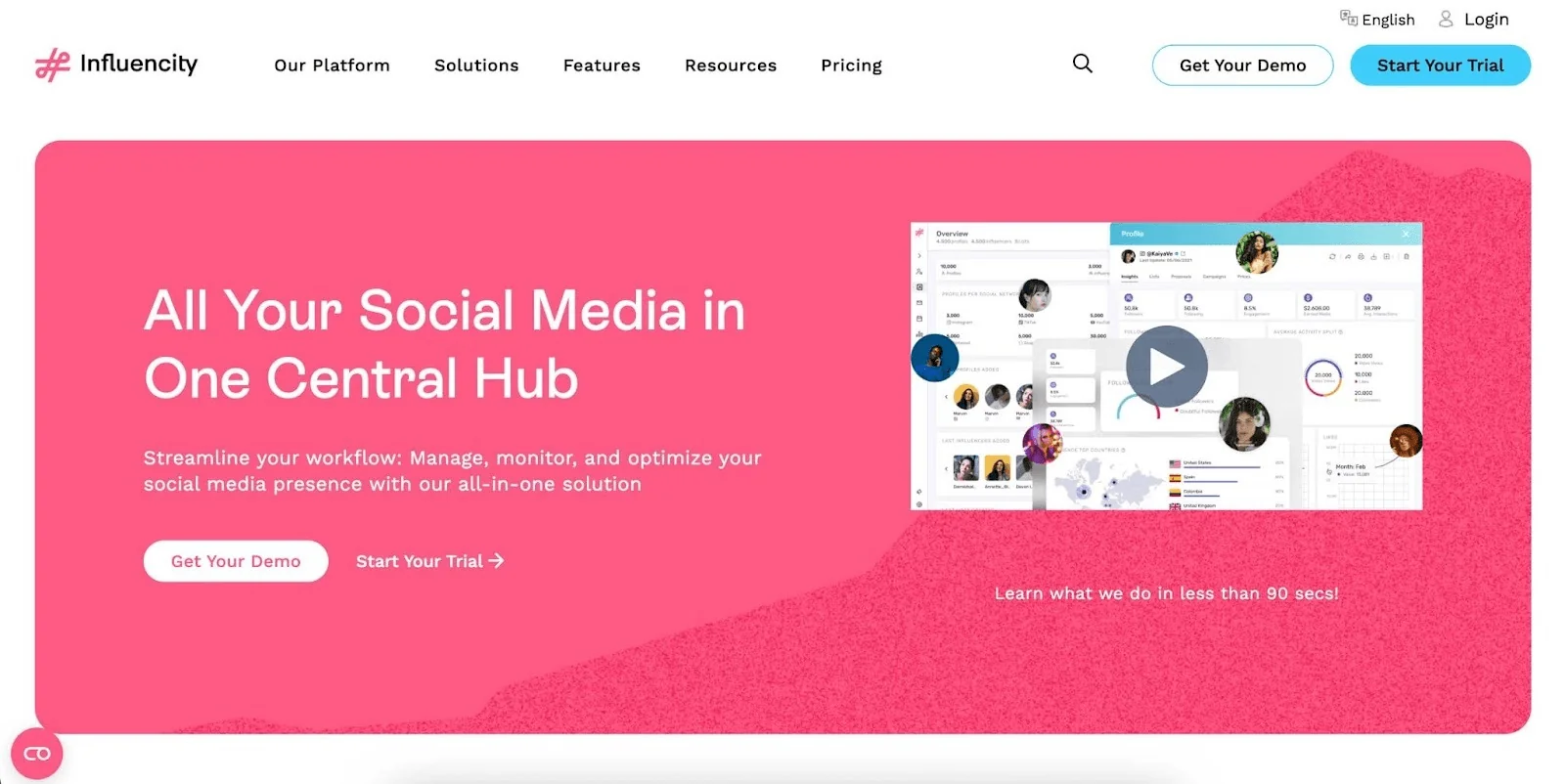
Influencity is a Madrid-based influencer marketing platform built around a 200M+ creator database spanning Instagram, TikTok, YouTube, and Twitch. The platform leans heavily into discovery and audience analytics — its strongest features sit on the front end of the campaign funnel (finding and vetting creators) rather than the operational side (outreach automation, payments, affiliate tracking).
Influencity Best Features
- AI-Powered Influencer Discovery Influencity's search engine is the platform's standout. You can filter creators by 50+ parameters including audience demographics, engagement rate, geo-location, brand affinity, and content topics. The AI Assistantt lets you describe what you're looking for in natural language and pulls a shortlist.
- Deep Audience Analysis Every profile breakdown includes audience quality scoring, fake follower detection, engagement benchmarks, and audience overlap analysis between creators. This is where Influencity earns its reputation — the analytical depth on individual profiles is genuinely strong.
- Influencer Relationship Management (IRM) A built-in CRM for tracking creator communications, notes, price history, and contact info. You can log every interaction and see how a creator's rates have changed over time — useful for agencies negotiating across multiple campaigns.
- Campaign Manager with Workflows Set up campaign tasks, brief creators, track deliverables, and manage proposals from inside the platform. The workflow builder is included on higher tiers and supports approvals, casting calls, and content review.
- Social Hub and Monitoring Beyond influencer work, Influencity bundles in a social media inbox, post scheduler, link-in-bio tool, and a monitoring module for tracking mentions, hashtags, and competitor activity. It's a wider toolset than most pure influencer platforms.
Influencity Reviews
Influencity holds a 4.6/5 rating on G2 across 263 reviews, with most coming from small-to-mid-sized businesses. Users consistently call out the depth of audience data and the customer support team as the platform's strongest points.
The friction points tend to cluster around three things: the learning curve when you first start using all the modules, occasional maintenance windows that interrupt workflows, and the fact that some advanced features and analytics depth are gated behind the higher tiers.
Reddit and forum sentiment generally aligns with G2 — users like the data but flag that the platform leans more toward discovery and analytics than full-stack campaign execution.
Influencity vs Influencer Hero Pricing
Influencity's entry tier is cheaper than Influencer Hero's, but the two platforms aren't priced to do the same job. Influencity Basic at $168/month is essentially a discovery-and-analytics seat — 30 monthly analyses, limited campaign tools, single user. The price is low because the scope is narrow.
Influencer Hero is built as a full operating system for influencer programs. The $649/month entry plan includes outreach automation with email sequencing, an integrated CRM for tracking creator relationships at scale, gifting management with Shopify integration, affiliate link tracking, UGC rights management, and ROI dashboards tying campaign spend to revenue. If you're running creator programs as a recurring growth channel rather than a quarterly experiment, the operational layer matters more than the database size.
If you're comparing both platforms in more detail, check out our full Influencity vs Influencer Hero breakdown for a side-by-side on features, workflows, and use cases.
Final Thoughts
Influencity earns its 4.6 rating for a reason — the discovery engine is solid, the audience analytics are deep, and the customer success team gets consistent praise. If your bottleneck is finding the right creators and vetting them properly, Influencity does that job well, and the $168 starting price makes it accessible for teams testing influencer marketing as a channel.
The gap shows up when programs scale. Once you're running outreach at volume, managing gifting logistics with Shopify, tracking affiliate revenue, and tying campaign performance back to actual sales, you need more than a discovery tool with bolt-on campaign features. That's where Influencer Hero sits — a full execution platform built around the post-discovery workflow. Other alternatives worth a look depending on your stack include Modash (discovery-first), GRIN (enterprise creator management), and Upfluence.
Want to see how Influencer Hero handles outreach, gifting, affiliates, and reporting in one platform? Book a demo and we'll walk you through it.
Summary
This is some text inside of a div block.
This is some text inside of a div block.
Pricing/Month
Shopify Reviews
This is some text inside of a div block.
This is some text inside of a div block.
This is some text inside of a div block.
This is some text inside of a div block.
This is some text inside of a div block.
This is some text inside of a div block.
This is some text inside of a div block.
This is some text inside of a div block.
This is some text inside of a div block.
This is some text inside of a div block.
This is some text inside of a div block.
This is some text inside of a div block.
This is some text inside of a div block.
This is some text inside of a div block.
This is some text inside of a div block.
This is some text inside of a div block.
This is some text inside of a div block.
This is some text inside of a div block.
This is some text inside of a div block.
This is some text inside of a div block.
This is some text inside of a div block.
Read More

FAQs




Most Popular Blogs


Drive ROI With Influencer Marketing
Join 1,200+ brands and 150+ agencies scaling creator programs with Influencer Hero.